TL;DR
AI lead prioritisation uses predictive algorithms to automatically rank leads by conversion likelihood. For local service businesses in Twin Falls, it means less time chasing unqualified leads and more time booking jobs that actually pay. In this post, we’ll break down how it works, why it matters, and how to make it part of your growth system.
You sent out 30 quotes last week. Called back 18 people. Followed up with maybe 10. The rest? Sitting in your inbox or scribbled on a notepad somewhere, getting colder by the hour.
Here’s the brutal truth: the average business takes 47 hours to respond to a lead. Almost two full days. And by then? The customer has already called three other contractors, gotten two estimates, and probably hired someone else.
You’re not slow because you don’t care. You’re slow because you’re juggling service calls, managing crews, handling emergencies, and trying to figure out which leads are actually worth your time. The problem isn’t effort—it’s prioritization.
That’s where AI-powered lead scoring changes everything.
Instead of treating every lead the same, AI lead prioritisation analyzes behavior, engagement patterns, and intent signals to automatically rank your prospects. It tells you who’s ready to buy now, who needs nurturing, and who’s just browsing. And it does it in real-time, without you lifting a finger.
For service businesses in Twin Falls and across the Magic Valley, this isn’t just about efficiency—it’s about survival. When 78% of sales go to the business that responds first, the difference between a smart lead scoring system and chaos is the difference between a booked calendar and wondering where your next job is coming from.
The Problem with Traditional Lead Scoring
Most CRMs use static point-based systems. Fill out a form? +10 points. Open an email? +5 points. Click a link? +3 points. Hit 50 points, and congratulations—you’re a “qualified lead.”
Sounds logical, right? Except it’s not.
Here’s the problem: not all form fills are equal. Not all email opens mean the same thing. A homeowner requesting an emergency plumbing quote at 11 PM is fundamentally different from someone downloading a coupon for a future roof inspection. But traditional scoring systems treat them identically.
These old systems don’t adapt to changing behavior or seasonality. They don’t recognize that storm-related inquiries convert faster than routine maintenance requests. They can’t tell the difference between “I need this done next week” and “Just getting some ideas for next year.”
And most critically—they don’t learn. A static scoring model looks the same on day one as it does on day 1,000, even though your business has collected thousands of data points about what actually leads to conversions.
Consider this scenario: A contractor in Twin Falls keeps chasing price-checkers because all leads look equal in his spreadsheet. He spends 30 minutes on a detailed estimate for someone who was never going to hire him, while a serious buyer—who called twice and texted once—sits waiting for a callback that comes too late. By the time he follows up, that serious buyer has already hired a competitor.
This happens every single day to service businesses that rely on guesswork instead of data.
According to research cited by SPOTIO, only 39% of sales professionals consistently apply lead qualification criteria, and a staggering 55% of leads are neglected entirely. That’s more than half of your potential revenue walking out the door because you couldn’t identify who deserved your attention first.
Predictive lead scoring corrects these limitations by learning from real patterns. It doesn’t just count actions—it interprets them. It understands context, timing, and intent. And it gets smarter with every interaction.
What Is AI Lead Prioritisation (and How It Works Behind the Scenes)
AI lead prioritisation uses machine learning models to identify high-quality prospects based on data that actually predicts conversion—not just surface-level activity.
Here’s what the AI analyzes:
Engagement timing: Did they respond to your text in 5 minutes or 5 days? Research shows leads contacted within 5 minutes are 21 times more likely to qualify than those contacted after 30 minutes. The AI knows this and weights faster responders higher.
Message sentiment: When someone fills out a form, the AI reads the language for intent. “Ready to start next week” scores higher than “just looking around.” It’s not just counting words—it’s understanding meaning.
Referral source: Not all traffic is equal. Organic Google leads often convert better than casual Facebook browsers because they’re actively searching for a solution. The AI tracks which sources produce the highest close rates in your specific business and adjusts scoring accordingly.
Responsiveness: A lead who opens three emails, clicks two links, and replies to a text is showing clear buying signals. The AI recognizes sustained engagement as a predictor of serious intent.
This isn’t about replacing your intuition. It’s about enhancing it with real-time data. You still make the final call—the AI just surfaces the opportunities you might have missed while you were out on a job site.
According to the U.S. Chamber of Commerce’s 2025 report, 58% of small businesses now use AI tools, up from 40% just a year earlier. And 71% of those businesses plan to increase their AI investment this year. The reason? AI works. Businesses using it report measurable improvements in efficiency, revenue, and customer satisfaction.
Inside the LeadProspecting AI Scoring Engine
LeadProspecting AI doesn’t just score leads—it acts on those scores automatically. Here’s how the system works:
Response speed tracking: The platform monitors how quickly leads engage after first contact. If someone replies to your SMS within minutes, that’s a red-hot signal. The AI assigns a higher score and triggers an immediate notification to your phone.
Source analysis: The system tracks where each lead originated—Google search, Facebook ad, referral, website form—and learns over time which sources produce the best conversions for your business. A plumbing company might discover that Google Ads leads close 40% faster than Facebook leads. The AI captures this pattern and prioritizes accordingly.
Language intent recognition: Using natural language processing, the platform analyzes the actual words people use in forms and messages. “Emergency,” “ASAP,” and “ready to schedule” all carry more weight than “thinking about” or “someday.”
Recency and frequency: The more recently a lead engaged—and the more often—the higher their score climbs. Someone who visited your website three times this week and opened two follow-up emails is showing sustained interest.
Automated action triggers: This is where LeadProspecting AI differentiates itself. The system doesn’t just assign scores—it executes the next best action:
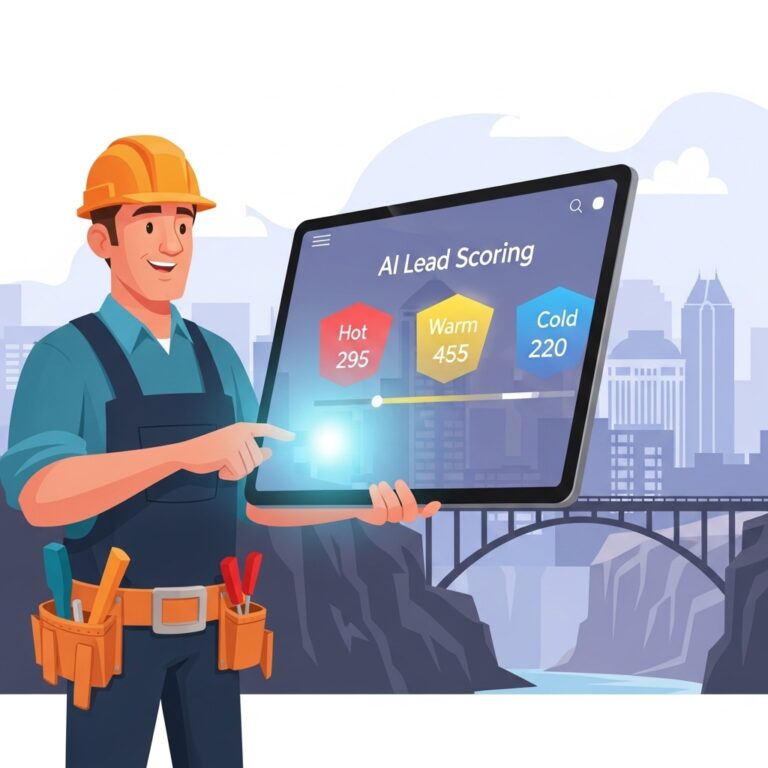
- Hot leads (high scores) trigger instant SMS and call notifications so you can respond immediately
- Warm leads (moderate scores) enter automated nurturing workflows with helpful content and gentle follow-ups
- Cold leads (low scores) move into re-engagement sequences after a set time period
You don’t have to manually sort through dozens of contacts deciding who to call first. The system handles prioritization and initial outreach, so you can focus on having conversations with people who are actually ready to hire.
A plumbing company in Twin Falls implemented this approach and saw dramatic results: they cut their average response time by 52% and increased conversions by 28% within two months. The difference? They stopped wasting time on tire-kickers and started focusing on serious buyers the moment they showed interest.
Predictive Lead Scoring in Action: Real-World Examples
Let’s look at how AI lead prioritisation plays out in real businesses—with real numbers.
Example 1: Roofing Company Prioritizes Storm-Related Inquiries
A roofing contractor in Jerome was getting buried after a major hailstorm. Dozens of homeowners were calling for inspections and quotes. The problem? He couldn’t tell who needed immediate work versus who was just checking for damage.
After implementing predictive lead scoring through LeadProspecting AI, the system identified a pattern: leads who mentioned insurance claims or used words like “urgent” and “leak” converted 42% faster than general inspection requests. The AI started flagging these high-intent leads immediately.
The result? The contractor reduced lost opportunities by 33% and completed 18 more jobs that quarter than the previous year—all without hiring additional staff. He simply focused his energy on the leads that were ready to buy.
Example 2: Cleaning Service Identifies Repeat Booking Behavior
A residential cleaning service in Twin Falls noticed something interesting in their LeadProspecting AI dashboard: customers who booked within 48 hours of their first inquiry were three times more likely to become repeat clients.
The AI had identified a conversion window the owner hadn’t consciously noticed. Armed with this insight, the business created an automated workflow: any lead who requested a quote would receive a personalized follow-up text within 2 hours, a detailed service breakdown via email at the 24-hour mark, and a limited-time discount offer at 36 hours.
The results were immediate. Their booking rate jumped from 22% to 41% in six weeks, and their repeat customer rate increased by 19%. The owner didn’t change the service—she just changed when and how she followed up.
Example 3: HVAC Company Stops Chasing Price-Shoppers
An HVAC contractor was frustrated. He spent hours preparing detailed estimates for leads who never hired him. After analyzing his LeadProspecting AI data, he discovered that leads who asked three or more detailed technical questions before requesting a quote had an 87% close rate, while leads who immediately asked “What’s your cheapest option?” closed at just 9%.
The AI scoring system began deprioritizing price-only inquiries and flagging high-engagement, question-asking leads as top priority. The contractor stopped burning time on estimates that went nowhere and started having deeper conversations with serious buyers.
The result? His close rate improved from 18% to 34%, and his average job value increased by $1,200 because he was working with customers who valued quality over the lowest bid.
These aren’t theoretical examples. They’re real businesses solving real problems with data-driven lead prioritization—and the numbers speak for themselves.
Why AI Lead Prioritisation Matters for Local Businesses
For service businesses in Twin Falls and the Magic Valley, responsiveness is everything. Research shows that leads are 10 times less likely to qualify when response time exceeds just 5 minutes. Ten times. That’s the difference between a booked job and a missed opportunity.
But here’s the challenge: you’re a small team. Maybe it’s just you. You’re out on job sites, managing crews, ordering materials, dealing with emergencies. You can’t sit at a desk refreshing your CRM every five minutes waiting for leads to come in.
That’s exactly why AI lead prioritisation matters more for small businesses than for big sales teams.
Large companies have dedicated sales reps whose only job is to qualify leads. You don’t have that luxury. You need a system that works while you’re working—one that identifies your best opportunities, reaches out automatically, and only pulls you into the conversation when someone is genuinely ready to hire.
According to Forrester Research, businesses using lead enrichment and automated qualification see a 25% increase in sales productivity. That’s not a small improvement—it’s the difference between struggling to fill your calendar and turning down work because you’re fully booked.
For service businesses, this also impacts your reputation. In Twin Falls, word travels fast. When you respond quickly, show up on time, and deliver quality work, people talk. Reviews and referrals follow. But if potential customers feel ignored—even if you were legitimately busy—they move on and tell their neighbors you never called back.
AI lead prioritisation protects your reputation by ensuring no serious lead slips through the cracks. The system doesn’t forget. It doesn’t get overwhelmed. It doesn’t take days off. It just consistently identifies and follows up with people who want to work with you.
And you don’t need to hire another person to make it happen.
How to Implement AI Lead Prioritisation in Your Sales Workflow
Ready to stop guessing which leads deserve your attention? Here’s how to make AI lead prioritisation part of your daily operation:
Step 1: Centralize your lead data
Stop juggling spreadsheets, sticky notes, and text messages. Move everything into one CRM where AI can actually analyze behavior patterns. LeadProspecting AI integrates with your website forms, phone system, and messaging platforms so every interaction is tracked automatically.
Step 2: Define what “qualified” looks like in your business
Not every business is the same. For a plumber, a qualified lead might be someone who needs work within 30 days and owns their home. For a landscaper, it might be someone with a property over one acre who’s requested a quote in the spring.
Identify 3-5 characteristics that your best customers share. Response speed? Project size? Location? Urgency level? These become the data points your AI model prioritizes.
Step 3: Let the AI learn from your history
Most AI systems—including LeadProspecting AI—can analyze your past conversions to identify patterns you might not consciously recognize. Upload historical lead data if you have it, or start fresh and let the system learn as new leads come in.
Within 60-90 days, the AI will have enough data to start making accurate predictions about which leads are most likely to convert.
Step 4: Automate follow-ups based on score thresholds
This is where the magic happens. Set up automatic triggers:
- Hot leads (score 80+): Send an instant SMS: “Got your request—calling you in the next 10 minutes.”
- Warm leads (score 50-79): Enter a 7-day email nurture sequence with helpful tips and case studies.
- Cold leads (score below 50): Check back in 30 days with a seasonal offer or project reminder.
You can customize these workflows to match your business style. The key is that the system handles the outreach so you can focus on conversations, not admin work.
Step 5: Review and refine monthly
Spend 15 minutes a month reviewing your AI dashboard. Which lead sources are converting best? What engagement patterns are your top customers showing? Are there any scoring adjustments you want to make based on real-world results?
The system gets smarter over time, but a quick monthly check ensures it’s aligned with your goals.
Quick win tip: Even a basic workflow that sends instant SMS to high-scoring leads can double your close rate. Start simple and expand as you see results.
For businesses looking for a complete growth system, LeadProspecting AI partners with FieldServ AI to handle everything from lead capture to job completion. LeadProspecting AI scores and nurtures your leads, while FieldServ AI manages scheduling, dispatch, and payments. Together, they create a seamless system that grows with your business—whether you’re a solo operator or managing multiple crews.
And for businesses ready to go all-in on automation and growth, the Founders Club offers exclusive access to done-for-you setup, priority support, and advanced features designed for contractors who want complete hands-off marketing systems.
The Future of AI Lead Prioritisation: Predictive, Personalized, and Profitable
The next generation of AI lead prioritisation isn’t just about ranking prospects—it’s about predicting outcomes before they happen.
Here’s where the technology is headed:
Predictive scoring that blends CRM and field data: Imagine a system that doesn’t just tell you who’s most likely to buy, but who’s most likely to become a repeat customer, refer others, and pay on time. By integrating lead behavior data from LeadProspecting AI with job completion history from FieldServ AI, businesses will soon be able to predict lifetime customer value at the first interaction.
That means you’ll know not just who converts fastest, but who’s worth the most over 5 years.
Personalization based on lifecycle stage: AI will automatically adjust messaging based on where someone is in their buying journey. A first-time visitor gets educational content. A repeat customer gets loyalty perks. A seasonal client gets timely reminders. All without you manually segmenting lists or writing different emails.
Cross-platform intelligence: The systems you use—CRM, scheduling software, payment processing, review management—will start talking to each other. When a customer books a job, the AI will automatically trigger a review request workflow. When they pay an invoice, it will note their payment speed and adjust future credit terms. When they refer a friend, it will prioritize that referral as a high-quality lead because referred customers convert at higher rates.
For Twin Falls contractors and service businesses, this means one powerful thing: your systems will get smarter the longer you use them. Every job you complete, every lead you convert, every customer you serve feeds the AI more data to make better predictions.
The businesses that adopt these tools early will have a massive competitive advantage. While others are still manually sorting through leads and hoping they’re calling the right people, you’ll have a system that automatically identifies your best opportunities and takes action before your competitors even know those leads exist.
As 71% of small businesses plan to increase their AI investment in 2025, the question isn’t whether to adopt AI lead prioritisation—it’s whether you’ll do it before your competition does.
Ready to Stop Guessing Which Leads Deserve Your Time?
AI lead prioritisation isn’t about replacing your instincts—it’s about amplifying them with data. It’s about responding faster, following up smarter, and spending your energy on the conversations that actually turn into jobs.
For service businesses in Twin Falls and across the Magic Valley, the cost of ignoring leads is too high. Every missed callback is a missed paycheck. Every slow response is a customer hiring someone else.
The good news? You don’t need a computer science degree or a massive budget to implement AI lead scoring. You just need a system that’s built for businesses like yours—one that understands the challenges of running a service company and automates the parts that eat up your day without adding value.
LeadProspecting AI was designed specifically for contractors, home service providers, and local businesses who need lead management that works while they’re working. From automated follow-ups to intelligent lead scoring to seamless integration with FieldServ AI for complete job management, it’s the all-in-one system that helps you capture more leads, close more deals, and build a business that doesn’t depend on your 24/7 attention.
Explore how LeadProspecting AI can help you automate lead scoring, follow-ups, and customer relationships—all from one dashboard. And if you’re ready for a fully managed growth system, check out the Founders Club for exclusive benefits and white-glove support.
Stop wasting time on leads that were never going to hire you. Start focusing on the ones that will.
FAQs About AI Lead Prioritisation and Lead Scoring
1. What’s the difference between AI lead prioritisation and traditional lead scoring?
Traditional lead scoring uses static point systems (e.g., +10 for form fill, +5 for email open) that treat all actions equally. AI lead prioritisation uses machine learning to analyze behavior patterns, engagement timing, message sentiment, and conversion history to predict which leads are most likely to buy. It adapts and learns over time, while traditional scoring stays the same.
2. How accurate is predictive lead scoring for small businesses?
Predictive lead scoring becomes more accurate as it collects more data. Most businesses see meaningful improvements within 60-90 days as the AI identifies patterns. Real-world case studies show conversion rate improvements of 25-40% once AI scoring is fully implemented, with some businesses doubling their close rates by focusing on high-scoring leads.
3. Can AI lead prioritisation work for service businesses in Twin Falls?
Absolutely. In fact, local service businesses benefit even more because responsiveness is critical in smaller markets where reputation spreads through word-of-mouth. Twin Falls contractors using AI lead scoring report faster response times, higher conversion rates, and better customer satisfaction because they’re reaching serious buyers before competitors do.
4. Do I need technical skills to use AI scoring in my CRM?
No. Modern AI-powered CRMs like LeadProspecting AI are designed for business owners, not data scientists. The system handles the complex analysis behind the scenes. You simply see which leads are “hot,” “warm,” or “cold” and the platform automatically triggers the appropriate follow-ups. Setup takes minutes, not months.
5. What kind of data does the AI analyze to rank leads?
AI lead scoring analyzes engagement timing (how quickly they respond), message sentiment (language indicating intent), referral source (where they found you), responsiveness (how often they engage), recency and frequency of contact, and historical conversion patterns. It combines these signals to predict buying likelihood.
6. How long does it take to see results after enabling AI lead prioritisation?
Many businesses see immediate improvements in response time and lead organization. Conversion rate improvements typically appear within 30-60 days as the AI learns your specific patterns. The longer you use the system, the smarter it gets—most businesses report peak performance after 90 days of consistent use.
7. Is lead scoring useful if I only get a few leads per week?
Yes. Even with low lead volume, AI scoring ensures you prioritize correctly. If you only get 5 leads a week, you can’t afford to chase the wrong ones. The AI helps you identify which 2-3 are most likely to convert so you focus your limited time on the best opportunities. Quality over quantity matters more when volume is low.
8. How does LeadProspecting AI integrate with FieldServ AI?
LeadProspecting AI handles lead capture, scoring, and nurturing on the front end. Once a lead converts to a customer, FieldServ AI takes over with job scheduling, dispatch management, technician tracking, and payment processing. Together, they create a seamless system from first contact to completed job—no manual data entry or switching between platforms.
9. What are the biggest lead scoring mistakes local businesses make?
The most common mistakes are: (1) treating all leads equally instead of prioritizing by intent, (2) waiting too long to follow up, (3) using static scoring rules that never adapt, (4) not tracking which lead sources produce the best customers, and (5) forgetting to nurture warm leads who aren’t ready to buy immediately. AI lead prioritisation solves all five problems automatically.
10. How can AI help Twin Falls contractors follow up faster and close more jobs?
AI systems send instant notifications when high-priority leads come in, so you can respond within minutes instead of hours or days. Automated follow-up sequences keep warm leads engaged without manual effort. And by identifying which leads are most likely to convert, you stop wasting time on price-shoppers and focus on serious buyers—resulting in faster close times and higher conversion rates.