TL;DR:
A full-time receptionist costs $55,000 to $70,000 per year when you factor in salary, benefits, training, and turnover, and still only covers about 24% of the week. Meanwhile, 62% of small business calls go unanswered, 85% of those callers never try again, and the average small business loses $126,000 per year from missed calls. A quality AI receptionist costs $199 to $299 per month, answers every call 24/7, and pays for itself the first month you recover even two or three previously missed jobs.
The True Cost of a Receptionist (And What You're Losing Every Time the Phone Goes to Voicemail)
TL;DR: A full-time receptionist costs $55,000 to $70,000 per year when you factor in salary, benefits, training, and turnover, and still only covers about 24% of the week. Meanwhile, 62% of small business calls go unanswered, 85% of those callers never try again, and the average small business loses $126,000 per year from missed calls. A quality AI receptionist costs $199 to $299 per month, answers every call 24/7, and pays for itself the first month you recover even two or three previously missed jobs.
Most small business owners think the cost of a receptionist is the number on the job posting. It is not. By the time you factor in benefits, payroll taxes, training, and the inevitable turnover, that number grows significantly before a single call gets answered.
But the salary is not even the biggest problem. The biggest problem is what happens when the phone rings and nobody picks up.
What a Receptionist Actually Costs
The U.S. Bureau of Labor Statistics reports the median hourly wage for receptionists was $17.90 in May 2024. Annualized for full-time work, that puts base salary in the range of $37,000 to $42,000 per year, consistent with Glassdoor's average of $41,615 based on nearly 37,000 self-reported salaries.
Then come the benefits. The BLS Employer Costs for Employee Compensation report for December 2024 found that for private industry workers, benefit costs average approximately 29.5% of total employer compensation. On a $40,000 salary, that adds roughly $11,800 per year for health insurance, retirement contributions, paid leave, and legally required costs like Social Security and Workers' Compensation.
You are also paying for training, which typically runs $2,000 to $5,000 for a new hire to get up to speed on your systems, your clients, and how you operate. And equipment: a workstation, phone system, and software licenses can add another $3,000 to $5,000 in setup costs.
Then there is turnover. Gallup estimates that replacing an employee costs 50% to 200% of their annual salary, depending on the role. For a receptionist earning $40,000 per year, one bad hire and replacement costs $20,000 to $80,000 before they have answered a single call at their new desk.
Add it up and the fully loaded cost of a receptionist runs $55,000 to $70,000 per year in a typical small business. That is the number most owners never see on paper.
The Shift Problem Nobody Talks About
A full-time receptionist works roughly 40 hours per week. There are 168 hours in a week. That means your phone coverage exists for about 24% of the total available time. The other 76% of the week, including evenings, weekends, holidays, sick days, and vacations, your calls go to voicemail.
For service businesses like HVAC companies, plumbers, electricians, and contractors, this is where the real money walks out the door. Emergency calls do not respect business hours. A burst pipe at 10 PM or an AC failure during a summer heat wave is worth $1,000 to $2,500 at emergency rates. When those calls hit voicemail, that revenue goes to whoever picks up.
Ruby's Call Trends Report, which analyzed over 25 million calls, found that after-hours calls increased more than 18% from 2020 to 2021. The trend has continued since. Your customers are not restricting themselves to business hours, and the businesses capturing the most revenue are the ones available when the phone rings.
The Real Issue: What Missed Calls Are Costing You Right Now
Here is the number that should change how you think about your phone system.
411 Locals monitored 85 small businesses across 58 industries for 30 days and found that only 37.8% of inbound calls were answered by a live person. Another 37.8% went to voicemail and 24.3% received no response at all. That means 62% of calls to small businesses go unanswered.
And what happens to those callers? PATLive research confirms that 85% of unanswered callers never try again. They move on. In most cases, they call the next business that shows up in search results.
Voicemail is not a safety net. Research consistently shows that 80% of callers sent to voicemail hang up without leaving a message. The expectation of a callback that never comes is not a customer retention strategy. It is the end of a transaction that never happened.
An August 2025 analysis by Ambs Call Center found that small businesses lose an average of $126,000 per year in revenue from missed calls. For home service businesses specifically, Invoca's call analytics research puts the cost of a single missed call at approximately $1,200 in lost revenue.
A human receptionist does not solve this problem. When they are on another call, at lunch, out sick, or off for the holiday, calls still go unanswered. You are paying $55,000 to $70,000 per year for coverage that still leaves the majority of your week unprotected.
What AI Receptionists Actually Cost
Quality AI voice receptionist platforms run $199 to $299 per month for unlimited calls and full features including appointment booking, CRM integration, and call routing. Budget options start around $49 to $99 per month, though they tend to lack the integrations and contextual conversation handling that make AI actually useful.
The math compared to a human receptionist:
A human receptionist costs $55,000 to $70,000 per year fully loaded. An AI receptionist at $299 per month costs $3,588 per year. Over five years, that gap compounds. A human receptionist costs $275,000 to $350,000. An AI solution at the same rate costs roughly $18,000. The difference is not incremental. It is structural.
More important than the cost comparison is the coverage comparison. AI answers every call, on the first ring, 24 hours a day, 7 days a week, including the calls your human receptionist cannot get to because she is already on the line with someone else.
The Adoption Curve You Should Know About
This is not a niche technology anymore. Gartner predicts that conversational AI deployments within contact centers will reduce agent labor costs by $80 billion globally by 2026, with one in 10 agent interactions fully automated. Their more recent research goes further: by 2029, Gartner predicts agentic AI will autonomously resolve 80% of common customer service issues without human intervention, leading to a 30% reduction in operational costs.
The broader market reflects the same direction. The global voice AI agents market is projected to grow from $2.4 billion in 2024 to $47.5 billion by 2034, a compounding annual growth rate of 34.8%. The businesses adopting this now are not early adopters chasing a trend. They are making a practical decision that the market data supports.
When AI Is the Right Call and When It Is Not
AI does not replace humans in every situation. If your business requires in-person client interaction, high-touch relationship management, or complex consultative conversations, a human receptionist still matters. The decision is not binary.
What AI handles exceptionally well is the work that drives most of the revenue loss: answering the phone when a human cannot, qualifying the call, booking the appointment, capturing lead information, and routing urgent requests appropriately. For a plumbing company, HVAC contractor, or any service business that lives and dies on booked jobs, that coverage is where the money is.
The most practical approach for most service businesses is a hybrid model: AI handles nights, weekends, overflow volume, and after-hours calls. A human handles daytime client relationships and the complex conversations that benefit from personal judgment. You get 24/7 coverage without paying for overnight shifts or burning out your staff.
The question worth asking is not whether AI can fully replace a receptionist. It is this: how much revenue are you losing right now because calls are going unanswered? For most small service businesses, the answer is more than the cost of both a human and an AI solution combined.
Ready to Stop Losing Revenue to Unanswered Calls?
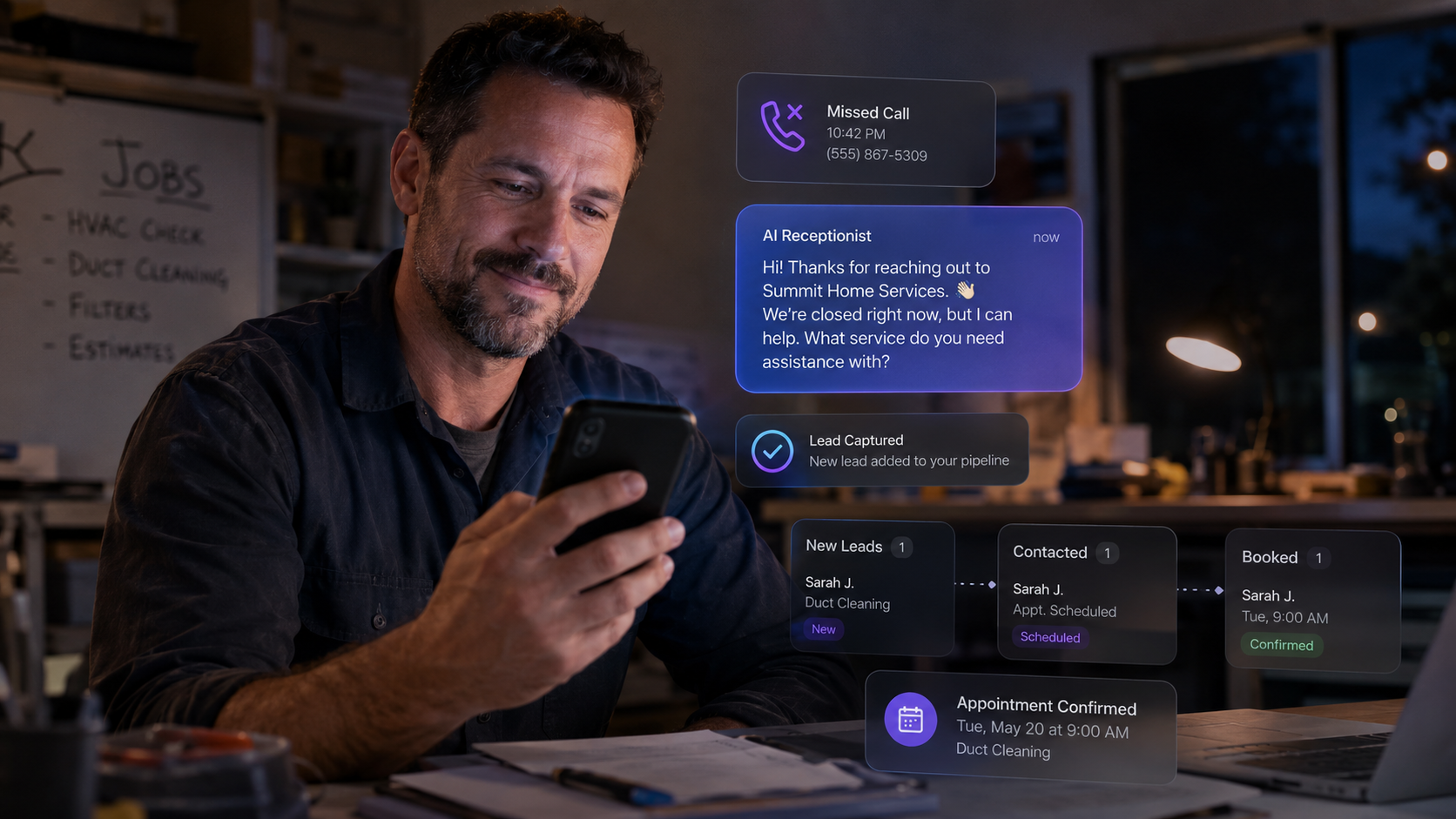
LeadProspecting AI's AI Receptionist answers every call 24/7, qualifies leads, books appointments, and transfers to your team when the situation calls for it. It integrates directly with our CRM so every call is tracked, every lead is captured, and nothing falls through after the conversation ends.
If you are also running outbound campaigns, our AI Email Campaigns and Lead Scraper connect to the same system, so inbound and outbound work together instead of living in disconnected tools.
Start a 14-day free trial with no credit card required and see what it looks like when every call gets answered.
Frequently Asked Questions
Q: Can an AI voice receptionist actually sound natural on the phone?
Modern AI voice technology has improved substantially. Natural language processing now handles interruptions, context shifts, and conversational back-and-forth far better than older IVR systems. Most callers describe the interaction as professional rather than robotic, and the technology continues to improve as the market grows.
Q: What happens when an AI cannot handle a call?
Quality AI systems are designed to recognize when a call needs a human. They can take a detailed message, route the caller via text or email to the right person on your team with full context, or schedule a callback. You maintain control over when and how complex calls transfer to humans.
Q: Does an AI receptionist integrate with my existing scheduling and CRM tools?
Most quality solutions integrate with major calendar platforms, booking tools, and CRM systems through direct connections or API. When a call comes in, the AI updates your system, books the appointment, or triggers a workflow automatically without manual data entry.
Q: How quickly does the ROI show up?
For businesses that are currently missing a meaningful percentage of inbound calls, ROI tends to show up in the first month. If your average job is worth $500 to $1,500 and you recover even two or three previously missed calls per month, the AI receptionist has paid for itself. The ongoing savings compound from there.
Q: Should I start with AI or hire a receptionist first?
Start with AI. You can deploy it in minutes, capture missed calls immediately, and evaluate whether it solves your coverage problem. If you need human presence later for in-person interaction or relationship management, you can add it. For businesses whose primary need is phone coverage and lead capture, AI handles the workload at a fraction of the cost.