You're Bleeding Money on Tools You Forgot You Had
It's 11 PM on a Tuesday. You're reviewing credit card statements and you see it: a $29 charge from a tool you don't recognize. Then another. Then three more. You've got an all in one CRM for small business subscription, but you're also paying for email marketing, scheduling software, a separate lead database, invoicing, customer support ticketing, and something called "workflow automation" that nobody on your team actually uses.
This isn't a money management problem. It's a technology debt problem, and it's costing you more than you think.
According to Freshworks research, companies waste $1 out of every $5 on software due to failed implementations, underused tools, and unexpected costs. The same study found that employees lose nearly seven hours every week to complicated processes and fragmented tools. That's 36 hours per month per person spent just context switching between disconnected systems.
For a five-person team, that's 180 hours of lost productivity every single month. At a conservative $50/hour burdened rate, you're hemorrhaging $9,000 monthly just from friction.
The Math Behind Your Tech Stack Bloat
Let's do a real audit. The average small business owner is juggling somewhere between 15 and 25 different SaaS tools. Here's what that actually looks like on a typical income statement:
- CRM platform: $99/month
- Email marketing software: $50/month
- Lead database or scraper tool: $149/month
- Scheduling/calendar app: $25/month
- Invoicing and billing: $40/month
- Project management: $60/month
- Customer support ticketing: $45/month
- Social media management: $75/month
- SMS/text messaging: $50/month
- Website builder or hosting: $35/month
- Analytics and reporting: $30/month
- Google Workspace or Microsoft 365: $15/month per user
- Miscellaneous integrations and add-ons: $50/month
That's $723 per month, or $8,676 annually. But that's just the subscription fees. 41% of small business owners report that software costs have increased over the past 12 months, and most don't know why.
The real cost multiplier comes from three places: integration headaches, duplicate data entry, and the fact that you're paying for features you'll never use.
Gartner reports the average organization manages more than 125 different SaaS applications, costing businesses $1,040 per employee every year. For a 10-person company, that's $10,400 annually on top of subscriptions.
Why Tool Consolidation Isn't Just Nice to Have, It's Survival
The data on tool consolidation is compelling. Companies that consolidate tools see a 42% boost in productivity and a 31% cut in wasted time. That's not marginal improvement. That's transformational.
Here's what actually happens when you consolidate:
- Data flows in one direction. Your leads enter once. They move through your pipeline without manual re-entry. Follow-ups trigger automatically. No more "Did I email this person already?" questions.
- Your team stops context switching. One login. One interface. One source of truth. Workers lose 32 days per year toggling between workplace applications, with context switching causing a 40% loss of productivity.
- You actually use what you're paying for. Integration overhead disappears. Training takes hours instead of weeks. Adoption happens naturally because the tool is intuitive and connected to the work people actually do.
- Your numbers improve faster. When you have one pipeline, one email platform, and one lead source, you can actually see what's working. Split your tools across five platforms, and you're flying blind.
An all in one CRM for small business with integrated lead scraping, email marketing, automation, and analytics becomes your operating system instead of a disconnected menu of point solutions.
What a Purpose-Built All in One CRM Actually Includes (And Why It Matters)
Not all CRM platforms are built the same. Many are designed for enterprise complexity, which means they're bloated, expensive, and require a dedicated admin to manage. A platform purpose-built for small business consolidation looks different.
It should include:
- Lead management with built-in scraping. A crm with lead scraper functionality means you're not paying for separate database subscriptions. You can pull verified contact information, email addresses, and social profiles directly into your pipeline without leaving the platform.
- Native email marketing and automation. Not just a basic email widget, but full marketing automation small business capabilities with drip campaigns, templates, and trigger-based workflows that actually send without requiring integrations.
- Lead nurturing built into the workflow. Real lead nurturing software means your follow-ups are automatic, sequenced, and intelligent. New leads don't fall through the cracks because a workflow reminds your team exactly when to reach out.
- Invoicing, quotes, and payment tracking. Stop switching to another platform to send a quote or track a payment. It should happen in the same system where the opportunity lives.
- SMS and missed call recovery. Text message follow-ups convert at 90%+ rates. If your client management tool doesn't include this natively, you're missing revenue.
- Review and referral automation. Automated requests for reviews and referrals should be built in, not bolted on as an afterthought.
- Role-based permissions and team collaboration. Your sales team sees the pipeline their way. Operations sees scheduling and fulfillment their way. Owners see the dashboard. One system, multiple perspectives.
The reason this matters: when these features are integrated, they compound. A lead that comes in through your scraper automatically gets added to your nurturing sequence, gets text followed up on the same day, and triggers a reminder for your closer to call them the next morning. No Zapier workarounds. No manual steps. No lost leads.
The Audit You Need to Do This Week
Here's your action item for today. Pull your credit card and bank statements for the last 12 months. Find every single recurring charge tied to business software. Spreadsheet it. Include subscriptions, integrations, add-on fees, and anything that bills monthly or annually.
For each tool, ask yourself three questions:
- Is this tool being actively used by someone on my team at least three times per week?
- Could this function be handled inside a better all in one CRM for small business?
- What would break if we turned this off tomorrow?
Most owners discover that 30 to 40 percent of their tools fail at least one of those questions. That's your consolidation target.
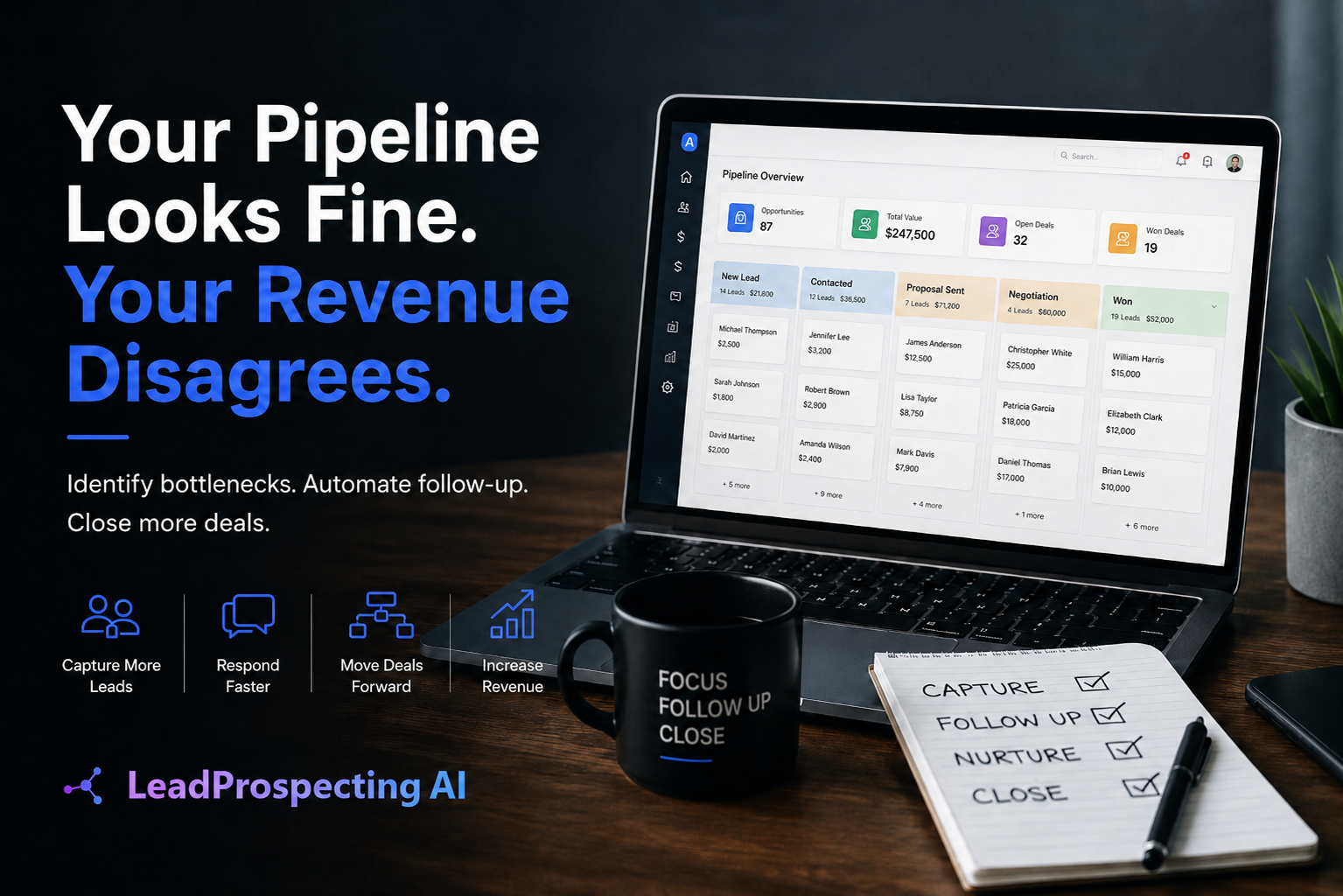
A platform like LeadProspecting AI is designed to replace 8 to 12 of those disconnected tools. Lead scraping, email marketing, SMS, invoicing, pipeline management, automation, review requests, and performance analytics all live in one place. The pricing is structured so that you're paying one consolidated cost instead of a dozen separate subscriptions.
The math is simple: if you're currently spending $700+ per month on fragmented tools, consolidating to one integrated platform typically costs less, eliminates integration headaches, and unlocks an additional 30 to 40 hours of productivity per month from your team.
What Changes When You Actually Consolidate
Real consolidation doesn't just save money. It changes how your business operates. Your sales cycle compresses because leads aren't dropped in handoff. Your close rate improves because follow-ups are timely and systematic. Your team spends more time selling and less time administering data entry between platforms.
One of our clients, a home service contractor, was using seven different tools. After consolidation, their cost per lead dropped 34 percent simply because their team could nurture more leads in the same timeframe, and the follow-up was actually systematic instead of sporadic.
The key is choosing a platform that doesn't require a six-month implementation. You should be operational in two weeks, not two quarters.
Frequently Asked Questions
Q: Isn't an all in one CRM for small business going to be too basic for our needs?
Not if it's purpose-built for small business operations. Modern all in one platforms include lead scraping, email automation, SMS, invoicing, payment tracking, custom workflows, and analytics. The difference is they're designed for simplicity and speed, not enterprise complexity. You get 90 percent of what you need and none of the bloat.
Q: How long does it take to migrate from multiple tools to one platform?
If you're consolidating eight tools with thousands of records, expect 3 to 6 weeks of preparation, data mapping, and testing. In practice, most teams run parallel systems for 2 to 4 weeks before fully switching. The good news is that once you're in, adding new data is instant.
Q: Will our team resist the change?
Adoption is typically faster than expected because your team is probably already frustrated by tool overload. A unified interface with fewer logins and less context switching is almost always met with relief. Training is minimal when the platform is intuitive. A good feature set with clear automation is self-teaching.
Q: What if we need a tool that isn't included?
The right platform should have integration partners for anything truly specialized. But here's the reality: most small businesses think they need five tools when what they actually need is good execution with one tool. Before adding integrations, consolidate first and see what you genuinely still need.
Q: How much should we expect to save?
If you're currently spending $600 to $1,200 per month on fragmented tools, consolidation typically reduces that to $300 to $500 while improving functionality. Beyond direct savings, you're recovering 30 to 40 hours of team time monthly. At $25/hour fully burdened, that's another $750 to $1,000 in monthly value.
Your Next Step: Audit and Consolidate
Your tech stack audit isn't optional anymore. It's the difference between running efficiently and throwing margin away on complexity.
This week, list every tool you're paying for. This month, consolidate around one all in one CRM for small business that actually handles lead generation, nurturing, sales, and operations. By next quarter, you'll have recovered $1,500 to $3,000 in annual spending, gained back dozens of hours of team productivity, and have a sales operation that actually compounds instead of leaks leads.
If you want to see what a truly integrated platform looks like for your specific business model, let's talk. We'll show you exactly where your current stack is bleeding money and what consolidation would actually look like with your numbers.