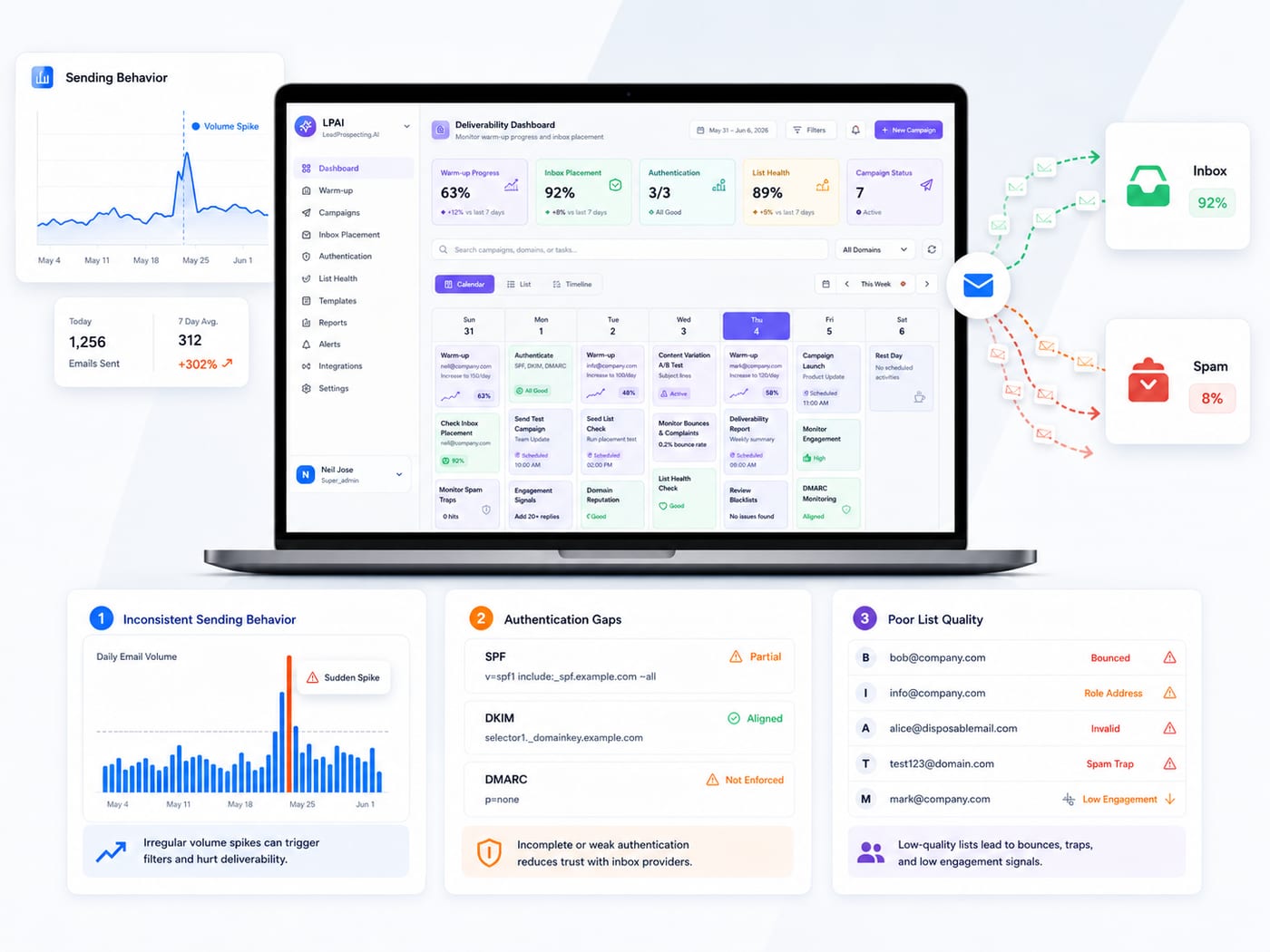
You write the perfect cold email. You craft an irresistible offer. You hit send to 100 prospects and wait for replies to flood in. But here’s what actually happens: your emails land in spam folders, your sender reputation tanks, and your outreach campaign dies before it begins.
This scenario plays out thousands of times daily for small businesses trying to generate leads through cold outreach. The problem isn’t your message or your offer. The problem is that Gmail, Outlook, and Yahoo don’t trust you yet as a sender. In 2026, email providers use sophisticated AI algorithms to analyze hundreds of signals beyond simple volume patterns. They’re evaluating sender reputation, engagement rates, authentication protocols, and behavioral patterns that separate legitimate businesses from spammers.
Email warm-up solves this problem. It’s the strategic process of gradually building trust with email service providers by slowly increasing your sending volume over 30 days while generating positive engagement signals. Think of it as introducing yourself to the gatekeepers who control inbox access. Without proper warm-up, even perfectly crafted emails from verified SMTP addresses disappear into spam folders.
The stakes are higher than ever in 2026. Google began actively rejecting emails from non-compliant senders in November 2025, and Microsoft followed with similar enforcement. High bounce rates now trigger immediate filtering or outright rejection. This complete 30-day action plan shows you exactly how to warm up your email account, avoid the biggest mistakes, and achieve 85-95% inbox placement so your cold outreach actually generates revenue.
How to Warm Up Email: Your Week-by-Week Action Plan
What should you do in weeks 1-2 of email warm up?
Start with authentication setup before sending a single email. Email service providers require three authentication protocols in 2026: SPF (Sender Policy Framework), DKIM (DomainKeys Identified Mail), and DMARC (Domain-based Message Authentication, Reporting, and Conformance). SPF tells email providers which servers can send from your domain. DKIM adds a digital signature proving your emails haven’t been tampered with. DMARC instructs providers what to do when emails fail authentication checks.
Missing even one protocol destroys your deliverability. Configure all three through your domain’s DNS records before warm-up begins.
Days 1-7 focus on foundation building. Send just 5-10 emails daily to your warmest contacts: team members, existing customers, business partners, or professional acquaintances who will definitely open and reply. Keep messages personal and conversational. The goal is establishing basic sending patterns with extremely high engagement rates (80%+ opens, 40%+ replies).
Use consistent sending times during this week. Email providers analyze when you send messages, so establish a pattern and stick with it. If you send at 9 AM on Monday, send around 9 AM Tuesday through Friday. This consistency signals predictable, human behavior rather than bot-like blasting.
Days 8-14 gently expand your circle. Increase volume to 10-20 emails daily while maintaining your focus on known contacts. Add people you’ve corresponded with previously but perhaps haven’t emailed recently. The key metric remains engagement: you want recipients opening emails and responding naturally.
Monitor your bounce rate obsessively during these first two weeks. Keep it under 2% (under 1% is ideal). Every bounced email damages your sender reputation, which is why starting with verified, known-good email addresses is critical. This is where SMTP verification becomes essential. Tools that verify emails before you send eliminate invalid addresses, spam traps, and disposable domains that trigger spam filters.
How do you scale email volume in weeks 3-4?
Weeks 3-4 build momentum while introducing cold prospects gradually. Days 15-21 increase volume to 20-30 emails daily. Continue prioritizing engaged recipients, but you can now mix in warmer prospects outside your immediate network: LinkedIn connections who’ve engaged with your content, leads who downloaded resources from your website, or attendees from webinars you hosted.
The 20% rule governs safe volume increases: never increase daily sending by more than 20% day-over-day. If you send 20 emails Monday, send no more than 24 Tuesday. This gradual ramp prevents the sudden spikes that trigger spam filters.
Days 22-30 mark your transition to cold outreach. Increase volume to 30-50 emails daily while mixing your first truly cold prospects into sequences. By day 30, you should reach 50-100 emails daily depending on your target volume. Most B2B sales teams find 50 emails per inbox per day optimal for cold outreach, while email marketing campaigns can scale to 100+ daily.
Maintain consistent sending patterns throughout. Avoid sporadic bursts where you send 10 emails one day and 80 the next. Email providers interpret irregular patterns as suspicious. Steady, predictable volume demonstrates legitimate business communication.
Track your inbox placement rates during weeks 3-4. Ask trusted contacts in different organizations to check where your emails land: primary inbox, promotions tab, or spam folder. If emails consistently hit spam, slow your volume increase and focus on engagement. Quality always beats quantity during warm-up.
What Are the 7 C’s of Email Etiquette for Warm Up Success?
How to write emails that build sender reputation
The 7 C’s framework ensures your warm-up emails signal legitimacy to spam filters while building authentic engagement. Clear emails use obvious subject lines that accurately reflect email content. Avoid clickbait or misleading subjects. “Following up on our conversation” works when you actually had a conversation. “Quick question about [specific topic]” works when you have a genuine question.
Concise messages perform better during warm-up. Keep emails between 150-300 words. Shorter messages generate higher response rates and look more like genuine business correspondence than marketing blasts. Save the detailed explanations for after your sender reputation is established.
Complete emails include all necessary context so recipients don’t need to hunt for information. If you’re referencing a previous interaction, remind them briefly. If you’re making an offer, state it clearly. Incomplete emails that confuse recipients generate low engagement, which hurts your reputation.
Correct grammar and spelling affect spam scores. Multiple typos, poor formatting, or obvious errors signal low-quality content that spam filters penalize. Professional presentation matters not just for human readers but for AI algorithms evaluating your credibility.
What is the +1 email trick for better engagement?
Courteous tone maintains professionalism without being stiff or overly formal. Write like you’re talking to a colleague, not lecturing a stranger. Respectful language acknowledges the recipient’s time and expertise.
Compliant emails follow CAN-SPAM regulations even during warm-up. Include your business name and physical address, provide a clear unsubscribe mechanism, and honor opt-out requests within 10 business days. Compliance isn’t optional in 2026. Violations carry penalties up to $51,744 per email.
Conversational style uses natural language rather than robotic or overly salesy phrasing. The “+1 email trick” means sending one more personalized follow-up than you think necessary. Most people quit after one or two attempts. Sending a third, genuinely helpful follow-up often breaks through because you’ve demonstrated persistence without being annoying. Reference something specific about their business. Ask a thoughtful question. Provide value without asking for anything in return.
This approach builds relationships, not just broadcasts messages. Email providers reward genuine conversation patterns with better inbox placement. When recipients reply to your emails, mark them as important, or forward them to colleagues, your sender reputation skyrockets.
How to Avoid the 5 Biggest Email Warm Up Mistakes
What is the 3 email rule and why it matters
The 3 email rule limits follow-ups during warm-up. Never send more than three emails to the same recipient during your 30-day warm-up period. Space follow-ups 3-5 days apart minimum. If someone doesn’t respond after the third attempt, stop. Continuing to email unresponsive contacts generates the exact signal spam filters look for: one-way broadcasting that recipients ignore.
This discipline protects your sender reputation. Email providers track engagement at the recipient level. If you repeatedly email people who never open your messages, algorithms learn your emails are unwanted. Respect recipient attention and inbox space.
The most common warm-up mistake is rushing volume increases. Jumping from 10 emails to 100 overnight screams “spam bot” to email providers. The temptation to blast your entire prospect list immediately is strong, especially when you’re excited about a new campaign. Resist it. Every successful email marketer reports the same experience: patience during warm-up pays off with sustained high deliverability for months or years afterward. Impatience during warm-up leads to permanently damaged domains that never recover.
Start with just 2-3 emails daily if you’re working with a brand new domain. Increase by approximately 20% each day until reaching your target volume. For cold emails, 50 emails per day per account is the recommended limit. For email marketing to opted-in lists, you can scale to 100+ daily.
What should you not do in an email warm up campaign?
Don’t skip authentication setup. This bears repeating because it’s the foundation everything else builds on. Missing SPF, DKIM, or DMARC records can get your domain blacklisted before you finish week one. Email providers in 2026 enforce authentication aggressively. Configure these protocols correctly or don’t bother starting.
Don’t use purchased or scraped email lists during warm-up. Invalid addresses, spam traps, and disposable emails guarantee spam complaints. Build your warm-up list from verified, opted-in contacts who actually want to hear from you. This is where SMTP verification becomes non-negotiable. Before importing any prospect list, verify every email address. SMTP verification connects to mail servers, confirms mailboxes exist, detects catch-all domains, and filters disposables.
Don’t ignore engagement metrics. Track open rates, click rates, reply rates, bounce rates, and spam complaints obsessively. If bounce rates exceed 2%, pause and clean your list. If spam complaints exceed 0.3%, stop immediately and diagnose the problem. Your content, targeting, or list quality has issues that must be fixed before continuing.
Don’t stop warm-up after the initial 30 days. Email warm-up is an ongoing process, not a one-time project. Maintain consistent sending volume and engagement focus forever. If you pause outreach for weeks or months, your sender reputation decays. When you restart, you’ll need to warm up again.
Don’t send identical messages to hundreds of recipients. Personalization matters even during warm-up. Vary your subject lines, adjust opening paragraphs, reference specific details about each recipient’s business or situation. AI spam filters in 2026 detect copy-paste campaigns and penalize them.
What Is the Best Way to Warm Up Using Automation?
How to write a killer cold email after warm up
After completing your 30-day warm-up, you’re ready for real cold outreach. The best cold emails in 2026 lead with personalized value, not company pitches. Start by referencing something specific about the recipient’s business: a recent company announcement, industry challenge they’re facing, or content they published. This proves you did research rather than blasting generic templates.
Keep your initial outreach under 200 words for optimal mobile reading. State your value proposition in the first two sentences. What specific problem do you solve? How does it benefit them? Skip the lengthy company history and feature lists. Those belong on your website, not in cold emails.
Include a single clear call-to-action. Don’t ask recipients to choose between scheduling a call, replying with questions, downloading a resource, and visiting your website. Decision paralysis kills conversion. Pick one action you want them to take and make it frictionless.
A/B test different approaches with small batches first. Send version A to 20 prospects and version B to 20 different prospects. Measure which generates better open rates, click rates, and reply rates. Scale the winner to larger volumes. This data-driven approach prevents you from blasting thousands of emails with an approach that doesn’t resonate.
What is the best email warm up tool for small businesses?
Automated warm-up tools handle the repetitive work of sending emails, generating engagement, and monitoring deliverability 24/7. Manual warm-up works fine for one or two email accounts, but scaling to 5, 10, or 50+ inboxes demands automation.
The best tools connect your email accounts to networks of thousands of high-reputation inboxes (typically real Gmail and Outlook accounts), send warm-up emails that simulate genuine business correspondence, generate realistic engagement (opens, replies, marks as important), remove emails from spam if they land there, monitor your reputation signals continuously, and adjust volume and patterns based on performance.
However, warm-up is just one piece of the email outreach puzzle. Small businesses need complete workflows: finding qualified leads with verified contact information, warming email accounts to build sender reputation, sending personalized cold outreach campaigns, tracking engagement and responses, and managing follow-up sequences.
This is where integrated platforms deliver significant advantages over point solutions. LeadProspecting AI combines lead generation and SMTP-verified email addresses in a single workflow. The Lead Scraper finds qualified business leads from Google Maps based on your search criteria (industry, location, business type), extracts 130+ data points per lead including business name, category, phone number, full address, and website, SMTP-verifies every email address before delivery (near-zero bounce rates), and enriches leads with 9 social profiles, Google reviews, ratings, business hours, and owner information.
The pricing model eliminates subscription traps: pay just $0.03 per lead with SMTP verification included. No monthly minimums, no hidden fees, no contracts. Credits never expire. Optional AI enrichment adds business insights and personalized email drafts for an additional $0.04 per lead.
This integrated approach solves the fragmented workflow problem. Instead of subscribing to a lead database ($119/month), separate email verification service ($79/month), warm-up tool ($49/month), and outreach platform ($97/month), you get verified leads ready for warm outreach at $0.03 each. For a 1,000-lead campaign, that’s $30 total versus $344+ monthly in subscription fees.
The workflow seamlessly connects: search for your ideal prospects, receive SMTP-verified emails with complete contact data, export directly to your email campaigns or CRM, and begin your warm outreach knowing every address is verified and deliverable.
Bottom Line: Email warm-up in 2026 isn’t optional for cold outreach success. It’s the foundation that determines whether your carefully crafted messages reach inboxes or disappear into spam folders. Follow this 30-day action plan starting with authentication setup, gradually ramping volume by 20% daily, maintaining consistent sending patterns, prioritizing engagement over quantity, and using SMTP-verified email addresses to eliminate bounces. The businesses that invest 30 days building sender reputation achieve 85-95% inbox placement rates and turn cold email into a reliable revenue channel. The businesses that skip warm-up watch their campaigns fail before they start.
FAQ
How do you warm up an email? Warm up an email by gradually increasing sending volume over 30 days, starting with 5-10 emails daily to known contacts and scaling to 50-100 daily while maintaining high engagement rates. Configure SPF, DKIM, and DMARC authentication before sending, use SMTP-verified email addresses to prevent bounces, and never increase volume more than 20% day-over-day.
What is the 60 40 rule in email? The 60/40 rule recommends email content should be 60% text and 40% HTML for optimal deliverability. This balance prevents spam filters from flagging messages as overly promotional while maintaining professional formatting and design elements.
What is a warm way to start an email? Start warm emails with personalized references to the recipient’s business, recent achievements, or shared connections. Use their name, mention specific details you researched, and lead with how you can help them rather than what you’re selling.
What are the 5 C’s of email writing? The 5 C’s are Clear (obvious subject lines), Concise (150-300 words), Complete (all necessary context), Correct (no grammar or spelling errors), and Courteous (professional, respectful tone). These principles build sender reputation during warm-up.
What is the +1 email trick? The +1 email trick means sending one more personalized follow-up than you think necessary. Most people quit after one or two attempts, but a third thoughtful follow-up often generates responses because it demonstrates genuine interest without being pushy.
What is the 3 email rule? Never send more than 3 emails to the same recipient during warm-up. Space follow-ups 3-5 days apart. If someone doesn’t respond after the third attempt, stop emailing them. This prevents spam complaints that damage sender reputation.
What is basic email etiquette? Basic email etiquette includes using professional subject lines, personalizing messages, keeping content concise, including clear calls-to-action, respecting recipient time, providing unsubscribe options, honoring opt-out requests, and maintaining consistent sender information.
What should you not do in an email? Don’t skip authentication setup, use purchased email lists, send identical messages to hundreds of recipients, increase volume more than 20% daily, ignore bounce rates above 2%, continue emailing unresponsive contacts, or stop warm-up after 30 days.
How to write a killer cold email? Write killer cold emails by leading with personalized value specific to the recipient, keeping messages under 200 words, stating your value proposition in the first two sentences, including a single clear call-to-action, and A/B testing different approaches before scaling.
What is the best email warm up tool? The best email warm-up tool integrates with your complete lead generation workflow. LeadProspecting AI combines SMTP-verified lead finding at $0.03 per lead with seamless export to email campaigns, eliminating the need for separate subscriptions to lead databases, verification services, and warm-up platforms.
For service businesses that turn cold emails into real jobs, FieldServ AI helps manage scheduling, dispatch, invoicing, and customer follow-ups in one simple platform so the leads you generate do not stop at replies, they become booked work.