How to Improve Lead Prospecting by Fixing What Prospects Actually See
Most lead prospecting advice starts at the wrong point. It jumps straight to CRM workflows, email sequences, and cold outreach tactics — all of which assume you already have prospects paying attention.
But here is the question nobody asks first: what happens when a potential customer searches for a business like yours?
If your Google Business Profile is incomplete, your website loads slowly on mobile, or your competitors are outranking you in every search result, then no amount of outreach effort will close that gap. The foundation of modern lead prospecting is not how aggressively you chase leads. It is whether those leads can find you, trust what they see, and take the next step — all before your sales team ever gets involved.
This guide walks through the prospecting factors that actually move the needle in 2026, starting with the ones most businesses overlook entirely.
Visibility Is the First Step in Every Prospecting Funnel
There is a disconnect in how most businesses think about lead prospecting. They invest in outbound tactics — calls, emails, ads — while their inbound presence quietly drives prospects straight to competitors.
Consider this: when someone needs a service, the first thing they do is search. They type a few words into Google, scan the results, and make a snap judgment about which businesses look credible and which do not. That judgment happens in seconds, and it is based entirely on what shows up on the screen.
If your business does not appear in those results — or if it appears but looks incomplete, outdated, or unprofessional — you have lost that prospect before you even knew they existed. No CRM, no automation tool, and no follow-up sequence can recover a lead that never found you in the first place.
This is why effective lead prospecting in 2026 starts with visibility. Not visibility in the advertising sense, but organic, earned visibility in the places where your ideal customers are already looking.
Your Google Business Profile Speaks Before You Do
For any business that serves a local or regional market, the Google Business Profile is often the very first impression a prospect sees. It appears in local search results, map packs, and increasingly in AI-generated search summaries. And most businesses are leaving it half-finished.
An incomplete profile — missing business hours, no photos, outdated categories, a handful of reviews — signals to prospects that the business either does not care about its online presence or is not actively operating. Neither impression leads to a phone call.
The businesses generating consistent inbound leads treat their Google Business Profile like a storefront. They keep categories accurate and specific to their actual services. They upload current photos regularly. They respond to every review, positive or negative. They ensure their name, address, and phone number are identical across every directory and platform where they appear.
This consistency matters because Google uses it as a trust signal. When your business information matches across your website, your Google profile, Yelp, Facebook, and industry directories, search engines gain confidence in recommending you. When it does not match, your rankings suffer and prospects see conflicting information — which erodes trust immediately.
If you have not audited your Google Business Profile recently, it is likely costing you leads you will never know about.
Your Website Is Either Converting Prospects or Losing Them
Once a prospect clicks through to your website, you have roughly ten seconds to convince them to stay. That is not an exaggeration. Studies on user behavior consistently show that most visitors decide whether to engage or bounce within the first few seconds of a page load.
Three things determine whether they stay.
First, speed. If your site takes more than three seconds to load on a mobile device, a significant percentage of visitors leave before seeing any content at all. They do not read your headline. They do not see your services. They simply leave and click the next result. Page speed is not a technical detail for your developer to worry about — it is a direct leak in your prospecting funnel.
Second, mobile experience. More than half of all web traffic now comes from mobile devices, and for local service searches, that number is even higher. If your site is not fully responsive — if text is too small, buttons are hard to tap, or the layout breaks on a phone screen — you are actively turning away your most motivated prospects. These are people searching on the go, often ready to take action immediately, and a clunky mobile experience sends them to your competitor instead.
Third, clarity of the next step. When a prospect lands on your site, do they immediately understand what you do, who you serve, and what they should do next? A visible phone number, a clear call-to-action button, a simple contact form — these are not design preferences. They are conversion mechanics. Without them, even a fast, beautiful website fails as a prospecting tool.
Every one of these factors is measurable, and every one of them can be improved. But most businesses have never actually tested their own site from the perspective of a first-time visitor on a phone.
Search Rankings Are Not Vanity Metrics — They Are Your Pipeline
There is a tendency to think of search engine rankings as a marketing scorecard — nice to track but disconnected from real business results. That thinking is outdated and expensive.
Here is how it actually works. When someone searches for a service you offer, Google returns a page of results. The top three organic results capture the vast majority of clicks. The local map pack — those three businesses shown with a map — captures even more for location-based searches. If your business is not in either of those zones, you are functionally invisible to the largest pool of high-intent prospects available.
These are not casual browsers. People searching for specific services have active intent. They are comparing options, checking reviews, and making decisions. Ranking on page two of Google for your primary keyword is the equivalent of having a billboard in a field no one drives past.
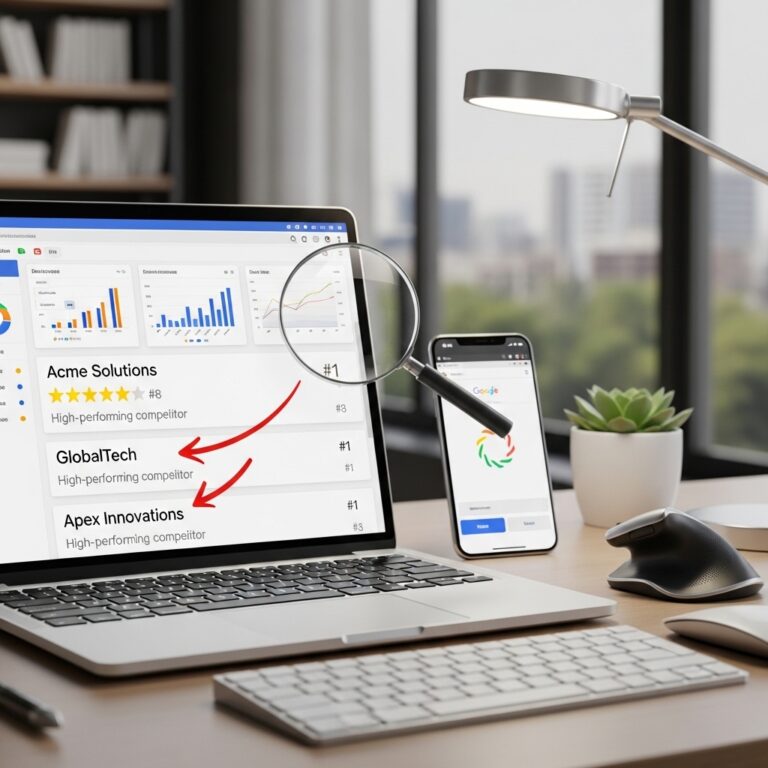
Improving your organic search position requires understanding what your competitors are doing right. What keywords are they targeting? How is their content structured? Do they have more reviews, better backlinks, stronger local citations? Without competitive analysis, you are optimizing in the dark.
This is one of the most overlooked aspects of lead prospecting. Most businesses have a general sense of who their competitors are, but very few have actually compared their digital presence side by side. They do not know that a competitor three miles away has four times as many Google reviews, ranks for twice as many keywords, and has a website that loads in half the time. That competitor is not necessarily better at what they do — they are just easier to find and faster to trust. And in a market where prospects make decisions based on what shows up on their screen, that difference translates directly into lead volume.
The businesses that consistently generate inbound leads are the ones that treat their search engine position as a core business metric — not a marketing afterthought.
Lead Scoring Starts Before the CRM
Traditional lead scoring assigns points to contacts based on demographic data and CRM activity — job title, company size, emails opened, forms filled out. That approach still has value, but it misses the most telling signals entirely.
Modern lead scoring incorporates digital behavior that happens before a prospect ever enters your CRM. Which pages did they visit on your website? How long did they spend on your pricing or services page? Did they come from an organic search or a paid ad? Did they visit your site multiple times before reaching out?
These behavioral signals reveal intent far more accurately than demographic checkboxes. A prospect who visited your services page three times in a week and then searched for your business by name is fundamentally different from someone who filled out a generic contact form once. AI-powered scoring tools can now process these signals in real time, helping sales teams prioritize the leads most likely to convert rather than simply the ones who showed up most recently.
The gap most businesses face is not that they lack a scoring system. It is that their scoring system only sees what happens after a lead makes contact. Everything that happens before that moment — the searches, the website visits, the competitor comparisons — is invisible to them. And that invisible data is often the most valuable.
Closing that gap starts with understanding your full digital footprint. When you know which search terms drive visitors to your site, which pages they visit, and how your online presence compares to competitors, you can build a scoring model that reflects real prospect behavior — not just CRM activity.
AI Is Changing How Prospects Discover Businesses
Search behavior is shifting. AI-powered search features — Google’s AI Overviews, ChatGPT-integrated search, conversational assistants — are changing how prospects find and evaluate businesses. Instead of scrolling through ten blue links, users increasingly receive summarized answers pulled from multiple sources.
This matters for lead prospecting because the businesses that appear in these AI-generated summaries are the ones with the strongest digital signals: consistent information across platforms, well-structured website content, genuine customer reviews, and clear service descriptions. AI systems prioritize clarity and credibility over clever marketing language.
Businesses that have neglected their digital fundamentals — inconsistent NAP data, thin website content, few reviews, no structured data markup — are being filtered out of these new discovery channels entirely. Meanwhile, competitors with clean, complete digital footprints are gaining visibility in channels that did not exist two years ago.
Optimizing for AI discoverability is not a future concern. It is already affecting which businesses get found and which get skipped.
The practical steps are not exotic. Answer common customer questions directly on your website. Use structured data markup so AI systems can parse your services and location. Make sure your Google Business Profile categories match exactly what you do. Build a review profile that gives AI tools evidence of real customer experience. These are the same fundamentals that improve traditional SEO — but they now carry double weight because they feed both search engines and the AI layers built on top of them.
You Cannot Improve What You Have Not Measured
This is the part most lead prospecting advice skips entirely. Every tactic — from CRM automation to content marketing to paid ads — works better when it is built on a clear understanding of your current position.
Most businesses have never systematically evaluated how they appear online. They do not know where they rank for their most important keywords. They do not know how their Google Business Profile compares to their top competitors. They have not tested their website speed on a mobile device. They have not checked whether their business information is consistent across directories. They have not looked at whether their site has proper schema markup, SSL security, or accessible navigation.
Without that baseline, every prospecting decision is a guess. You might invest in content marketing when your real problem is page speed. You might pay for ads when your Google Business Profile is turning away the traffic you already have. You might hire an SDR when your website is doing the damage before they ever pick up the phone.
The first step in any serious lead prospecting strategy is a diagnostic — an honest, detailed look at what prospects actually see when they search for your business. Not what you think they see. Not what your website looked like when it launched. What they see right now, today, compared to your competitors.
Once you have that picture, every decision gets sharper. You know where to invest. You know what to fix first. You know which improvements will actually move leads into your pipeline rather than just checking boxes on a marketing to-do list.
The Prospecting Advantage Starts with Knowing Where You Stand
Lead prospecting has changed. The businesses winning the most qualified leads are not just the ones with the best outreach — they are the ones that show up first, look credible instantly, and make it effortless for prospects to take the next step. That requires a digital presence that is fast, visible, trustworthy, and optimized for how people actually search in 2026.
Before investing in any new prospecting strategy, start with the foundation. Find out how your business actually appears in search results, how your website performs, and where you stand against competitors. A comprehensive website audit gives you that clarity — and it takes less time than you think.
[Run your free website audit here] and see exactly what prospects see when they search for a business like yours. The results might surprise you — and they will definitely show you where to focus next.
FAQ Section
What is the most important first step in lead prospecting? Before investing in outreach tools or CRM automation, the most important first step is understanding how your business appears online. If prospects cannot find you in search results or if your website creates a poor first impression, no outbound strategy will compensate. A website audit gives you a clear picture of where you stand and what to fix first.
How does my Google Business Profile affect lead prospecting? Your Google Business Profile is often the first thing a prospect sees when searching for businesses like yours. Incomplete profiles with missing hours, few photos, and low review counts signal neglect and push prospects toward competitors. Keeping your profile accurate, active, and fully optimized directly increases the volume of inbound leads you receive.
Why is website speed important for generating leads? If your website takes more than three seconds to load on mobile, a large percentage of visitors leave before seeing any content. These are potential leads who searched with intent, clicked your result, and then abandoned you because of a technical issue. Improving page speed is one of the fastest ways to reduce lead loss.
How do search engine rankings impact lead generation? The top three organic results on Google capture the majority of clicks for any given search. If your business ranks on page two or beyond for your primary keywords, you are effectively invisible to the largest pool of high-intent prospects available. Improving your search position directly increases the number of qualified leads entering your pipeline.
How is AI changing lead prospecting in 2026? AI-powered search features like Google’s AI Overviews and conversational assistants now summarize and recommend businesses based on digital signals such as review quality, structured data, content clarity, and information consistency. Businesses with strong digital foundations are gaining visibility in these new channels, while those with weak online presences are being filtered out entirely.
FieldServ AI is an all‑in‑one field service platform built by LeadProspecting AI that helps contractors quote, schedule, dispatch, invoice, and manage jobs, replacing 5+ separate tools with one system.