TL;DR: Websites build trust and credibility for long-term branding, while landing pages drive higher conversions (9.7% vs 2.4%) for specific campaigns. Smart small businesses use both: websites as their digital headquarters and landing pages for targeted offers. Startups can begin with landing pages, but established businesses benefit from integrated solutions that manage both tools seamlessly.
If you’re a small business owner trying to figure out your digital marketing strategy, you’ve probably encountered this debate: should you focus on building a comprehensive website or create targeted landing pages? It’s one of the most common questions we hear from entrepreneurs across the country, and the answer isn’t as straightforward as you might think.
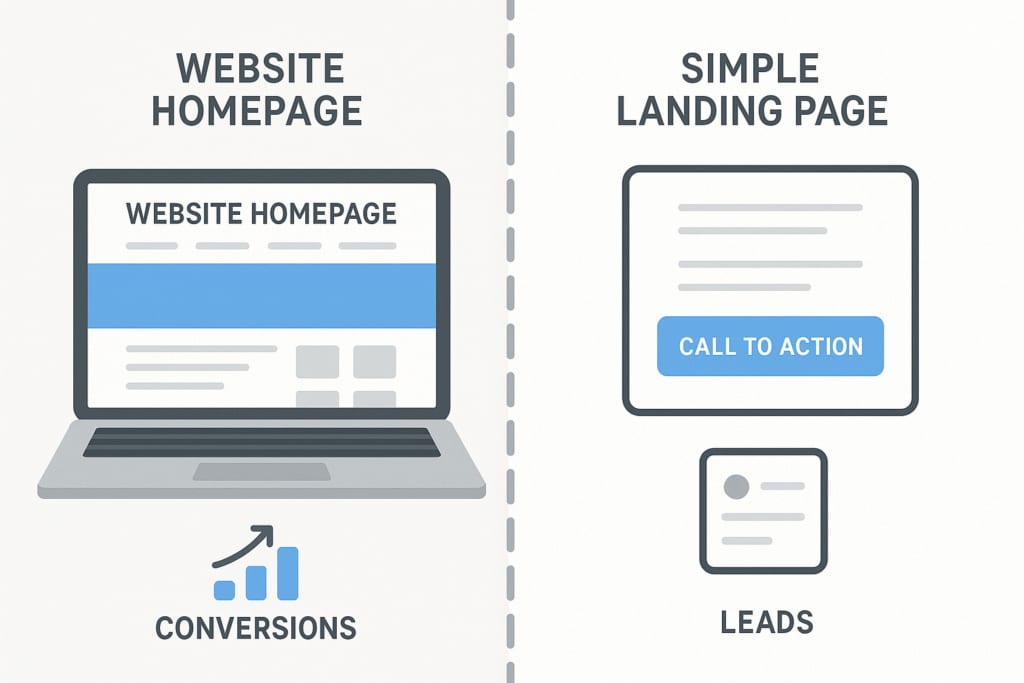
The confusion is understandable. Both landing pages and websites serve important roles in your marketing arsenal, but they work in fundamentally different ways. A website acts as your digital headquarters—a comprehensive hub where visitors can learn about your business, browse your services, and get to know your brand. Landing pages, on the other hand, are laser-focused tools designed for one specific goal: converting visitors into leads or customers.
Understanding when and how to use each tool can mean the difference between a thriving online presence and missed opportunities. Let’s break down everything you need to know about landing pages vs websites for small business success.
The Role of Websites in Small Business Lead Generation
Your website serves as your digital storefront, often providing the first impression potential customers have of your business. For small business lead generation, websites play a crucial foundational role that can’t be overlooked.
Think of your website as your business’s home base online. When someone searches for services like yours, your website needs to accomplish several things simultaneously: establish credibility, showcase your expertise, provide essential information, and yes—capture leads. This is particularly important for service-based businesses like plumbing companies, HVAC contractors, or consulting firms, where trust and expertise are paramount.
Recent data from 2025 shows that 73% of consumers research a business online before making contact, yet nearly 28% of small businesses still lack a professional website. Even more concerning, businesses with poorly designed or outdated websites lose an average of 35% of potential leads due to visitors bouncing within seconds of arriving.
This is exactly why your business needs a website that works hard for you. Your website should tell your complete story, demonstrate your value proposition, and provide multiple pathways for visitors to engage with your business—whether that’s through contact forms, phone calls, or appointment scheduling.
The Benefits of Landing Pages for Local Marketing Campaigns
While websites provide the foundation, landing pages excel at driving specific actions. The benefits of landing pages become clear when you’re running targeted marketing campaigns or promoting particular offers.
Landing pages are built with one primary goal: conversion. Unlike your main website, which might have dozens of navigation options and pieces of information, a well-designed landing page eliminates distractions and guides visitors toward a single action. This focused approach is incredibly powerful for specific marketing objectives.
Consider these scenarios where landing pages shine: promoting a limited-time discount on your services, capturing leads for a free consultation, registering attendees for a webinar, or highlighting a seasonal service offering. Each of these campaigns benefits from the laser focus that only a dedicated landing page can provide.
The statistics speak for themselves: the average landing page converts at 9.7%, compared to just 2.4% for typical website pages. When you’re investing in paid advertising or targeted outreach, that conversion rate difference can dramatically impact your return on investment.
Landing pages also allow you to match your message precisely to your marketing source. If someone clicks on a Facebook ad about roof inspections, they should land on a page specifically about roof inspections—not your general roofing company homepage where they might get distracted by other services.
Landing Pages vs Websites: Which One Converts Better?
When we examine landing pages vs websites from a pure conversion standpoint, the answer depends entirely on your specific goals and where visitors are in their buyer’s journey.
Websites excel at building trust and credibility over time. They’re perfect for visitors who are in research mode, comparing options, or trying to understand your business better. Your website supports long-term branding efforts and provides the comprehensive information that helps establish you as an industry authority.
Landing pages, however, are conversion powerhouses for specific offers and campaigns. They work best when you have a clear value proposition and want visitors to take immediate action. For businesses working with smaller marketing budgets, landing pages often deliver quicker ROI because they’re designed to convert visitors who are already interested in what you’re offering.
The key to conversion rate optimization for small businesses isn’t choosing one over the other—it’s understanding when to use each tool. Your website builds the foundation of trust and authority, while landing pages capitalize on specific opportunities to convert that trust into business.
Smart businesses use both strategically. They maintain a professional website that serves as their digital headquarters, then create targeted landing pages for specific campaigns, seasonal promotions, or high-value service offerings.
Choosing the Right Tool for Your Business Growth
Deciding between a website-first or landing-page-first approach depends on where your business stands and what your immediate goals are.
For startups and new businesses, a targeted landing page might be the smart first move. You can validate your market, start capturing leads, and generate revenue while you’re still building out your full web presence. This approach lets you test your messaging and offers before investing in a comprehensive website.
Established businesses typically benefit from having both a solid website foundation and strategic landing pages for specific campaigns. Your website handles the heavy lifting of brand building and comprehensive information sharing, while landing pages drive conversions for particular offers or seasonal services.
When selecting the best website builder for small businesses, look for platforms that make it easy to create both websites and landing pages. The ideal solution should offer drag-and-drop simplicity, mobile responsiveness, and integrated lead capture strategies without requiring technical expertise.
Effective lead capture strategies include strategically placed contact forms, live chat functionality, downloadable resources in exchange for email addresses, and clear calls-to-action throughout your site. The best platforms make these features simple to implement and manage, so you can focus on running your business instead of wrestling with technology.
The Smart Move for Small Business Owners
Here’s what successful small business owners have figured out: it’s not about choosing landing pages or websites—it’s about using each tool when it makes the most sense.
Instead of juggling multiple platforms and tools to manage your online presence, modern businesses are moving toward integrated solutions that handle both websites and landing pages in one place. This approach eliminates the complexity of managing multiple logins, design systems, and analytics dashboards.
The most effective strategy combines the credibility and comprehensive information of a professional website with the conversion-focused power of targeted landing pages. When these tools work together seamlessly, they create a digital marketing system that builds trust, captures leads, and grows your business efficiently.
Consider exploring platforms that simplify this entire process, allowing you to build professional websites, create high-converting landing pages, and manage your leads all from one dashboard. The time you save on technical management can be reinvested in what matters most: serving your customers and growing your business.
Ready to streamline your lead generation? LeadProspecting.ai provides everything you need—professional websites, high-converting landing pages, and automated lead management—all in one powerful platform. Start your free trial today and see how much easier growing your business can be.
For field service businesses, we’ve partnered with FieldServ.ai to help you manage operations from lead capture to job completion with AI-powered scheduling and automation.
FAQs About Landing Pages vs Websites
Here are the most common questions business owners ask when deciding between landing pages and websites:
What is the main difference between a landing page and a website?
A website is a comprehensive collection of pages that tells your complete business story, while a landing page is a single, focused page designed to drive one specific action, like capturing leads or making a sale.
Do landing pages really improve small business lead generation?
Yes, significantly. Landing pages convert at an average rate of 9.7% compared to 2.4% for regular website pages because they eliminate distractions and focus on one clear goal.
How many landing pages should my business have?
Most small businesses benefit from 3-5 targeted landing pages for their main services or offers, plus additional pages for seasonal campaigns or special promotions.
Why does my business still need a website if landing pages convert better?
Your website builds trust, credibility, and provides comprehensive information that helps visitors become comfortable with your business. Landing pages work best when visitors already have some interest—your website creates that interest.
What are the benefits of landing pages compared to traditional websites?
Landing pages offer higher conversion rates, faster loading times, easier A/B testing, and better message matching for specific campaigns or advertising sources.
Can I use a landing page instead of a website for my startup?
For new businesses testing the market, starting with a landing page can be smart. However, plan to add a full website as you grow to build long-term credibility and trust.
Which converts more leads: website vs landing page for marketing?
Landing pages typically convert better for specific campaigns, while websites are better for building overall trust and capturing leads from organic search traffic.
What’s the best website builder for small businesses?
Look for platforms that offer both website and landing page creation, drag-and-drop design, mobile optimization, and integrated lead capture tools—all without requiring coding knowledge.
How do I improve conversion rate optimization for small businesses?
Focus on clear headlines, compelling calls-to-action, mobile-friendly design, fast loading times, social proof like testimonials, and removing unnecessary distractions from your conversion pages.
What are simple lead capture strategies that work for service-based businesses?
Effective strategies include offering free consultations, downloadable guides, email newsletters with valuable tips, live chat support, and clear contact forms with minimal required fields.