A homeowner in Jerome just discovered their furnace quit working. January temperatures are dropping fast. They grab their phone and search for HVAC help. Within sixty seconds, they’ve submitted requests to three different contractors serving the Magic Valley.
The contractor who responds first will book that job 40% more often than competitors. Not the cheapest option. Not the one with the most years in business. The one who answers first.
This is the new reality for service businesses across Twin Falls, Kimberly, Filer, Buhl, and Gooding. Customers expect immediate responses, and they’re comparing you against every competitor who shows up in their search results. The lead-to-job cycle, meaning everything from initial contact to completed payment, now happens at digital speed.
Yet most Magic Valley contractors still manage this cycle with disconnected tools. Leads come in through email, voicemail, Google Business Profile, Thumbtack, and website forms. Each channel requires separate logins, separate tracking, and separate follow-up. Important leads slip through the cracks while business owners drive between job sites across southern Idaho.
The Twin Falls businesses winning more jobs aren’t necessarily working harder. They’re working smarter by managing their entire lead-to-job cycle in a single platform. They respond faster because every lead flows to one place. They convert more because nothing falls through the cracks. They build trust because their systems work together seamlessly.
This guide breaks down exactly how the lead-to-job cycle works, why fragmented systems cost Magic Valley businesses money, and how consolidating everything into one platform transforms your conversion rates. Whether you’re a plumber in Twin Falls, an HVAC contractor serving Jerome, a landscaper in Kimberly, or a roofer covering the entire Magic Valley, these principles will help you book more jobs without working more hours.
Why Are Magic Valley Businesses Losing Jobs to Competitors?
Service businesses lose jobs primarily because they respond too slowly and manage leads inefficiently. The problem isn’t a lack of leads. It’s a lack of systems to capture and convert those leads before competitors do.
How Fast Do Customers Expect a Response?
Customers expect responses within minutes, not hours. When a Twin Falls homeowner’s air conditioning fails in July or a Buhl family’s toilet overflows at midnight, they’re not waiting around for callbacks. They’re contacting multiple providers simultaneously and booking whoever responds first.
Research shows that 40% of customers choose the service provider who responds first. This first-responder advantage compounds over time. A Magic Valley business that consistently responds within five minutes doesn’t just win individual jobs. They build a reputation for reliability that generates referrals throughout the community.
The challenge for local contractors is that leads don’t arrive on a convenient schedule. They come in while you’re installing a water heater in Jerome, meeting with a client in Filer, or finally sitting down for dinner with your family. Without systems that capture and respond to leads automatically, you’re competing with one hand tied behind your back. Your competitors use automated response systems that reply instantly while you’re still checking voicemail between jobs.
What Does Juggling Multiple Systems Actually Cost?
Managing leads across disconnected systems costs small businesses thousands of dollars monthly in lost opportunities and wasted time. The average service business uses between five and ten different tools for lead management, scheduling, invoicing, and communication. Each tool requires separate logins, separate data entry, and separate monitoring.
This fragmentation creates three expensive problems. First, leads fall through cracks when there’s no unified view of every incoming opportunity. A lead from Thumbtack might get overlooked because you were focused on Google leads that day. Second, manual data entry between systems wastes hours weekly. Copying customer information from an email into your scheduling tool into your invoicing system adds up fast. Third, you can’t see the full picture of what’s working. When leads live in different systems, calculating which marketing channels actually generate profitable jobs becomes nearly impossible.
One contractor described their pre-platform reality as “fly-by-the-seat-of-your-pants.” After consolidating everything into one system, they doubled revenue and staff within five years. The tools didn’t do the work for them. The tools stopped the work from getting lost.
What Makes a Lead-to-Job Cycle Actually Work?
An effective lead-to-job cycle captures leads from every source, responds immediately, nurtures prospects until they’re ready, and converts them into paying customers through a predictable process. Understanding each stage helps you identify where your current system breaks down.
Where Should Leads Flow Into Your Business?
Your leads should flow from every relevant platform directly into one central hub. For most Magic Valley service businesses, this means connecting Google Business Profile, lead generation platforms like Thumbtack and HomeAdvisor, your website contact forms, phone calls, text messages, and social media inquiries.
The keyword is “directly.” If leads from Thumbtack go to your email, while Google leads go to a separate app, while website forms go somewhere else entirely, you’ve already created friction. Every additional step between lead arrival and your response increases the chance that the lead chooses a competitor.
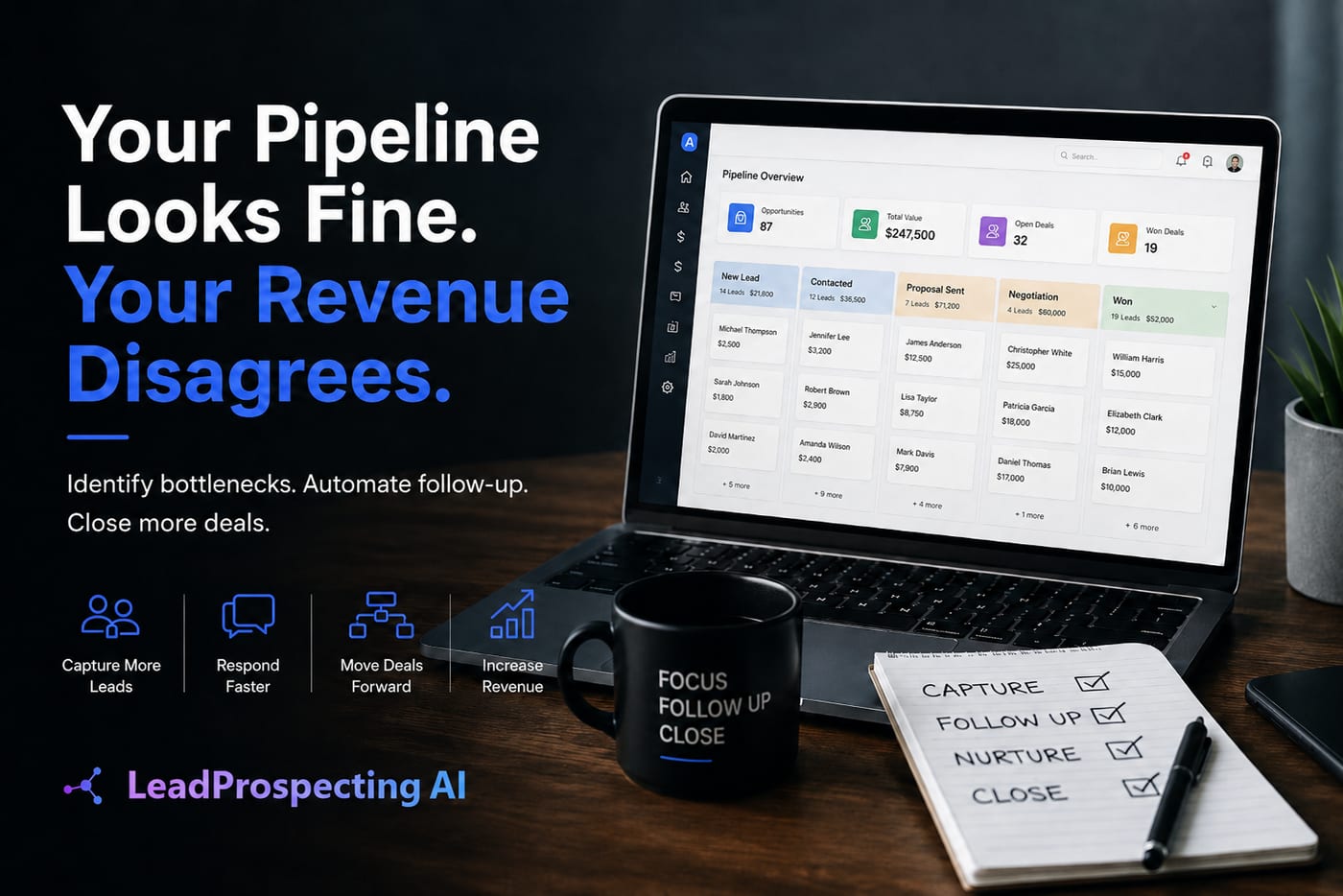
Platforms like LeadProspecting AI solve this by integrating all lead sources into a single inbox. A lead from any channel appears in the same place, triggers the same notification, and enters the same follow-up process. Whether you’re driving between Twin Falls and Gooding or finishing a job in Kimberly, you’re managing everything from one dashboard on your phone.
What Converts a Lead Into a Booked Job?
Speed, professionalism, and systematic follow-up convert leads into booked jobs. The conversion process isn’t mysterious, but it requires consistency that’s difficult to maintain manually.
First, an immediate response acknowledges the lead and sets expectations. Even an automated text saying “Thanks for reaching out. We serve Twin Falls and surrounding areas and will call you within 15 minutes” dramatically improves conversion rates compared to silence. Second, professional communication builds confidence. Customers are evaluating whether you’ll show up on time, do quality work, and stand behind it. Your responsiveness during the sales process signals what they can expect as customers. Third, systematic follow-up catches leads who don’t book immediately. Many Magic Valley homeowners are researching options, comparing prices, or waiting until payday.
The businesses that convert consistently aren’t relying on memory or sticky notes. They’re using automated sequences that ensure every lead receives timely follow-up until they book or explicitly decline.
How Does One Platform Change Everything?
Managing your lead-to-job cycle in one platform eliminates the friction, delays, and data loss that kill conversion rates. This isn’t about having fancier technology. It’s about removing the obstacles between you and booked jobs.
Why Does Integration Beat Multiple Tools?
Integration beats multiple tools because it eliminates the gaps where leads get lost and time gets wasted. When your CRM, scheduling, communication, and invoicing tools all share the same data, everything works together automatically.
Consider what happens when a Jerome homeowner books an appointment in an integrated system. The appointment appears on your calendar. The customer receives a confirmation text. A reminder goes out the day before. After the job, an invoice generates automatically. A review request follows. All of this happens without manual data entry, copy-pasting between systems, or remembering to send follow-ups.
Now consider the disconnected alternative. You manually add the appointment to your calendar. You remember to send a confirmation (sometimes). The reminder might happen if you’ve set it up in whatever scheduling tool you’re using. After the job, you create an invoice from scratch. You probably forgot to ask for a review because you’re already driving to your next call in Filer. Each manual step is an opportunity for something to fall through the cracks.
LeadProspecting AI was built around this integration principle. Rather than forcing small businesses to connect multiple expensive tools, everything works together from day one. The CRM, automation, communication tools, and pipeline management share the same data and trigger each other automatically.
What Should Your Single Platform Actually Do?
Your platform should capture every lead, enable instant response, automate follow-up, manage your schedule, and track what’s actually working. These aren’t nice-to-have features. They’re the minimum requirements for competing in today’s market.
Lead capture means connecting every source where potential customers find you. Instant response means automated acknowledgment even when you’re on a roof in Buhl. Automated follow-up means no lead goes cold because you got busy with emergency calls. Schedule management means seeing your availability and booking jobs without phone tag. Performance tracking means knowing which lead sources generate profitable jobs versus which ones waste your marketing budget.
The platform should also grow with your business. What works for a one-person operation needs to scale when you hire technicians, add service areas, or expand into new trades. Look for platforms designed to scale, with features you might not need today but will need when business doubles.
How Do You Build Credibility Before Customers Call?
You build credibility through visible online presence, consistent reviews, and professional digital touchpoints that customers encounter before they ever contact you. By the time a Twin Falls lead reaches out, they’ve already formed impressions based on what they found online.
Why Do Reviews Matter More Than Advertising?
Reviews matter more than advertising because 87% of customers read reviews before choosing a service provider. You can spend thousands on ads driving traffic to your business, but if prospects find few reviews or negative experiences, that advertising money is wasted.
Reviews serve multiple functions for Magic Valley businesses. They provide social proof that you do quality work throughout the region. They improve your visibility in local search results, since Google rewards businesses with more positive reviews. They answer questions potential customers have about working with you. And they differentiate you from competitors who might be cheaper but lack credibility.
The businesses with hundreds of five-star reviews didn’t get them by accident. They built review collection into their workflow, asking every satisfied customer and making it easy to leave feedback. One contractor using systematic review requests accumulated over 3,000 five-star reviews, making their credibility nearly impossible for competitors to match. For Magic Valley contractors competing in a tight-knit community, that reputation spreads through word of mouth and online visibility simultaneously.
How Can You Automate Review Collection?
You automate review collection by triggering requests at the right moment through the right channel. The ideal time to ask for a review is immediately after completing a successful job, when the customer’s satisfaction is highest.
Automated review requests work better than manual asking for several reasons. They happen consistently, not just when you remember. They arrive through text message, which customers respond to more than email. They include a direct link to your Google review page, removing friction. And they can be personalized with the customer’s name and service details.
Within LeadProspecting AI, review requests become part of your job completion workflow. When a technician marks a job complete in Kimberly, the customer automatically receives a personalized text asking about their experience. If they indicate satisfaction, they get a direct link to leave a Google review. This systematic approach builds reviews steadily without requiring constant attention from you or your team.
The compounding effect transforms your competitive position over time. A business that collects ten reviews monthly has 120 more reviews than its competitors after a year. In a market like Twin Falls, where reputation travels fast, that gap in credibility influences every potential customer comparing options.
The Bottom Line
The lead-to-job cycle determines how many potential customers become paying jobs. Magic Valley businesses managing this cycle through fragmented tools lose leads to competitors who respond faster, follow up consistently, and build credibility systematically. Consolidating everything into one platform removes the friction that kills conversion rates. Every lead flows to one place. Responses happen instantly. Follow-up runs automatically. Reviews accumulate steadily. The Twin Falls, Jerome, Kimberly, Filer, Buhl, and Gooding contractors booking more jobs aren’t working harder. They’re working from a single platform where nothing falls through the cracks.
Frequently Asked Questions
What is the lead-to-job cycle for service businesses?
The lead-to-job cycle is the complete process from when a potential customer first contacts your business until they become a paying customer. It includes lead capture, initial response, follow-up communication, appointment scheduling, service delivery, payment collection, and review requests. For Magic Valley contractors, managing this cycle efficiently determines how many leads convert into revenue.
How fast should Twin Falls businesses respond to new leads?
You should respond to new leads within five minutes whenever possible. Research shows that businesses responding first win 40% more jobs than slower competitors. For contractors serving Twin Falls, Jerome, and surrounding areas, automated instant responses can acknowledge leads immediately even when you’re on a job site.
Why do Magic Valley contractors lose leads to competitors?
Leads fall through the cracks when businesses manage them across multiple disconnected systems. When leads arrive via email, voicemail, text, Google, and Thumbtack without flowing to a central location, some inevitably get overlooked. A unified platform solves this by bringing every lead into one inbox with consistent follow-up processes.
What platforms should integrate with my lead management system?
Your lead management system should integrate with Google Business Profile, lead generation platforms like Thumbtack and HomeAdvisor, your website forms, phone systems, and text messaging. The goal is to capture leads from every source where Magic Valley customers find you and managing them in one place.
How do online reviews affect my ability to book jobs in Twin Falls?
Reviews significantly affect booking rates because 87% of customers read reviews before choosing a service provider. Twin Falls businesses with more positive reviews appear higher in local search results, build more trust with potential customers, and convert leads at higher rates than competitors with fewer reviews.
Can small Magic Valley businesses compete with larger companies on response time?
Yes, small businesses can absolutely compete on response time using automation. Automated instant responses, systematized follow-up sequences, and unified lead management allow a one-person operation in Filer to match or exceed the responsiveness of larger competitors. Technology levels the playing field.
What does an all-in-one platform include for service businesses?
An all-in-one platform includes CRM functionality, lead capture and management, automated communication via email and text, scheduling tools, invoicing capabilities, review management, and performance analytics. Everything shares the same data and works together automatically.
How long does it take to see results from better lead management?
Most businesses see measurable improvements within 30 to 60 days of implementing unified lead management. Faster response times produce immediate results, while benefits from systematic follow-up and review collection compound over several months.
Who can I contact for help setting up lead management in Twin Falls?
LeadProspecting AI serves small businesses throughout the Magic Valley. You can reach our team at 208-432-3964 for a walkthrough of how unified lead management works for your specific trade, whether you’re a plumber, HVAC contractor, landscaper, roofer, or other service business.
LeadProspecting AI partners with FieldServ AI to support service businesses across the full lead-to-job cycle. FieldServ AI offers iOS and Android apps so teams can manage jobs, updates, and field activity from anywhere.
• iOS: Download on the App Store
• Android: Get it on Google Play