You have a great business. You do good work. Your customers are happy. But somehow, the phone isn’t ringing enough, the inbox is quiet, and new customers feel harder to find every month.
You’ve probably tried a few things already. Maybe you boosted a Facebook post, dabbled in Google Ads, or asked a friend to help with your website. Some of it worked for a minute. Most of it didn’t move the needle.
Here’s what nobody tells you: the problem usually isn’t that you need more marketing tactics. The problem is that your online foundation has gaps you can’t see, and every dollar you spend on marketing is leaking through those gaps before it ever turns into a phone call.
This article is going to help you find those gaps. By the time you finish reading, you’ll know exactly where your lead generation is breaking down and what to do about it, starting this week.
The Three Pillars Every Small Business Needs to Generate Leads
Before you spend another dollar on advertising or another hour on social media, you need to understand the three things that determine whether a potential customer contacts you or your competitor.
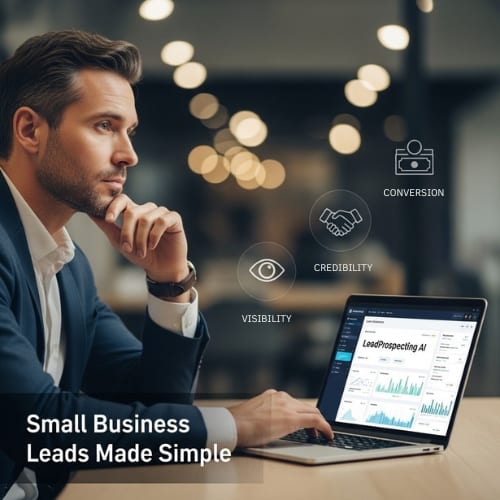
Visibility is whether people can find you at all. When someone searches for what you do, in the place where you do it, do you show up? Not just on Google, but in map results, directory listings, and increasingly in AI tools like ChatGPT and Google’s Gemini. If they can’t find you, nothing else matters.
Credibility is what people see when they do find you. Your website, your reviews, your photos, your Google Business Profile, your social media presence. In about 7 seconds, a potential customer decides whether you look like someone they’d trust with their money. If your online presence looks outdated, incomplete, or unprofessional, they’re moving on to the next option.
Conversion is whether your online presence makes it easy to take the next step. Can they call you with one tap on their phone? Is your contact form simple and fast? Do they know exactly what to do next, or do they have to hunt for a phone number buried in a footer?
Most small businesses are weak in at least one of these areas. Many are weak in all three without realizing it. Let’s walk through each one so you can figure out where your leads are actually getting lost.
Visibility: Can Prospects Actually Find You?
The most common thing we hear from small business owners is “I have a website, so people should be able to find me.” Having a website is the starting point, not the finish line. The question is whether the right people can find you at the moment they’re looking for what you offer.
Google Business Profile is the single highest-ROI asset most small businesses ignore. When someone searches “plumber near me” or “best roofer in my area,” Google shows a map with three businesses listed. That’s called the local pack, and getting into those three spots can be the difference between 5 leads a week and 50. Yet most small businesses have incomplete Google Business Profiles with missing hours, no photos, outdated service descriptions, and zero posts.
Setting up and optimizing your Google Business Profile correctly isn’t complicated, but it does require attention to detail. You need accurate business categories, complete service descriptions, quality photos of your actual work, regular posts showing activity, and consistent business information that matches what’s listed everywhere else online.
Search engine optimization goes beyond your website. Your website needs to be structured so that Google understands what you do, where you do it, and why you’re a credible option. That means every page needs a clear purpose, proper title tags, meta descriptions written for real people, and content that actually answers the questions your customers are asking. If your website is a five-page brochure that says “we offer quality service” with no specifics, search engines have very little to work with.
AI search is the channel nobody is talking about yet. Right now, a growing number of consumers are skipping Google entirely and asking ChatGPT, Gemini, or Perplexity questions like “who’s the best electrician in Denver” or “what should I look for in a roofing company.” These AI tools pull their answers from structured website content, reviews, directory listings, and authoritative online mentions. If your website content is written clearly, answers specific questions, and demonstrates expertise, you have a real shot at being recommended by AI tools. If your online presence is thin, you won’t show up in these results at all. This is where things are going, and businesses that get ahead of it now will have a massive advantage in the next two to three years.
Here’s a quick self-check you can do right now: open an incognito browser window, search for your primary service plus your city, and see where you land. Then open ChatGPT and ask it to recommend a business like yours in your area. The results might surprise you.
Credibility: What Do Prospects See When They Find You?
Getting found is only half the battle. What happens next is where most small businesses lose leads without ever knowing it.
Your website is your digital storefront, and first impressions are brutal. A potential customer who clicks on your site makes a snap judgment based on how it looks, how fast it loads, and whether it immediately tells them they’re in the right place. If your website takes more than three seconds to load on a phone, roughly half your visitors will leave before they see a single word. If the design looks like it was built in 2015, visitors assume your business is just as outdated.
A great small business website doesn’t need to be expensive or complicated. It needs to load fast, look professional on a phone, clearly state what you do and where you do it, show proof that you’re good at it, and make it dead simple to contact you. That’s it. Businesses working with AI-powered design and development tools can now get a website that checks every one of these boxes at a fraction of what agencies charged five years ago.
Online reviews are your most powerful credibility signal. This isn’t a nice-to-have anymore. When a prospect finds two businesses offering the same service and one has 47 reviews at 4.8 stars while the other has 6 reviews at 4.2 stars, the decision is already made. Reviews influence both buyer behavior and search rankings, Google explicitly factors review quantity, quality, and recency into local search results.
The businesses that consistently generate reviews aren’t doing it by hoping customers remember. They have a system. Automated review request sequences that go out via text or email after every completed job are the most reliable way to build review volume without adding work to your plate. A good system sends a friendly request within 24 hours while the experience is fresh, follows up once if there’s no response, and makes leaving a review as easy as tapping a link.
Consistent business information across the internet matters more than you think. If your business name, address, and phone number are slightly different across Google, Yelp, Facebook, the Better Business Bureau, and the 50 other directories where you’re listed, it confuses both search engines and customers. Search engines see inconsistencies and lose confidence in your legitimacy. Customers see different phone numbers and wonder which one is real.
Here’s another self-check: Google your business name in quotes and scan the first two pages of results. Look at every listing that appears. Are your hours correct everywhere? Is the phone number the same? Is your address formatted consistently? Most businesses find at least three or four inconsistencies they didn’t know about.
Conversion: Is Your Presence Turning Interest Into Action?
A prospect found you. They looked at your site and your reviews and decided you seem legit. Now they’re ready to reach out. This is where a shocking number of small businesses fumble the handoff.
Click-to-call has to work perfectly on mobile. More than 60 percent of local searches happen on phones, and the most common action a prospect takes is tapping to call. If your phone number isn’t a clickable link, if it’s buried at the bottom of the page, or if it goes to a voicemail that sounds like it was recorded in a car, you’re losing leads you already earned.
Contact forms need to be short and frictionless. Every additional field you add to a contact form reduces completions. Name, phone or email, and a brief description of what they need. That’s enough to start a conversation. If you’re asking for their mailing address, how they heard about you, and a detailed project description before they can hit submit, you’re creating a barrier that kills conversions.
Live chat and quick response set you apart. Prospects who are actively searching and comparing often go with the first business that responds. If your competitor has a chat widget and responds in 90 seconds while your contact form generates a reply 48 hours later, you’ve lost that lead. Even a simple automated chat that captures their name and question while you’re unavailable is dramatically better than silence.
Lead magnets offer value before asking for commitment. One of the most effective small business lead generation strategies is giving something useful to the prospect before asking them to buy. A free assessment, a checklist, a guide, a cost calculator, or an audit of their current situation. The prospect gets immediate value, you get their contact information, and the relationship starts with generosity instead of a sales pitch. This is the backbone of modern lead generation, and most small businesses haven’t tapped into it at all.
The Tactics That Actually Move the Needle on a Real Budget
Now that you understand where leads get lost, let’s talk about what to prioritize. Because small business owners don’t have unlimited time or money, and doing everything at once is a recipe for doing nothing well.
Fix your foundation first. Before spending a dollar on advertising, make sure your website loads fast, looks professional on mobile, has clear calls to action, and accurately represents what you do. Make sure your Google Business Profile is complete, active, and optimized. Make sure your reviews reflect the quality of your work. This isn’t glamorous, but it’s where the biggest ROI lives because every future marketing effort depends on it.
Invest in content that works while you sleep. Blog posts that answer the real questions your customers ask, service pages that describe exactly what you do in each area you serve, FAQ content that addresses objections before they become deal-breakers. This kind of content builds search visibility over time, feeds AI search tools the information they need to recommend you, and positions you as the knowledgeable option. A consistent content marketing effort, even two to four articles per month, compounds over time in ways that paid advertising never will.
Automate your review generation. Stop relying on customers to remember. Set up automated text or email sequences that request reviews after completed work. This alone can transform your online reputation within 90 days, and the impact on both search rankings and buyer confidence is immediate.
Scale with paid advertising only after your foundation is solid. Google Ads targeting high-intent local searches can be incredibly effective, but only if the landing page is fast, professional, and conversion-optimized. Running ads to a slow website with no reviews is burning money. Once your foundation is strong, even a modest ad budget of a few hundred dollars a month can produce consistent, measurable leads.
Don’t ignore AI discoverability. Structure your website content so AI tools can understand and reference it. Write clear, specific answers to common questions. Use structured data. Build the kind of online presence that AI tools recognize as authoritative. This is not a future consideration. It is happening now, and the businesses that adapt first will capture leads their competitors don’t even know exist.
Where to Start: Finding Your Specific Gaps
The hardest part of improving your lead generation isn’t knowing what to do. It’s knowing what to do first. And that starts with understanding where your business stands right now across visibility, credibility, and conversion.
You can start with the self-checks in this article. Search for yourself, read your own reviews, load your website on your phone, and ask an AI tool about your industry in your area. You’ll learn a lot in 15 minutes.
But if you want the full picture, run a free audit of your online presence. Our AI-powered audit tool analyzes how your business appears across search engines, Google Business Profile, reviews, website performance, and more, then gives you a clear score and specific recommendations you can act on immediately.
It takes less than 60 seconds to start, and the results will show you exactly where your leads are getting lost and what to fix first. No obligation, no sales pitch, just clarity.
Run your free audit now and find out where your business stands.
Take Control of Your Leads Today with LeadProspecting AI
Don’t wait for another potential customer to slip through the cracks. LeadProspecting AI helps small businesses like yours identify exactly where leads are being lost across your website, Google Business Profile, reviews, and more. In under 60 seconds, our AI-powered audit gives you:
• A clear score of your online presence
• Actionable recommendations for improving visibility, credibility, and conversions
• Insights that help your marketing dollars actually produce leads
It’s fast, free, and gives you a roadmap to start generating more leads immediately — no complicated software, no sales pitch, just clarity.
FAQ Section (Add to Bottom of Blog, Above CTA)
How do I generate leads for my small business without a big budget? Start with the free foundations: fully optimize your Google Business Profile, set up automated review requests after every job, and make sure your website loads fast on mobile with a clear call to action above the fold. These three things cost little or nothing and produce the highest ROI for most small businesses. Paid advertising should only come after your foundation is solid so you’re not sending traffic to a site that doesn’t convert.
What is the fastest way to get more leads for a small business? The fastest improvement almost always comes from fixing what’s already broken rather than adding new tactics. Load your website on your phone — if it’s slow, hard to navigate, or the phone number isn’t clickable, you’re losing leads right now. Complete your Google Business Profile with updated photos, hours, and services. Then launch an automated review request sequence. Most businesses see measurable improvement within 30 to 60 days from these three changes alone.
Does my small business need to worry about AI search? Yes, and sooner than most people think. A growing number of consumers are asking ChatGPT, Gemini, and Perplexity for business recommendations instead of using Google. AI tools pull from structured website content, reviews, and authoritative mentions across the web. Businesses with clear, specific, well-organized online content are already getting recommended in AI results. Those with thin online presences are invisible in this channel entirely.
How do I know if my website is actually generating leads? If you can’t point to a specific number of contact form submissions, phone calls, or chat conversations your website produced last month, it’s probably not working as a lead generation tool. A well-built small business website should make it obvious what you do, who you serve, and how to contact you — within 5 seconds of landing on any page. Running a free online presence audit can show you exactly where your site is falling short on visibility, credibility, and conversion.
How important are online reviews for lead generation? Extremely. Reviews influence both whether Google shows your business in local search results and whether a prospect chooses you over a competitor. A business with 40+ recent reviews at 4.5 stars or higher will outperform a competitor with 6 old reviews nearly every time — both in search rankings and in buyer confidence. The key is building a system (ideally automated) that consistently requests reviews while the customer experience is still fresh.
What should I fix first — my website, my SEO, or my advertising? Your website. Always. Everything else drives people to your website, so if the site is slow, outdated, or confusing, every marketing dollar is wasted. After the website, optimize your Google Business Profile and build your review volume. Only then should you invest in SEO content and paid advertising. Think of it as building a house — you don’t paint the walls before pouring the foundation.
FieldServ AI helps small businesses manage jobs, track leads, and grow revenue, all from one smart, easy-to-use platform.