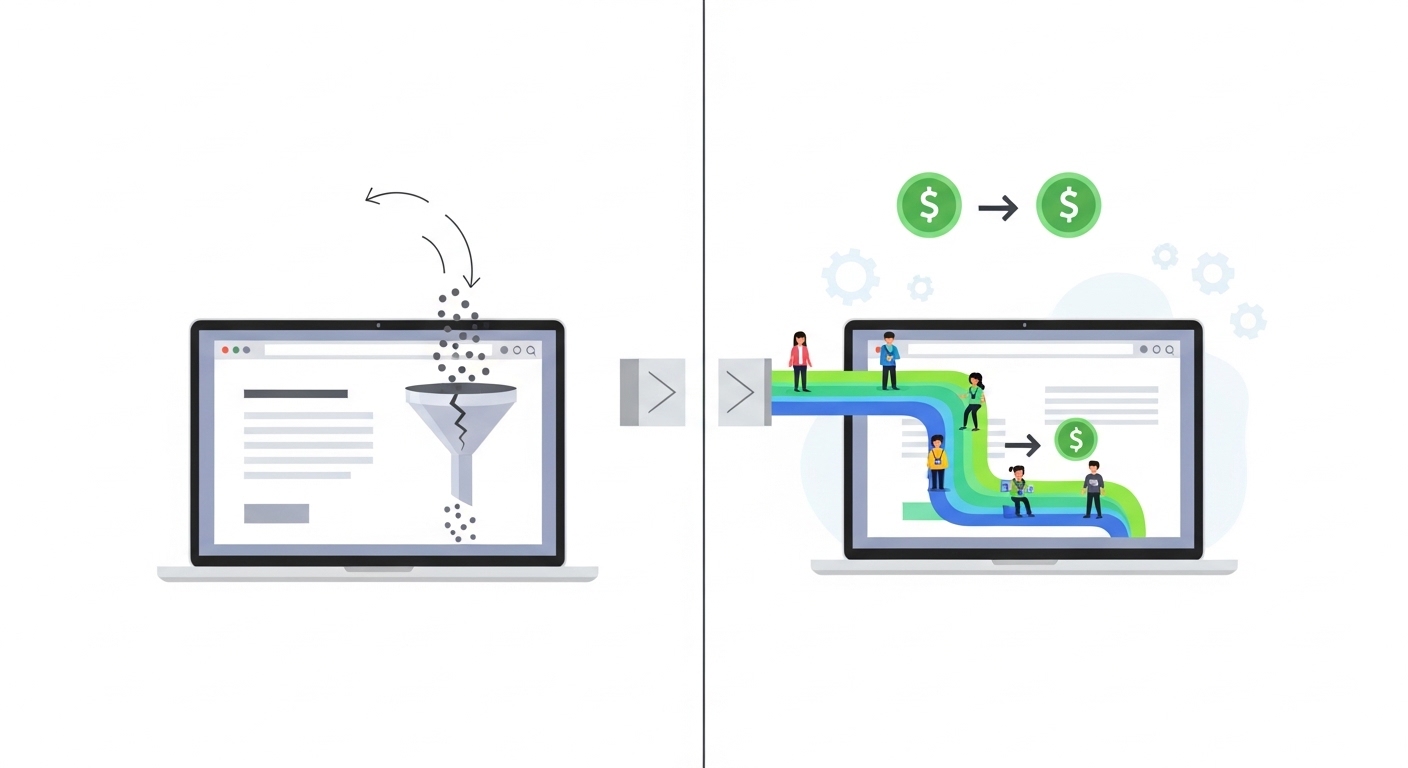
Your Website Is Either Making You Money or Costing You Clients
If you've ever used an ai content writer for business to punch up your website copy, only to realize the site itself was turning visitors away, you already know the problem. A great message trapped inside a mediocre website is like a brilliant salesperson working a broken phone line.
Here's the decision nearly every small business owner faces at some point: do you save money with a drag-and-drop website builder, or do you invest in professional web design and actually build something that converts? The answer isn't as obvious as either side wants you to believe, and getting it wrong costs real money.
Let's break it down with actual numbers, real trade-offs, and a clear framework for making the right call based on where your business is right now.
The Website Builder Promise vs. The Reality
Website builders have gotten genuinely impressive. According to Wix, the global website builder market is projected to reach $2.6 billion in 2026, up 13% from 2025, with Wix alone holding 45% market share across 8 million live sites. That's not a fad. That's a massive, validated market.
And for certain use cases, builders make total sense. A freelance photographer needing a portfolio up by Friday? A builder works. A food truck wanting a simple one-pager with hours and a contact form? Go for it.
But here's where owners get burned. They build a site that looks decent on a laptop, launch it, wait for leads, and hear nothing. So they wonder if it's the marketing, the pricing, the service area. It's often none of those things. It's that the site was never built to convert in the first place.
Template-based sites are designed to look good. They are not designed around your specific conversion goals, your customer's buying psychology, or your local search environment. There's a meaningful difference, and it shows up in your pipeline.
What Professional Web Design Actually Delivers
Let's talk numbers, because this is where the conversation gets serious.
Research from Bent Enterprise found that custom websites deliver 150% or more ROI over three years, compared to just 60 to 80% ROI for template-based sites. That gap compounds. If you're generating 20 leads a month from a custom site versus 9 from a template, you're not just ahead this month. You're building a lead engine that outpaces your competitors every single month going forward.
And according to New Media, every $1 invested in conversion-focused design can yield up to $100 in return, and businesses that invest in UX design see conversion rates improve by up to 400%. That's not a typo. Four hundred percent.
Here's what professional design actually includes that a builder won't do for you by default:
- Conversion architecture: Every page is structured around a specific action you want the visitor to take, not just "looking professional."
- Mobile-first performance: Mobile conversion rates jump 30 to 40% with professional optimization, according to ACS Creative. Builders often deliver mobile-responsive, not mobile-optimized. That's a real distinction.
- Speed and technical SEO: Page speed affects both rankings and bounce rate. A developer fixes this at the code level. A builder gives you a slider.
- Brand trust signals: Strategic placement of reviews, certifications, guarantees, and social proof in spots that actually influence decisions.
- Custom integrations: Your CRM, booking system, payment processor, and forms all talk to each other from day one.
If you're a home service contractor, a med spa, a real estate agency, or a professional services firm, your website is your highest-volume salesperson. Treating it like a cost instead of an investment is a mistake that shows up in your revenue every single month.
Using an AI Content Writer for Business to Maximize Your Web Investment
Here's a nuance that most people miss: even the best-designed website goes stagnant without fresh, strategic content. This is where an ai content writer for business changes the economics completely.
Traditionally, keeping a website active with SEO blog content meant hiring a writer, briefing them constantly, reviewing drafts, and hoping they understood your industry. That process is slow, expensive, and inconsistent. An ai blog writer for business handles ongoing content production at scale, publishing optimized posts that bring in organic search traffic month after month.
At LeadProspecting AI, the website design service and SEO blog content creation work as a connected system. Your site is built to convert, and then it's continuously fed with content that drives the right visitors to it. That's the compounding advantage that template builders and generic content agencies can't replicate.
Think of it this way: the design gets people to stay. The content gets people there. Both have to work, and they have to work together. This is also why we see so many business owners finally get traction after they stop treating their website and their content as separate projects.
If you want to understand how this fits into a broader tech stack built for growth, check out Why Small Businesses Are Consolidating Their Tech Stack (And What It Actually Saves). The pattern is consistent: fewer disconnected tools, better results.
The Real Cost Comparison: Builder vs. Professional (With Honest Math)
Let's run the numbers honestly, because most comparisons cheat in one direction or another.
Website Builder Route (Year 1):
- Builder platform subscription: $200 to $600 per year
- Premium templates or plugins: $100 to $400
- Your time to build and maintain it: 40 to 80 hours (conservatively)
- Content writing or DIY time: ongoing
- Estimated conversion rate: 1 to 2% of visitors
Professional Web Design Route (Year 1):
- One-time design and development investment: $2,500 to $8,000 (varies by scope)
- Hosting and maintenance: $300 to $600 per year
- Your time: minimal after launch
- SEO content and CRM integration: included in a platform like LeadProspecting AI
- Estimated conversion rate: 3 to 6% of visitors
Now apply that conversion rate difference to real traffic. If you get 500 monthly visitors and convert at 1.5% with a builder, that's 7 to 8 leads. At 4% with a professional site, that's 20 leads. If each lead is worth $500 in revenue to your business, that's roughly $6,000 more per month. The site pays for itself in weeks, not years.
Over 70% of small businesses report increased revenue after launching a site, and those with optimized web experiences generate up to 2x more leads, according to Network Solutions. "Optimized" is doing the heavy lifting in that sentence. A builder default is not optimized.
For those managing clients, properties, or recurring service accounts, this also ties directly into your CRM strategy. Whether you're running a crm for agencies managing multiple client pipelines or a crm for real estate agents tracking listings and follow-ups, the website feeding your CRM has to be doing its job. A leaky front end means a dead pipeline no matter how good your backend is. Check out How to Choose the Right CRM in 2026: What Small Businesses Actually Need for a deeper look at how these pieces connect.
How LeadProspecting AI Fits Into This Decision
LeadProspecting AI's professional website design service is not a template shop with a premium price tag. It's a conversion-focused build that integrates directly with the AI-powered CRM, pipeline management, lead capture forms, missed-call text-back, automated review requests, and every other tool in the platform.
When a visitor fills out a form on your site, they land in your pipeline automatically. When they don't call back, your automation follows up. When they become a client, the system requests a review. That's not a website. That's a revenue loop.
The ai blog writer component means your site keeps growing in organic search authority without you writing a single word. And because it's all inside one platform, nothing breaks, nothing requires a developer to reconnect, and your data lives in one place.
You can see exactly how this is structured by visiting the Features page at LeadProspecting AI, or if you're ready to talk specifics, the Services page walks through each component in plain English.
And if you're also thinking about how AI tools are handling other repetitive costs in your business, this breakdown is worth a read: AI Voice Receptionist vs. Hiring: Real Cost Breakdown for 2026. The theme is consistent: smart automation beats manual overhead every time.
Frequently Asked Questions About Web Design ROI for Small Businesses
Q: Can't I just start with a website builder and upgrade later?
Technically yes, but "later" comes with a real cost. Every month you're running a low-converting site is a month of missed leads. Rebuilding later also means paying twice. If your business depends on inbound leads, the math usually favors starting with professional design from the beginning.
Q: How does an ai content writer for business improve my website's ROI?
A well-designed site without consistent content stops growing in search rankings after a few months. An ai content writer for business keeps publishing optimized blog posts that bring in organic traffic month after month. That traffic compounds over time, meaning your cost per lead drops while your lead volume grows. It's one of the highest-ROI activities a small business can do consistently.
Q: What's the realistic timeline for seeing ROI from a professional website?
Most businesses with a conversion-optimized site and consistent SEO content start seeing measurable results within 60 to 90 days. Well-executed redesigns typically show a 15 to 25% conversion rate increase within 6 months, according to ACS Creative. Paid traffic can accelerate results from day one if you're running ads to the site simultaneously.
Q: Does LeadProspecting AI offer both website design and CRM in one package?
Yes. The platform is built specifically so your website, CRM, email marketing, lead capture, and automations all run from a single environment. You can review available plans at the LeadProspecting AI Pricing page, or reach out directly through the contact page to walk through what makes sense for your specific business model.
Q: Is professional web design worth it for a very small or solo business?
It depends on how central your website is to lead generation. If your business relies on people finding you online and contacting you, a low-converting site is actively costing you money every month. If you're purely referral-based and rarely send anyone to your site, a builder placeholder can work short term. But most solo operators who invest in professional design report that it changes how clients perceive and trust them, which affects pricing power and close rates, not just traffic volume.
If you're done guessing and ready to build a website that actually works as part of a connected revenue system, LeadProspecting AI offers professional web design, SEO content, CRM, and automation under one roof. Stop paying for disconnected tools that don't talk to each other. Visit the Services page to see the full picture, or reach out today and let's map out what your business actually needs.