Every Twin Falls business owner faces the same question: Should I spend more on Google Ads to get leads today, or invest in content that builds long-term organic traffic?
It’s a legitimate dilemma. Your marketing budget is finite—probably somewhere between $500 and $2,000 monthly if you’re running a 3-5 person operation. One dollar spent on ads can’t also be spent on blog content. And with Twin Falls’ population growing 17% in the past decade and competition heating up, making the wrong choice feels risky.
Here’s the truth: Both strategies work. But they work differently, deliver results on different timelines, and require different approaches to maximize ROI. This guide breaks down the real numbers, shows you what works specifically for Magic Valley businesses, and gives you a practical framework for deciding where to invest your marketing dollars in 2025.
TL;DR: Quick Answer for Busy Business Owners
Paid ads deliver fast results but stop the moment your budget does. Content marketing takes longer to build momentum—but the ROI compounds over time and keeps working 24/7.
Here’s what Twin Falls businesses need to know:
- Paid advertising works best for immediate needs—new business launches, seasonal promotions, or testing new services. Expect $8-15 per click locally for contractor keywords, with leads stopping when your budget runs out.
- Content marketing costs 62% less per lead and generates 3x more leads per dollar spent long-term, but requires 3-6 months to gain traction.
- For most Magic Valley businesses, a blended approach delivers the best results: 60% content investment for long-term authority, 40% paid ads for immediate visibility and quick wins.
This post shows real ROI comparisons, Twin Falls-specific data, 12-month projections, and how automation helps you maximize both strategies without doubling your workload.
The Appeal of Paid Advertising: Speed and Simplicity
Let’s start with why paid ads are so tempting for Twin Falls contractors, remodelers, and service businesses.
Immediate visibility. Launch a Google Ads campaign this morning, and you’re showing up at the top of search results by this afternoon when homeowners search “emergency plumber Twin Falls” or “HVAC repair near me.” There’s no waiting, no patience required—just budget, targeting, and leads.
Measurable results. You spend $1,000, you get X clicks, Y leads, Z customers. The math is straightforward. If your average job ticket is $300 and you close 25% of leads, you know exactly how many leads you need to break even. This clarity appeals to business owners who think in numbers.
Budget control. Set your daily spend at $30, and Google won’t charge you $31. Pause campaigns when you’re booked solid, resume when you have capacity. This flexibility matters in Twin Falls where seasonal demand fluctuates—winter pipe emergencies, summer AC failures, spring roofing projects.
Precise targeting. Want to reach homeowners in Twin Falls proper but not Jerome? Done. Target people searching during business hours or after-hours emergencies? Easy. Facebook and Google let you narrow your audience to almost absurd specificity.
Real Twin Falls Paid Ads Example
A local HVAC company runs Google Ads targeting “furnace repair Twin Falls” and “emergency heating Magic Valley” during winter months. At $12 per click average, their $1,500 monthly budget generates about 125 clicks. With a 20% conversion rate (industry standard), that’s 25 leads. If they close 40% of those at $350 average ticket, that’s $3,500 in revenue from $1,500 spend—a healthy 233% ROI.
But here’s the catch: In February when they pause the campaign because they’re fully booked, the leads stop completely. All that momentum? Gone. The next winter, they start from zero again.
The Pros and Cons of Paid Advertising
Pros:
- Immediate lead generation (hours, not months)
- Highly measurable and trackable
- Precise audience targeting
- Scalable up or down based on capacity
- Great for testing new service offerings or markets
Cons:
- Stops completely when budget runs out (zero residual value)
- Rising costs—CPCs increased 10% in 2024 across industries
- No long-term brand equity built
- Requires ongoing investment to maintain results
- Ad fatigue and banner blindness (70-80% of users ignore paid ads)
- Competitive keywords like “plumber Twin Falls” cost $8-15 per click locally
For Twin Falls businesses, paid ads work best as a short-term accelerator, not your only marketing strategy. Think of them like renting visibility—the moment you stop paying rent, you lose the space.
Content Marketing vs Paid Advertising ROI: The Numbers Behind the Strategy
Now let’s talk about content marketing—the long game that pays compound interest.
Content marketing means creating valuable information that attracts your ideal customers organically: blog posts answering common questions, how-to guides, seasonal checklists, local area guides, case studies, and videos. Instead of paying Google for every click, you earn those clicks by ranking in organic search results.
The ROI timeline looks completely different from paid ads.
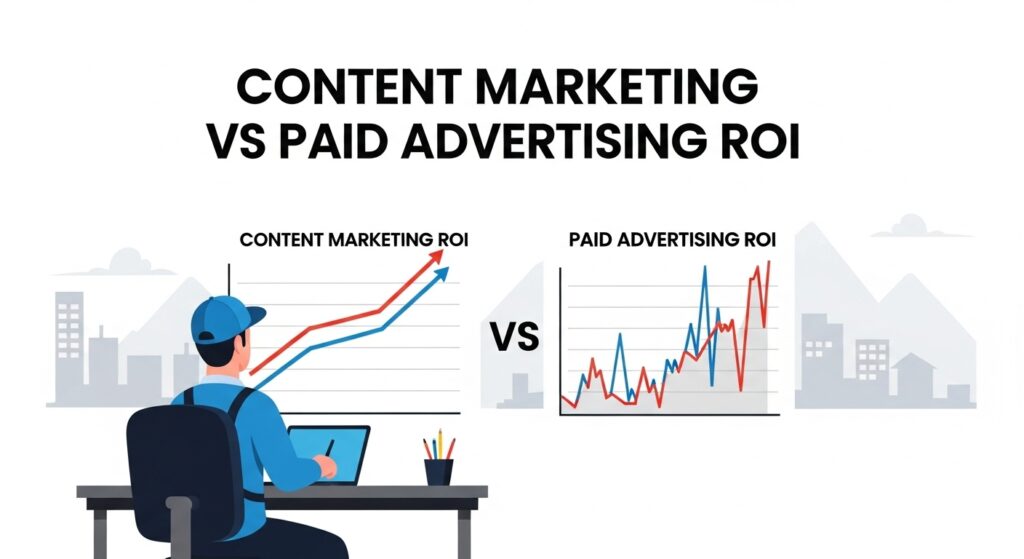
The Real ROI Difference: A 12-Month Comparison
Let’s use real numbers for a Twin Falls contractor with a $1,500 monthly marketing budget.
Scenario A: 100% Paid Ads ($1,500/month)
- Month 1: $1,500 spend ÷ $12 CPC = 125 clicks → 25 leads → 10 jobs → $3,000 revenue
- Month 6: $1,500 spend ÷ $12 CPC = 125 clicks → 25 leads → 10 jobs → $3,000 revenue
- Month 12: $1,500 spend ÷ $12 CPC = 125 clicks → 25 leads → 10 jobs → $3,000 revenue
- 12-Month Total: $18,000 spent → 300 leads → 120 jobs → $36,000 revenue
- ROI: 200%
- When budget stops: Leads stop immediately
Scenario B: 100% Content Marketing ($1,500/month for 6 months, then $500/month maintenance)
- Month 1: Publish 3 blog posts → 50 visits → 5 leads → 2 jobs → $600 revenue
- Month 3: 6 total posts now ranking → 180 visits → 18 leads → 7 jobs → $2,100 revenue
- Month 6: 12 posts + improved rankings → 450 visits → 45 leads → 18 jobs → $5,400 revenue
- Month 9: Content compounding → 650 visits → 65 leads → 26 jobs → $7,800 revenue
- Month 12: Mature content strategy → 800 visits → 80 leads → 32 jobs → $9,600 revenue
- 12-Month Total: $10,500 spent → 425 leads → 170 jobs → $51,000 revenue
- ROI: 486%
- When investment stops: Content continues generating leads indefinitely
The difference? Content marketing costs 62% less per lead and delivers 41% more total jobs over 12 months. More importantly, those blog posts you published in Month 2 are still driving traffic in Month 24, Month 36, and beyond—no additional spending required.
Why Content Marketing Wins Long-Term
Industry data backs this up. Content marketing generates three times more leads per dollar spent than traditional advertising. B2B marketers report that 70% believe SEO is more effective than PPC in driving sales. And approximately 70-80% of internet users ignore paid ads in search results entirely—they’re clicking organic listings.
For Twin Falls businesses specifically, here’s what this means: When a homeowner in Jerome searches “how to prevent frozen pipes” in November and finds your comprehensive guide, you’ve just earned trust and top-of-mind awareness. When their pipes actually freeze in January, who do they call? The plumber whose helpful blog they remember, or a random Google Ad?
Content builds authority. Paid ads build awareness. Authority converts better and lasts longer.
A Twin Falls Content Marketing Success Story
A Magic Valley plumbing company invested $2,400 over four months to create eight high-quality blog posts: “Winter Pipe Prevention Guide,” “What to Do When Your Furnace Leaks,” “Twin Falls Water Heater Replacement Cost Guide,” and similar topics.
By Month 6, those posts ranked on page 1 for multiple keywords. By Month 12, they were generating 40 leads monthly—without any additional spending. At a 30% close rate and $350 average ticket, that’s $4,200 in monthly revenue from a one-time $2,400 investment. That’s a 2,100% ROI over 12 months, and it keeps compounding.
The best part? That content continues working while the owner focuses on actual plumbing work, not constant ad management.
Why Twin Falls Businesses Should Care About Organic ROI
Let’s bring this home to Magic Valley specifically.
Twin Falls isn’t Boise. You’re not competing with 500 contractors for every keyword. This is actually an advantage—your content can rank faster and cost less to produce because the competition is lighter. But search volume is also smaller, which means every organic ranking you earn is proportionally more valuable.
Here’s the local context that matters:
Twin Falls population has grown 17% in the past decade to nearly 57,000 people. The Magic Valley region has roughly 189,000 residents. That’s enough search volume to sustain multiple successful contractors, but small enough that dominating page 1 of Google is actually achievable within 6-12 months for local businesses.
Local search behavior drives this strategy. When a Twin Falls homeowner searches “plumber near me” or “best HVAC company Magic Valley,” Google shows three types of results:
- Paid ads (top 2-3 spots—whoever pays the most)
- Local map pack (top 3 Google Business Profiles with reviews)
- Organic results (websites that rank based on content quality and authority)
Most clicks go to the map pack and organic results. If your business shows up in both—with great reviews in the map pack AND helpful blog content in organic results—you own the entire search experience without paying per click.
The trust factor matters here too. Twin Falls has a tight-knit business community. Word-of-mouth and reputation drive referrals. When your content consistently helps people solve problems (even before they hire you), you build the kind of local authority that turns into loyal customers and referrals.
The Magic Valley Economic Reality
Let’s talk budgets honestly. Most Twin Falls contractors allocate $500-2,000 monthly to marketing—maybe 5-8% of revenue for a healthy business. National averages show small businesses spend 85% of marketing budgets under $10,000 total, and local businesses typically put 5-10% of revenue into digital marketing.
If you’re spending $1,200/month and putting it all into Google Ads, you’re stuck on a treadmill—running constantly just to stay in place. The moment you step off, visibility disappears.
But if you allocate even 60% of that budget ($720) to content creation for six months, you build an asset that generates leads while you sleep, work job sites, or take time off. The other 40% ($480) keeps immediate paid ad visibility running for urgent needs and seasonal peaks.
This is how smart Twin Falls businesses compete with bigger Boise operations without matching their ad budgets dollar-for-dollar.
Automation: The Missing Link Between Both Strategies
Here’s where most businesses stumble: They treat paid ads and content marketing as separate universes. Someone clicks your ad? They fill out a form and… then what? Someone reads your blog post? They visit once and disappear.
Marketing automation connects both strategies and multiplies your ROI.
Think of it this way: You paid $12 for that ad click, or you invested $200 creating that blog post that earned the organic visit. Either way, that visitor is valuable. But only 2-5% of website visitors take action on the first visit. The other 95-98% leave—and most never return unless you give them a reason to.
This is where platforms like LeadProspecting.ai bridge the gap. When someone clicks your ad or reads your content:
- They automatically get added to a nurture sequence tailored to their interest
- If they don’t book, they receive helpful follow-ups (not pushy sales pitches)
- If they abandon a form, they get a gentle reminder
- If they book a service, they’re added to seasonal maintenance reminders
The result? That $12 ad click or organic visit doesn’t get one chance to convert—it gets multiple touchpoints over weeks or months, dramatically improving your overall ROI.
Real Example: Automation Boosting Both Channels
A Twin Falls HVAC company runs both Google Ads and publishes monthly blog content. Before automation, their conversion rates were:
- Paid ads: 20% (industry standard)
- Organic blog traffic: 10% (also standard)
After implementing automated follow-up sequences:
- Paid ads: 28% conversion (40% improvement)
- Organic traffic: 16% conversion (60% improvement)
Why the bigger jump for organic? Because organic visitors are earlier in their research journey—automation gave them time to warm up through helpful emails, seasonal reminders, and trust-building content.
The math: Their $1,500 monthly combined budget (ads + content) went from generating 35 leads to 52 leads—a 48% increase with zero additional ad spend. That’s the automation multiplier effect.
For field service businesses especially, combining LeadProspecting.ai’s marketing automation with FieldServ.ai’s job management creates a complete ecosystem—from initial lead capture through job completion to review requests and future rebooking. Every customer touchpoint is optimized without requiring manual effort.
How Twin Falls Businesses Can Blend Content and Ads for Maximum ROI
Most businesses don’t need to choose between content and paid ads—you need a strategic blend based on your goals, budget, and growth stage.
The Blended Strategy Framework
For New Businesses (First 6 Months):
- 70% paid ads, 30% content
- Why: You need immediate visibility and leads to build cash flow
- Use ads to test messaging, identify your best customer segments, and generate revenue
- Use content to start building SEO foundation (even if it doesn’t rank yet)
For Growing Businesses (Year 1-2):
- 50% content, 50% paid ads
- Why: Balance immediate leads with long-term asset building
- Ads fund operations while content gains traction
- As content starts ranking, gradually shift budget allocation
For Established Businesses (Year 3+):
- 70% content, 30% paid ads
- Why: Your content generates most organic leads; ads supplement for specific needs
- Use ads tactically for seasonal campaigns, new service launches, or geographic expansion
- Content maintains your market dominance with minimal ongoing investment
For Mature Businesses (Market Leaders):
- 85% content, 15% paid ads
- Why: Your organic authority drives most leads automatically
- Ads only for competitive defense or experimental campaigns
- Content budget focuses on maintaining rankings and expanding into adjacent topics
A Practical Twin Falls Implementation Plan
Let’s say you’re a 3-tech plumbing company with $1,200 monthly marketing budget. Here’s your 12-month roadmap:
Months 1-3: Foundation Building (60% Ads / 40% Content)
- Paid ads: $720/month targeting high-intent keywords (“emergency plumber Twin Falls”)
- Content: $480/month—create 2 comprehensive blog posts monthly
- Goal: Generate immediate leads while establishing content foundation
Months 4-6: Momentum Shift (50% Ads / 50% Content)
- Paid ads: $600/month—maintain visibility but reduce spend slightly
- Content: $600/month—now publishing 3 posts monthly, updating old content
- Goal: First blog posts start ranking, organic traffic begins growing
Months 7-9: Content Traction (40% Ads / 60% Content)
- Paid ads: $480/month—tactical campaigns only (seasonal, emergency services)
- Content: $720/month—aggressive content production, local SEO optimization
- Goal: Organic leads now generating 30-40% of total pipeline
Months 10-12: Optimization (30% Ads / 70% Content)
- Paid ads: $360/month—specific campaigns, competitive keywords only
- Content: $840/month—content maintenance, expanding into adjacent topics
- Goal: Organic leads generating 60%+ of pipeline, ads supplement strategically
Year 2+: Maintenance (20% Ads / 80% Content)
- Paid ads: $240/month—defensive campaigns, new service testing
- Content: $960/month—market dominance, expanding geographic reach
- Goal: Content generates most leads; ads used for specific tactical needs only
Which Tasks to Automate in a Blended Strategy
When running both paid ads and content simultaneously, automation becomes critical:
Automate These:
- Lead capture from both ad clicks and blog readers
- Follow-up sequences tailored to traffic source (ad vs. organic)
- Review requests after job completion (builds SEO and ad credibility)
- Seasonal campaign emails (promotes both content and service offerings)
- Retargeting ads to blog readers who didn’t convert
- Social media sharing of blog content
Keep Manual:
- High-value proposal calls
- Complex consultations
- Relationship-building with commercial accounts
- Networking in local chambers and business groups
The goal isn’t to automate everything—it’s to automate repetitive touchpoints so you can focus on high-value interactions that close deals.
When to Choose What: The Decision Framework
Still not sure how to allocate your budget? Use this decision tree:
Choose Paid Ads When:
You need immediate results (new business, cash flow urgency, seasonal opportunity)
- Example: It’s October, furnace season is starting, you need leads NOW
You’re testing a new service offering
- Example: Launching water heater installation, unsure of demand
- Test with ads before investing in content
You have a specific promotion or event
- Example: “Winter tune-up special—$99 through November”
- Ads drive urgency; content can’t
Your market is highly competitive
- If 10 competitors rank organically, ads guarantee visibility
- Twin Falls generally isn’t this competitive, but specific niches might be
You have conversion optimization dialed in
- If your website converts well, ads are a straightforward scaling lever
Choose Content Marketing When:
You want long-term, sustainable growth
- Example: Building a business for the next 10-20 years
- Content compounds; ads don’t
Your budget is limited but time isn’t
- You can write content yourself or trade time for agency fees
- Content has lower monthly costs but requires patience
You’re in a complex, education-heavy service
- Example: Geothermal HVAC installation—customers need education
- Content builds trust through expertise
Your competitors aren’t investing in content
- Twin Falls opportunity: many local contractors have outdated or no blogs
- First-mover advantage in content marketing is significant
You want to build brand authority and trust
- Helpful content positions you as the local expert
- Especially valuable in relationship-driven markets like Magic Valley
Choose Both (Blended Approach) When:
You have a reasonable budget ($1,000+/month)
- Allows meaningful investment in both channels
You’re in year 1-3 of business growth
- Need immediate leads AND long-term foundation
You operate in a seasonal business
- Ads for peak season immediate needs
- Content for off-season research and planning
You want maximum market coverage
- Dominate both paid and organic search results
- This is the ultimate competitive advantage
For most Twin Falls contractors, HVAC companies, remodelers, and service businesses, the blended approach delivers the best results. You’re not choosing between short-term survival and long-term success—you’re building both simultaneously.
Real ROI: What 88% of Businesses Are Doing in 2025
Let’s look at what the data shows about actual business decisions.
Nearly half (45%) of marketers report their content marketing budget will increase in 2025. Meanwhile, 88.2% of businesses expect content marketing budgets to grow or stay the same—up from just 54.5% in 2024. This massive shift reflects a fundamental realization: content works, and the ROI is too good to ignore.
At the same time, paid advertising hasn’t disappeared. Digital marketing spending accounts for 57.1% of total marketing budgets, with paid ads typically taking 10-20% of marketing budget in stable years, increasing to 30-40% for businesses in active growth mode.
The pattern? Successful businesses aren’t abandoning paid ads—they’re rebalancing toward content while using ads strategically rather than as their only lead source.
For Twin Falls specifically, this means you’re not behind the curve by investing in content now—you’re actually ahead of most local competitors who are still 100% reliant on paid advertising or outdated word-of-mouth alone.
The Founder’s Club Advantage
For Magic Valley businesses serious about maximizing both strategies without the complexity of managing multiple platforms, the Founder’s Club offers an integrated approach. Instead of juggling separate tools for content management, ad tracking, lead nurturing, job scheduling, and customer follow-up, you get a unified system designed specifically for service businesses.
Members receive priority onboarding, exclusive training on blending content and paid strategies effectively, and access to both LeadProspecting.ai’s marketing automation tools and FieldServ.ai’s field operations management—creating a complete business growth engine from initial lead through completed job and ongoing customer relationships.
It’s the difference between hoping your marketing works and knowing exactly what’s driving results.
Take Action: Build Your Marketing ROI Engine
Here’s what we’ve covered: Content marketing vs paid advertising ROI isn’t really a versus proposition—it’s about strategic allocation based on your business stage, budget, and goals.
Paid ads deliver immediate visibility and predictable lead flow, but stop the moment your budget runs out. They’re best for new businesses, seasonal promotions, and tactical campaigns where urgency matters.
Content marketing costs 62% less per lead, generates 3x more leads per dollar long-term, and builds compounding equity that works 24/7 for years. It’s best for sustainable growth, market authority, and businesses playing the long game.
For most Twin Falls contractors and service businesses, the winning formula is:
- Start with 50-60% content investment to build long-term foundation
- Supplement with 40-50% paid ads for immediate leads and tactical campaigns
- Use automation to maximize ROI from both channels
- Shift allocation over time as content gains traction
The numbers don’t lie: Businesses that blend both strategies, track their ROI accurately, and automate the repetitive touchpoints consistently outperform those married to a single approach.
Ready to stop guessing and start measuring your marketing ROI? Whether you’re currently spending 100% on ads and wondering why it feels like a treadmill, or you’ve tried content without seeing results because you lacked the right system, it’s time for a data-driven approach.
Get a free marketing ROI assessment to see exactly where your dollars are going and where they should go. Or explore the Founder’s Club to implement a complete marketing and operations system built specifically for growing service businesses in markets like Twin Falls—no expensive agencies, no complex tech stacks, just proven tools that work.
The Magic Valley economy is growing. Your marketing strategy should grow smarter, not just bigger.
Frequently Asked Questions
1. What’s the main difference between content marketing and paid ads for local businesses?
Paid advertising delivers immediate visibility by placing your business at the top of search results or in social feeds, but you pay for every click and leads stop when spending stops. Content marketing earns visibility organically by creating valuable information that ranks in search results, costs 62% less per lead long-term, and continues generating traffic 24/7 even after you stop investing. Paid ads are renting visibility; content is building equity.
2. How long before content marketing starts showing ROI?
Most Twin Falls businesses see initial traction within 3-4 months (first rankings and organic leads), meaningful ROI by month 6 (content generating 20-30% of total leads), and full ROI within 12 months (content often outperforming paid ad spend). The timeline depends on content quality, consistency, competition level, and how well you target local search intent. Early wins come from low-competition local keywords like “plumber Buhl” or “HVAC maintenance Magic Valley.”
3. Is paid advertising still worth it for Twin Falls small businesses?
Yes, especially for immediate needs, seasonal campaigns, and new businesses building cash flow. Paid ads work best as part of a blended strategy—use them to generate leads today while your content builds authority for tomorrow. Local CPCs for contractor keywords run $8-15 in Twin Falls (lower than Boise), making ads more affordable here than in major metros. The key is not relying 100% on paid ads, because you’re building zero long-term assets.
4. How can I track my ROI more accurately?
Track these key metrics separately for paid ads and content: cost per lead (total spend ÷ leads generated), lead-to-customer conversion rate, average customer value, and customer lifetime value for repeat services. Use UTM parameters to identify which blog posts or ads drive actual bookings. Set up conversion tracking in Google Analytics and your CRM. Review monthly: if paid ads generate leads at $40 each and content generates them at $15 each, you know where to allocate budget.
5. What’s the best mix of paid ads and content for a Twin Falls service company?
For most established service businesses (year 2+), allocate 60% to content creation and maintenance, 40% to paid advertising for tactical campaigns. New businesses should start 50/50 or even 60/40 favoring ads for immediate cash flow, then shift toward content as rankings improve. Seasonal businesses should increase ad spend during peak seasons, then invest heavily in content during slow periods to build authority for next year’s busy season.
6. Does Google favor paid ads or organic content more in 2025?
Google’s algorithm prioritizes user experience—the best answer to the search query wins, whether paid or organic. However, 70-80% of users skip paid ads entirely and click organic results, and organic listings get significantly more clicks than ads in the long tail. Google also updates its algorithm to reward helpful, high-quality content, which benefits businesses investing in genuine value rather than just bidding for ad placement. Both can win; organic content just tends to win more cost-effectively over time.
7. How can automation improve content marketing ROI?
Automation turns one-time blog readers into long-term leads through nurture sequences. When someone reads your “Winter Pipe Prevention” blog in September, automation can follow up with seasonal maintenance offers, winter prep checklists, and emergency service reminders throughout the cold months—without manual effort. This increases blog content conversion rates from typical 5-10% to 15-20%+. Automation also schedules social sharing, sends review requests that boost content SEO, and segments leads based on content topics they engaged with.
8. How much should Twin Falls businesses budget for content vs ads?
Most Twin Falls service businesses allocate $500-2,000 monthly total to marketing (5-8% of revenue). A healthy split: $700-1,200 for content creation (blog posts, local guides, video content) and $300-800 for paid ads (Google Search, Facebook, seasonal campaigns). Start with 50/50 if unsure, track results for 90 days, then reallocate based on which channel delivers better cost-per-lead. Many businesses find they can reduce ad spend by 30-40% once content gains traction while maintaining or increasing total lead volume.
9. What’s the most common marketing mistake small Idaho businesses make?
Putting 100% of budget into paid ads with zero content investment. This creates complete dependence on ad platforms—when CPCs rise (they increased 10% in 2024), your costs go up with no alternative lead source. The second biggest mistake is creating content without a distribution strategy—publishing blogs but not optimizing for local search, not promoting on social media, and not using automation to nurture blog readers into leads. Successful businesses blend both channels and connect them with automation.
10. How can LeadProspecting.ai help improve ROI for content and paid campaigns in Twin Falls?
LeadProspecting Ai creates unified tracking across both channels so you can see exactly which blog posts and ads drive actual customers, not just clicks. The platform automates follow-up sequences for both ad clicks and content readers, dramatically improving conversion rates from both sources. Built-in analytics show cost-per-lead by channel, helping you reallocate budget to highest-ROI sources. For service businesses also using FieldServ.ai, the integration provides complete visibility from initial marketing touchpoint through completed job—letting you calculate true customer acquisition costs and lifetime value accurately.