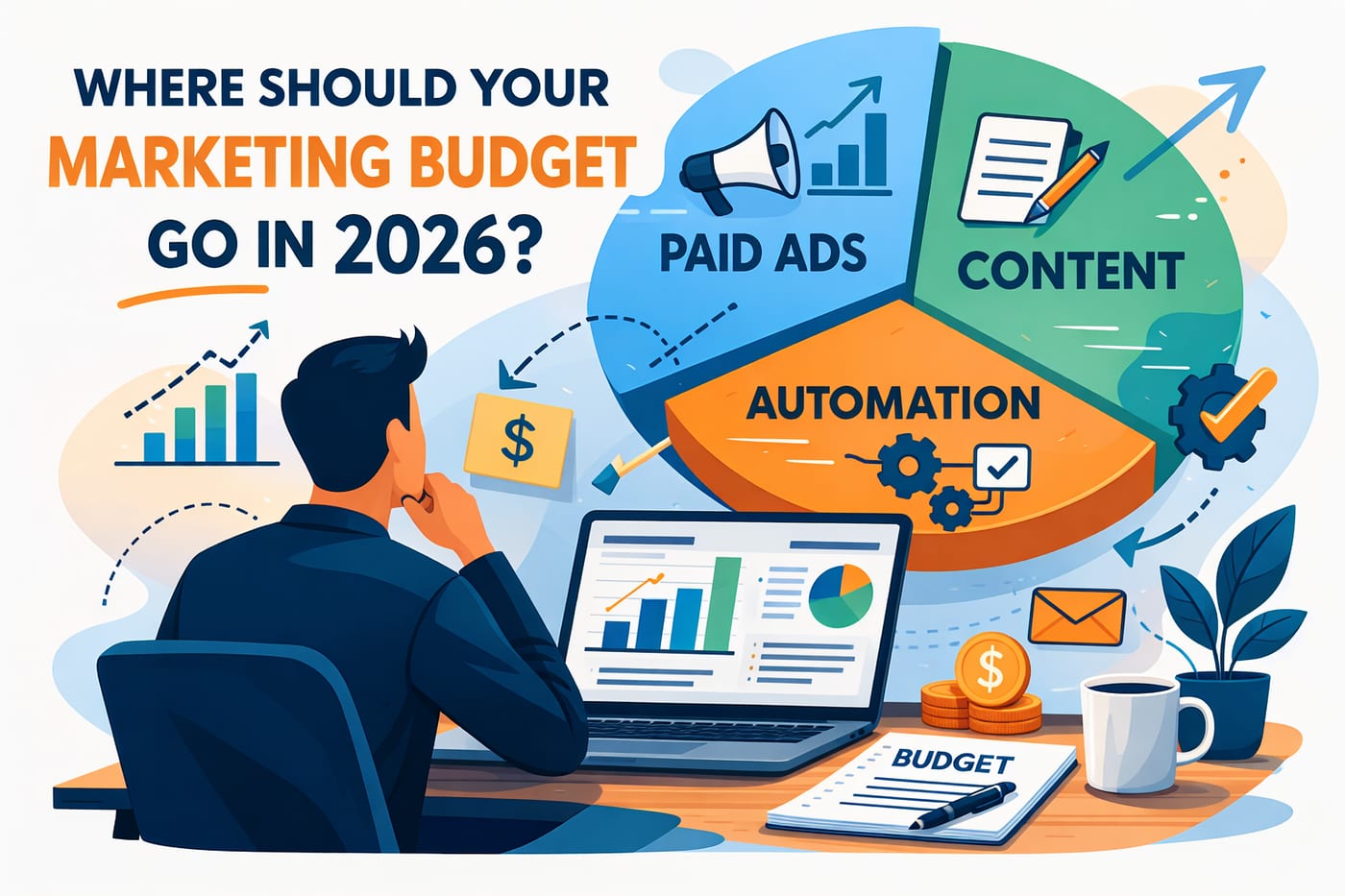
It's January, and you've got a marketing budget for Q1 2026, maybe $5,000, maybe $50,000. You know you need leads, but you're staring at three choices: paid ads, content creation, and automation. The question isn't which one works. It's which mix actually moves revenue for your business right now.
Most Twin Falls business owners default to throwing money at Google and Facebook ads because results show up fast. But speed isn't the same as profit. In our years serving small businesses across Idaho and nationwide, we've watched owners waste 40 to 60% of ad spend on poor targeting, dead leads, and no follow-up system. The missing piece isn't always more ads. It is strategy, content that converts, and automation that stops leads from falling through the cracks.
Here's what this post covers: the real budget breakdown that works for growing businesses, where your first dollar should go, and how to measure what actually drives revenue.
The Broken 3-Way Split (And Why It Doesn't Work)
Most marketing advice suggests splitting the budget equally: 33% ads, 33% content, 33% tools. That's wrong for small businesses. Equal splits assume equal maturity, which you don't have.
If you have no lead system, paid ads just generate expensive noise. If you have no content, you can't rank for organic traffic or build trust with cold leads. If you have no automation, you're losing 70% of leads because follow-up depends on someone remembering to call back.
The right split depends on where you are right now. Let's break this into three scenarios:
Budget Split by Business Stage: The Real Numbers
If You're Just Starting (Under 5 Employees, Under $500K Revenue):
Content + SEO
Allocate about 50% of your marketing budget here. A blog post typically costs $200 to $500 to write and publish. Over 12 months, that investment compounds into traffic that does not cost more per click. One post ranking for local searches can generate 5 to 15 qualified leads per month, which often beats paid ads for long-term ROI.
Automation + CRM
Invest roughly 30% of your budget into CRM and automation. You cannot afford to lose leads because of poor follow-up. A CRM platform with automation ensures every lead receives consistent follow-up through email sequences, appointment reminders, and triggered workflows. Typical platforms cost $99 to $300 per month, but they can increase conversions from existing leads by 40 to 60%.
Paid Ads
Reserve about 20% of your marketing budget for paid advertising. Ads work best once your funnel is already converting. Use them primarily for retargeting and lead generation once your system is in place. Running ads too early often wastes budget because there is no optimized conversion process behind them.
If You're Growing (5–15 Employees, $500K–$3M Revenue):
Content + Social
Allocate about 40% of your marketing budget to consistent content and visibility. Blog posts, social media scheduling, and email newsletters all work together to keep your brand in front of prospects. At this stage, the goal is not just traffic but authority. Consistent marketing compounds over time and builds trust that paid ads alone cannot create.
Paid Ads
Reserve about 35% of your marketing budget for paid advertising. At this stage, your system is already working, so ads should be used to scale what is converting. If your content converts at around 3%, ads can feed more traffic into that system and increase lead volume. Expected cost per lead typically ranges from $15 to $40, depending on the industry and targeting.
Automation + Tools
Invest roughly 25% of your marketing budget into automation and operational tools. This includes CRM systems, email warming tools, lead scrapers for verified contact data, SMS follow-up, and appointment scheduling. These systems allow your team to handle more leads and increase output without adding additional headcount.
If You're Scaling (15+ Employees, $3M+ Revenue)
Paid Ads
Allocate about 40% of your marketing budget to paid advertising. At this stage, your systems are mature enough to test, fail, and optimize campaigns. Your conversion rate is usually stable enough that customer acquisition cost (CAC) becomes predictable, allowing you to scale traffic confidently.
Content
Invest roughly 30% of your marketing budget into content. Instead of publishing isolated blog posts, focus on building content ecosystems such as pillar pages, lead magnets, webinars, and case studies. Each asset should feed both your paid and organic marketing channels.
Advanced Automation + Team
Dedicate about 30% of your budget to advanced automation and marketing operations. This can include marketing automation platforms, analytics tools, dedicated marketing operations support, and integrations across your entire technology stack.
The pattern is clear. Earlier-stage businesses need organic reach and automation leverage because they cannot afford wasted ad spend. Scaling businesses can afford to buy traffic because their systems convert that traffic efficiently.
Where Your First Dollar Should Actually Go in Q1 2026
If you're not sure which category you fall into, start here: Don't build the system you want. Fix the system you have.
Walk through your last 10 leads. How many did you convert? How many did you lose track of? If the answer is "way too many fell through the cracks," you're not a content problem or an ads problem; you're a follow-up problem. Before you spend money on new leads, plug the leaks in your existing funnel.
For Twin Falls businesses and service contractors, especially, this matters. Home services, dental practices, and local B2B depend on fast response and consistent contact. One qualified lead that's followed up costs $0 more to convert than one that's ignored. That's where your first dollar goes: into a system that tracks every lead and automates the follow-up.
After that, ask: What's your biggest visible gap?
- No organic search visibility? Start with content. One blog post per week costs $800–2000/month for outsourcing. In 6 months, you'll see organic traffic compound. For Twin Falls small businesses, local SEO content is massively underused; your competitors aren't doing it, which means the opportunity is wide open.
- No email list or nurture system? Start with email warming and drip campaigns. A warmed email domain with consistent inbox placement turns cold outreach into conversation. Cost per lead drops dramatically when the email actually lands.
- Getting leads but not converting? Start with paid retargeting ads ($500/month) and automation sequences. Make sure every lead gets 5+ touches before you give up on them.
The Hidden Cost Nobody Talks About: Switching Costs
Here's what kills Q1 budgets: tool sprawl. You're paying $99 for CRM, $199 for email marketing, $150 for social scheduling, $300 for ads management, and $200 for lead gen. That's $950/month for a system that doesn't talk to each other. Leads live in one tool, follow-ups happen in another, and social posts are scheduled in a third. Your team spends 10 hours per week on data entry and manual handoffs.
In our experience, consolidating to an all-in-one platform saves 30–40 hours per month of admin work. That's 1–2 hours per day your team doesn't spend copying data between tools. At $25/hour labor, that's $750–1500/month in payroll you just saved by paying for one platform instead of five fragmented ones.
When you're allocating Q1 budget, factor that in. A platform that handles CRM, lead generation, email, social, and automation in one place costs less than managing five subscriptions and the overhead of data chaos.
Q1 2026 Budget Template You Can Use Right Now
Here's a practical breakdown for a $10,000 Q1 budget (January–March):
Scenario A: Startup (0–2 years in business)
| Investment Area | Budget | Details |
| CRM + Automation Platform | $300 | $99 to $150 per month for 3 months |
| SEO Blog Content | $4,500 | 6 posts at $750 each, or $200 to $250 per month with an in-house writer |
| Email Warming + Sequences | $300 | $100 per month |
| Google Ads Testing | $3,000 | $1,000 per month capped budget to test what works |
| Reserve / Contingency | $1,900 | Flexible budget for adjustments or unexpected costs |
Scenario B: Growing (2–5 years, $500K+ revenue)
| Investment Area | Budget | Details |
| Paid Ads (Google + Facebook) | $3,500 | $1,166 per month |
| Content + Social Media Management | $3,500 | $1,166 per month for blog content and social scheduling |
| CRM + Lead Tools | $1,500 | $500 per month |
| Email Marketing + Nurture | $900 | $300 per month |
| Reserve | $600 | Flexible budget for testing or scaling campaigns |
Scenario C: Scaling ($3M+ revenue)
| Investment Area | Budget | Details |
| Paid Ads (Multi-Channel) | $5,000 | $1,666 per month across platforms |
| Content Ecosystem (Blog, Video, Lead Magnets) | $3,000 | Content assets that support both organic and paid channels |
| Automation + Analytics | $1,200 | Marketing automation tools, reporting, and integrations |
| Testing + Optimization | $800 | Budget for campaign testing, experimentation, and performance improvements |
These aren't gospel. Your actual split depends on your CAC, close rate, and margins. But this template beats the alternative: throwing money at channels and hoping something sticks.
One More Thing: Measurement
You can't optimize what you don't measure. Before Q1 ends, make sure you're tracking these metrics for every dollar spent:
- Cost Per Lead (CPL): Total spend ÷ leads generated. Should be 10–15% of customer lifetime value.
- Cost Per Acquisition (CPA): Total spend ÷ customers closed. This is the real number that matters.
- Lead-to-Close Rate: Of the leads you generated, what % converted? If it's under 5%, your follow-up system or qualification is broken.
- Email Open/Click Rates: If you're warming email, track deliverability. Should be consistent inbox placement.
- Content ROI: Which blog topics generated the most traffic and conversions? Double down on those in Q2.
A good CRM tracks all of this automatically. If you're using separate tools, you're guessing.
Your Q1 Action Plan
Here's what to do Monday morning:
- Audit your current spend. List every tool and platform you're paying for. Total it. (Most small businesses are shocked it's 2–3x what they thought.)
- Determine your stage. Are you a startup, growing, or scaling? Your budget split depends on this.
- Identify your biggest leak. Are leads lost in follow-up? Is there no organic traffic? No email system? Fix that first.
- Consolidate tools. Replace five tools with one platform that handles CRM, automation, and lead tracking. See pricing options that fit your budget.
- Allocate based on your stage. Use the templates above to split your budget intentionally, not equally.
- Set measurement targets. Write down your CPL, CPA, and close rate goals for Q1. Track them weekly.
Q1 is the perfect time to recalibrate. Most businesses coast through January with last year's strategy. You've read this far because you know that doesn't work. The businesses that win in 2026 aren't the ones with the biggest budgets; they're the ones with the smartest allocation and the discipline to measure every dollar.
Ready to get started? Get a free website and marketing audit that shows exactly where your leads are getting lost and which channels are actually profitable. Or book a free strategy call with someone who runs a business, not just sells software. We'll walk through your current spend, show you where you're bleeding money, and give you a clear budget roadmap for Q1. Start your free trial today. No credit card required, cancel anytime.
Frequently Asked Questions
Q: Should I spend more on ads or content in Q1 2026?
Content if you have no organic visibility. Ads if you have a proven conversion system. If you're uncertain, split 60/40 between content and ads. Content compounds over time. Ads show results immediately but cost more per lead in the long run.
Q: What's a realistic cost per lead for a Twin Falls business?
It depends on the industry. Home services typically run $15 to $35 per lead through Google Ads. Professional services often range from $25 to $75. If your CPL is higher, your targeting or follow-up system is likely broken. Strong targeting and automation should reduce your actual cost per acquisition by 30 to 50%.
Q: How much should I spend on email marketing if I'm just starting?
Start with $100 to $150 per month for an email platform with automation. This usually includes email warming to improve deliverability. As your list grows, scale to $200 to $300 per month. If you are not sending an email, you are leaving money on the table. Email consistently produces one of the highest returns in marketing, averaging 36:1 ROI.
Q: Can I do Q1 marketing on a $3,000 budget?
Yes, but you need to be precise. Allocate $500 to a CRM with automation, $1,500 to content or email nurture, where you will see compounding returns, and $1,000 to testing one paid channel. Do not spread your budget thin across five channels. Focus on one or two and dominate them. After 90 days, measure results and adjust.
Q: When should I hire an agency versus doing marketing in-house?
Start with in-house tools first, typically $100 to $300 per month for a platform. Then hire freelancers for content and ads, usually $500 to $2,000 per month. Consider hiring an agency, often $3,000 to $10,000 or more per month, only after your marketing model is proven and you are ready to scale with outside expertise. Most small businesses should outsource content and advertising while keeping CRM and lead follow-up in-house, so they retain control of their customer data.