TL;DR:
Local content marketing is the highest leverage move most small businesses aren't making. Google's own data shows "near me" searches with purchase intent have grown over 500% in recent years, and BrightLocal's 2024 Brand Beacon Report found that 94% of high-performing brands have a dedicated local marketing strategy compared to just 60% of average performers. This post lays out four content moves that work at any market size, a realistic weekly rhythm you can run in two to three hours, and how to prospect actively while your content builds passively. Every stat is sourced.
It's a Wednesday morning in Twin Falls. An HVAC contractor published a blog post three weeks ago answering the question "how much does it cost to replace a furnace in Idaho." He wrote it in 45 minutes between jobs, posted it to his website, and forgot about it. This morning, a homeowner in Jerome Googled that exact question, found the post, read it, clicked "call now," and booked a $3,800 install for Friday.
That contractor didn't run an ad. He didn't hire a marketing agency. He didn't post on social media. He answered a question that someone in his service area was already asking, and Google connected the two of them for free.
This is what local content marketing actually looks like when it works. Not a content calendar with 47 color-coded cells. Not a social media strategy deck. A simple, repeatable system that puts your expertise in front of people who are already searching for what you do.
Why content compounds and ads don't
Paid ads stop working the moment your budget runs out. A blog post you publish today can rank for two years and deliver leads while you're on a job site. That's the fundamental math of content marketing, and it's why it works so well for small businesses with limited budgets.
The data backs this up across multiple credible sources.
Google's own research through Think with Google shows that mobile "near me" searches with purchase intent (like "where to buy near me") grew over 500% in the years leading up to 2019, and the trend has only accelerated as mobile search behavior has become the default. Today, 76% of people who search for something nearby on their phone visit a business within 24 hours.
BrightLocal's Brand Beacon Report, published in 2024, surveyed multi-location businesses and found that 94% of high-performing brands have a dedicated local marketing strategy, compared to just 60% of average performers. That 34-point gap isn't explained by budget. It's explained by whether the business has a system or not.
And reviews alone aren't enough to carry you. BrightLocal's 2026 Consumer Review Survey found that 41% of consumers now always read reviews when browsing for businesses, up sharply from 29% the year before, and consumers are checking an average of six review sites before making a decision. If your only online presence is a Google Business Profile with a handful of reviews, your foundation is fragile. Content gives you a second layer of visibility and trust that reviews alone can't provide.
Four content moves that work at any market size
You don't need to invent anything here. These four moves are affordable, repeatable, and designed to work whether you're in a major metro or a town of 12,000.
Publish one problem-solving blog post per week. Not a company update. Not a press release. A post that answers the exact question your best customer typed into Google at 11 p.m. "How much does it cost to replace an HVAC unit?" "What documents do I need to file an LLC?" "How often should I have my roof inspected in Idaho?" These posts build topical authority over time and drive organic traffic that converts because the reader arrived with intent.
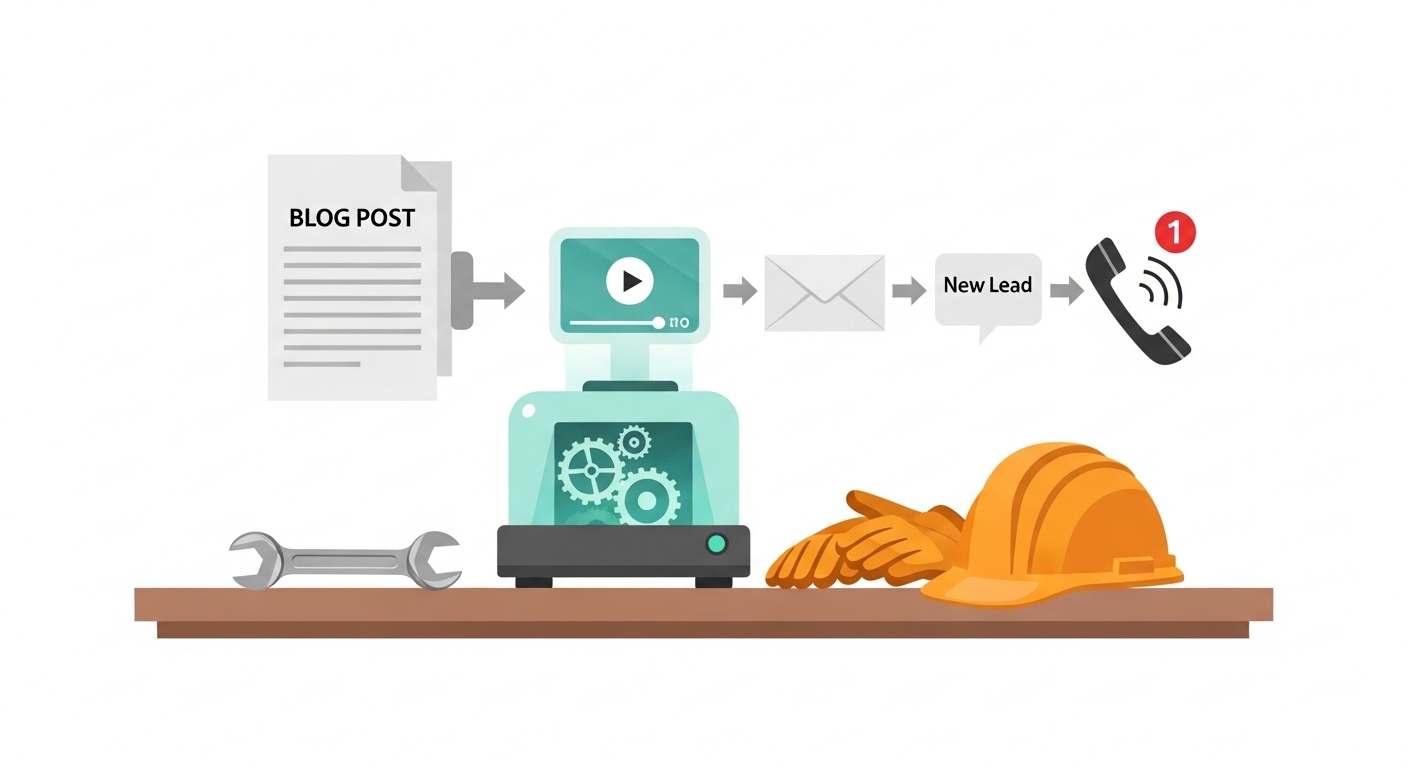
Repurpose every blog post into short-form video. A 60-second vertical video summarizing your post's main point is enough. Film it on your phone. Post it to your social channels. HubSpot's 2026 State of Marketing Report, surveying over 1,500 marketers, found that short-form video is the top ROI-driving content format, with 49% of marketers ranking it first. You don't need a production crew. You need your phone and 10 minutes.
Send a monthly email to your list. Not a newsletter nobody reads. A curated email with your best post of the month, one client win, and one actionable tip. If your domain isn't warmed up, none of this matters because the email will land in spam. Domain warming is a non-negotiable first step before any email campaign goes live. We covered exactly how this works in the cold email playbook post.
Turn reviews into content. Screenshot a glowing review, add a one-sentence commentary, and post it to social. Write a blog post about the problem the client had before they hired you. The review becomes a case study, and the case study becomes an SEO asset that ranks for months.
Content builds passively. Prospecting happens now.
Content marketing is a long game. It's one of the smartest investments you can make, but it doesn't fill your pipeline next Tuesday. So what do you do in the meantime?
You prospect actively while your content builds in the background. The combination is what separates businesses that plateau from businesses that scale.
The fastest way to do this without hiring a sales team is to use a lead scraping tool that pulls real business data with verified contact information. You write the content that builds credibility. You use the scraper to identify who to send it to. Then your email warming infrastructure ensures the outreach actually lands in the inbox, not spam. That's a complete top-of-funnel system that most agencies charge tens of thousands a year to build.
HubSpot's same 2026 report confirmed that the top marketing channels driving ROI for B2B brands in 2024 were website and blog SEO efforts, paid social media content, and social media shopping tools. Notice what all three require: consistent execution across multiple touchpoints. That's nearly impossible when your tools don't talk to each other, which is why so many small businesses are consolidating to platforms that handle content, CRM, and outreach in one place.
What a real content week looks like
Here's a simple weekly rhythm you can implement this week with no additional headcount.
Monday. Publish one SEO blog post. Target a specific question your audience is searching for. Keep it between 1,000 and 1,500 words. Prioritize clarity and usefulness over polish.
Tuesday. Film a 60-second video summarizing the post's main takeaway. Post it to your social channels. Batch-schedule if you have a scheduling tool. If not, post manually. The important thing is consistency, not perfection.
Wednesday. Pull three to five target leads from your lead scraping tool and add them to a nurture sequence in your CRM. These are prospects who match your ideal customer profile but haven't found you yet.
Thursday. Send a follow-up to any leads who opened last week's email but didn't reply. Add new value or context in each follow-up rather than repeating the same pitch. Backlinko's research on 12 million outreach emails found that a single follow-up boosts replies by 65.8%.
Friday. Review your pipeline. Check which content is getting traction in Google Search Console. Queue next week's topic based on what questions your audience is actually searching for.
That's five days, roughly two to three focused hours total, touching content, lead generation, outreach, and pipeline management in a single week. Scale that rhythm over 90 days and you have a growing body of content that ranks, a list of warm contacts, and a CRM that shows you exactly where every deal stands.
The tech stack question
This is where most small businesses make a painful mistake. They sign up for six separate platforms because each one does one thing well, and then they spend more time managing tools than running their business. A project management app, a separate CRM, a social scheduler, an email platform, a landing page builder, a lead database. Sound familiar?
The math is simple: fewer tools means fewer gaps, and fewer gaps means fewer dropped leads. If your blog content, your lead capture forms, your CRM, your email sequences, and your social scheduling all live in separate systems that don't share data, every handoff between tools is a place where leads leak out.
LeadProspecting AI was built specifically to solve this for service businesses. It brings your CRM, content publishing, social scheduling, email marketing with built-in domain warming, lead scraping, and pipeline management under one roof. Instead of managing six logins and hoping the data stays in sync, you run one system that handles the entire rhythm described above. If you want to see how the pieces connect for your specific business, the free trial is the fastest way to find out, no credit card required.
Frequently asked questions
How long does it take for local content marketing to produce results? Most businesses see measurable organic traffic improvements in 60 to 90 days if they publish consistently and target the right keywords. Leads from content typically follow traffic by 30 to 60 days. This is a 90-day game, not a 30-day sprint. Active prospecting bridges the gap while your content builds momentum.
Do I need to hire a writer to make this work? Not necessarily. AI-assisted content workflows combined with your own industry knowledge can produce solid blog posts consistently. The key is SEO intent and structure, not polished prose. You know your trade better than any writer. The tools help you organize that knowledge into posts that rank.
What's the difference between a social media scheduling tool and just posting manually? Consistency and time. A scheduling tool lets you batch-create content, schedule it across platforms in advance, and track performance in one place. Manual posting means you're reactive, not strategic. Missed days compound into missed visibility, and visibility is the foundation of local content marketing.
Is it worth investing in content if my business is purely referral-based? Even referral-based businesses benefit from content. When a friend refers someone to you, the first thing that person does is Google your name. What they find determines whether they call or keep scrolling. A business with five blog posts, a handful of reviews, and a professional site converts referrals at a significantly higher rate than one with just a bare-bones listing.
How do I know which topics to write about? Start with the questions your customers actually ask you. What do they want to know before they hire you? What concerns come up during estimates? What do they Google at 11 p.m. when something breaks? Every one of those questions is a blog post. Tools like Google's "People Also Ask" boxes and autocomplete suggestions show you exactly what your audience is searching for in your market.