TL;DR:
Sales reps spend only 28 to 30% of their time actually selling. The rest goes to administrative work, CRM updates, manual prospecting, and internal meetings. Sales prospecting automation does not replace your team. It gives them back the time they are currently losing to work that does not require human judgment, so they can spend it on the conversations that actually close deals.
The Real Problem Underneath the Quota Problem
When a sales team misses quota, the instinct is to hire more reps, run more training, or change the pitch. The data suggests the problem is usually elsewhere.
According to Salesforce's State of Sales Report 2024, sales reps spend only 28 to 30% of their time actively selling. The remaining 70 to 72% is consumed by administrative tasks, data entry, CRM updates, and internal coordination. Gartner puts the admin burden even higher, estimating that 50% of rep time goes to non-selling work.
A separate InsideSales analysis found that reps spend nearly 18% of their time inside their CRM alone, entering data and managing records, which is more time than they spend in customer meetings. When the tool meant to help them sell is eating their day, the system is structured backwards.
This is not a motivation problem. It is not a hiring problem. It is a process problem, and it is one that automation is specifically designed to fix.
What Sales Prospecting Automation Actually Does
Sales prospecting automation handles the repetitive, rules-based work that currently consumes the majority of your team's day. That includes lead capture, contact enrichment, lead scoring, follow-up sequencing, CRM data entry, and routing leads to the right rep based on predefined criteria.
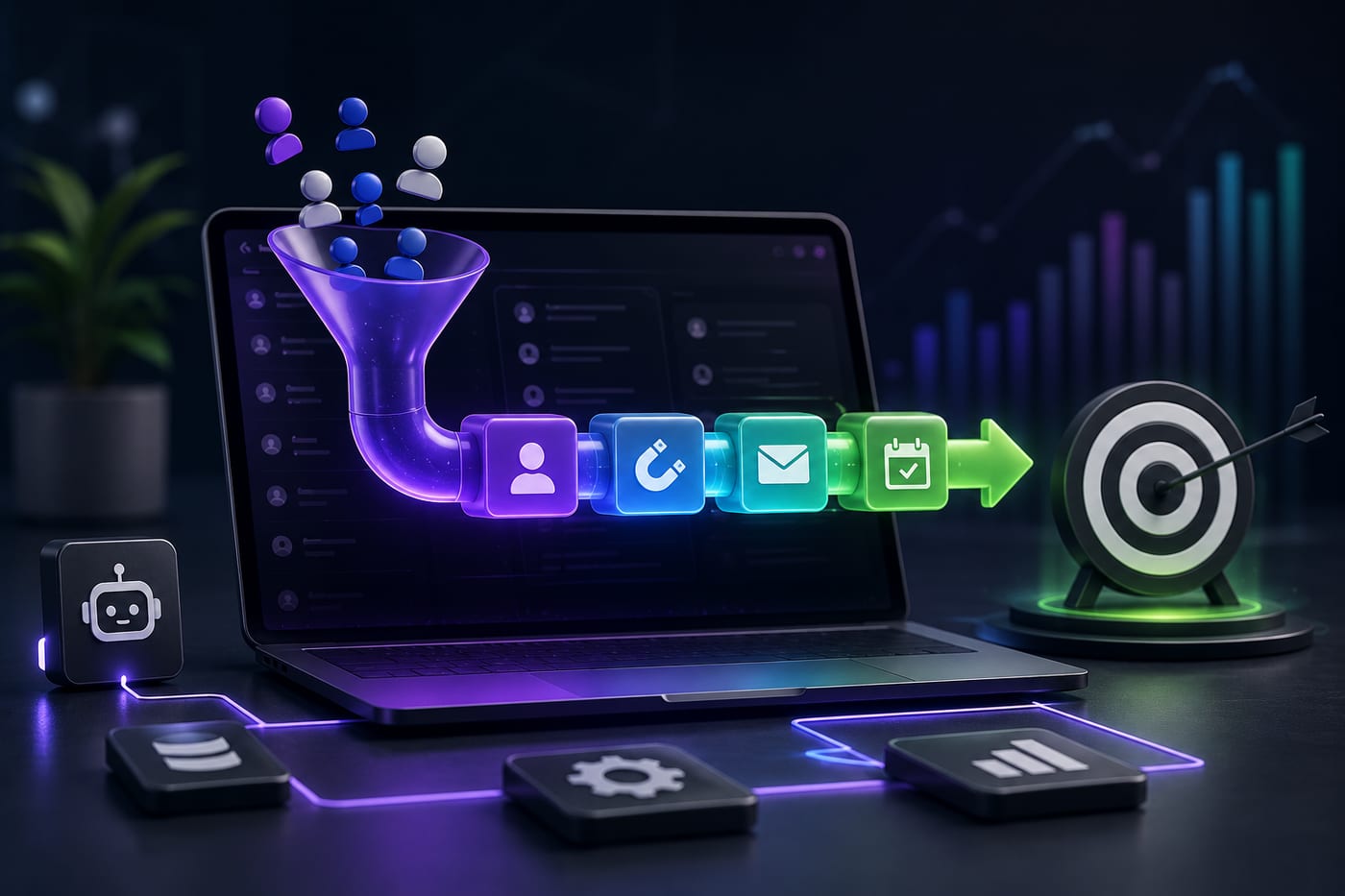
The workflow looks like this in practice: a prospect visits your website, fills out a form, or is sourced from a contact database. Automation captures that lead, enriches the record with firmographic data, scores it against your ideal customer profile, assigns it to the right rep, and triggers a follow-up sequence, all without manual intervention. Your rep's first interaction with that lead is a warm, qualified conversation rather than a cold data entry task.
McKinsey reports that sales representatives using AI and automation have seen a 15 to 20% increase in productivity, and companies integrating automation into sales processes see up to a 10% increase in revenue. AI sales tools can increase leads by 50% and cut costs by up to 60%, according to separate McKinsey research.
The practical implication: automation handles the volume so your reps can focus on the conversations that require human judgment.
The Speed Problem That Automation Solves
Lead response time is one of the highest-leverage variables in sales, and most teams are operating far outside the range that converts.
A Harvard Business Review study found that companies responding within one hour are seven times more likely to qualify a lead than those that wait longer. Contacting a lead within five minutes makes them 21 times more likely to convert compared to waiting 30 minutes.
The average B2B lead response time is 42 hours. A 2024 RevenueHero study of over 1,000 companies found that 63% of businesses did not respond to inbound leads at all, and only 17% responded instantly. In the five minutes after a prospect submits a form or makes an inquiry, their intent is at its peak. Two days later, most have moved on.
No team can manually respond to every inquiry within five minutes across all time zones and business hours. Automated lead routing and instant acknowledgment sequences are what make it possible. The rep who follows up with a warm, context-rich message five minutes after a lead comes in wins more deals than the rep who calls 24 hours later with no preparation.
What a CRM With Automation Actually Changes
A CRM is not just a contact database. When properly implemented with automation, it becomes the system that prevents deals from stalling and leads from being forgotten.
Salesforce research shows CRM adoption leads to a 29% increase in sales, a 34% improvement in sales productivity, and a 42% increase in forecast accuracy. Nucleus Research puts the average ROI of CRM at $8.71 for every dollar spent, one of the highest returns of any business software category.
The productivity gains come specifically from automation within the CRM. According to CRM.org research, CRM systems save businesses five to ten hours of employee workload per week by automating repetitive tasks, centralizing data, and streamlining communication. That is time that goes back into selling.
94% of businesses report increased sales productivity after adopting a CRM platform. The 6% that do not typically point to the same root cause: poor user adoption or failure to build automation workflows that make the tool work for the rep rather than creating additional data entry burden.
The distinction matters. A CRM with no automation is a smarter spreadsheet. A CRM with automation is the operating system that keeps your pipeline moving without requiring your reps to manually manage every touchpoint.
Lead Nurturing as a Revenue Multiplier
Most businesses treat lead nurturing as an email newsletter they send occasionally. The research on what systematic nurturing actually produces is worth understanding before you dismiss it as a nice-to-have.
Forrester Research found that companies excelling at lead nurturing generate 50% more sales-ready leads at 33% lower cost per lead than companies without systematic nurturing. The Annuitas Group found that nurtured leads make 47% larger purchases than non-nurtured leads.
The mechanism is straightforward. A prospect who enters your funnel today is rarely ready to buy today. Roughly 50% of leads are qualified but not yet ready to purchase at the moment they first engage. Without a nurturing sequence that keeps your brand present and adds value over time, those leads go cold. With one, a meaningful percentage of them convert weeks or months later at no additional acquisition cost.
Behavior-triggered nurturing sequences, which send content based on what a prospect actually does rather than on a fixed calendar, consistently outperform static drip campaigns. When a prospect opens a pricing page, downloads a specific resource, or returns to your site after a gap, those signals tell you where they are in the buying process. Automation that responds to those signals in real time is what separates a pipeline that compounds from one that leaks.
Where Human Judgment Still Wins
Automation does not close deals. People do.
Research from Bain and McKinsey confirms that AI adoption increases seller satisfaction and performance by automating routine work, not by replacing the judgment that makes complex sales work. Gartner data shows that reps who effectively partner with AI tools are 3.7 times more likely to meet quota than those who do not.
The leverage point is not whether to use automation. It is using automation for the right things. Automation handles 100 leads so your rep can have meaningful conversations with the 10 most qualified. Automation responds at 11 PM so your rep can follow up with context at 9 AM. Automation scores and routes so your rep enters every call knowing exactly who they are talking to and why.
Negotiation, trust-building, consultative problem-solving, and closing complex deals all require human skill. Automation creates the conditions for those conversations to happen more often, with better-prepared reps, at the moment of peak prospect intent.
What to Look For in an Automation Platform
Not all platforms deliver equally. The variables that matter most in practice are these:
Verified lead data. Automation built on bad data produces fast failures rather than slow ones. A lead scraper that delivers verified contact information is the foundation everything else runs on.
End-to-end workflow integration. The biggest efficiency gains come from eliminating handoffs between tools. If your lead data lives in one place, your email sequences in another, and your CRM in a third, you are creating friction at every transition. Platforms that connect these natively remove the integration work and the data loss that comes with it.
Automated follow-up with behavioral triggers. Sequences that respond to prospect behavior consistently outperform sequences on fixed schedules. Look for platforms that trigger follow-ups based on opens, clicks, page visits, and form submissions rather than just sending the next email on day seven regardless of engagement.
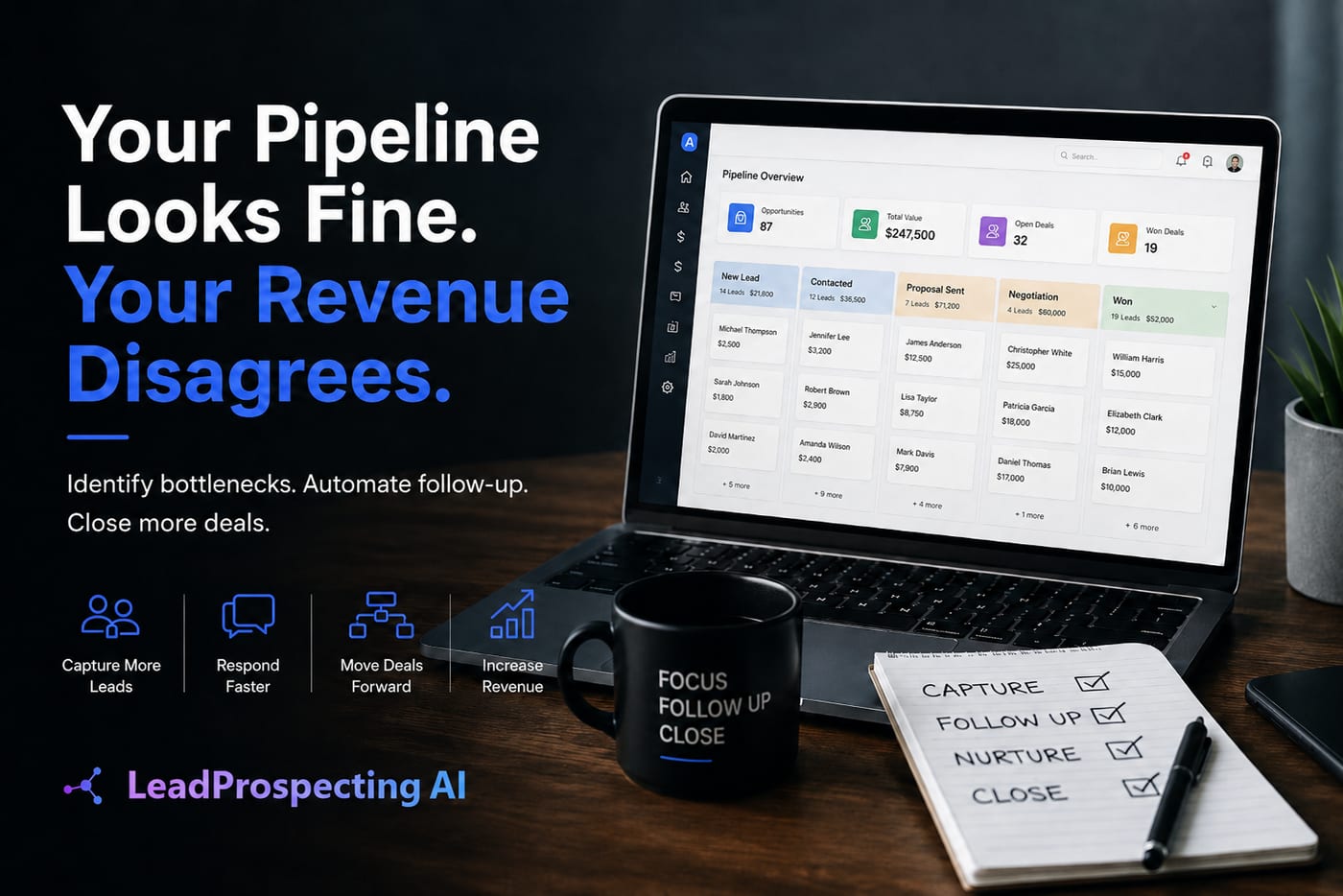
Real-time pipeline visibility. If your manager cannot assess pipeline health in 30 seconds, the reporting is not working. Clear stage definitions, deal age tracking, and automated alerts for stalled opportunities are what allow coaching to happen before deals go cold rather than after.
Ready to Give Your Team Back Their Selling Time?
LeadProspecting AI combines verified lead data, CRM pipeline management, automated email sequences, and email warming in one platform. Your team spends less time on the work that does not require them and more time on the conversations that do.
Explore our CRM, Lead Scraper, and AI Email Campaigns or start a 21-day free trial with no credit card required.
Frequently Asked Questions
Q: Will automation replace my sales team?
No. Research from Bain and McKinsey consistently shows that AI adoption increases seller satisfaction and performance. The sales work that automation handles, data entry, routing, follow-up sequencing, and scheduling, is the work that prevents reps from selling. Removing it frees them to do what they were hired for.
Q: How quickly can I expect to see results from automation?
Most teams see measurable pipeline impact within 30 days if they set up automation workflows and clean their contact data before launching. The biggest variable is lead data quality. Clean, verified data produces results immediately. Stale or unverified data produces faster failures than manual prospecting would.
Q: What is the biggest mistake teams make when implementing automation?
Automating a broken process without fixing it first. If your lead qualification criteria are unclear, automation will route unqualified leads faster. If your follow-up messaging is generic, automation will send it at higher volume with no improvement in conversion. Set up the process correctly first, then use automation to run it at scale.
Q: Does automated personalization actually outperform generic outreach?
Yes. AI-powered personalization tools that pull in company-specific context, role-relevant pain points, and behavioral signals consistently produce higher open and reply rates than template-based sequences. The difference is whether the personalization is genuine, meaning it reflects actual knowledge of the prospect, or cosmetic, meaning it just inserts a first name.
Q: Should I implement a CRM or a lead scraper first?
CRM first. You need a structured place for your data and a defined sales process before you flood your pipeline with new contacts. Once your pipeline system is solid and your team knows how to work leads through it, a verified lead scraper accelerates prospecting significantly. Running leads into a disorganized pipeline produces chaos, not revenue.