Your Pipeline Is Full in April and Empty in November. Here's Why That Keeps Happening.
If you run a pressure washing business, you already know the feast-or-famine cycle better than anyone. And if you've been searching for ai crm software that actually fits how seasonal contractors work, you've probably noticed that most options were built for SaaS sales teams, not for someone juggling driveways, commercial accounts, and a crew that doubles in size between March and August.
Here's the real problem: it's not that you don't have enough leads. Most pressure washing contractors get plenty of inbound interest during peak season. The problem is that leads fall through the cracks, follow-ups get forgotten, and repeat customers never hear from you again because you're buried in the work itself.
According to the U.S. Bureau of Labor Statistics, the building and grounds cleaning industry employs over 3.2 million workers and is projected to grow steadily. That means competition is increasing. The contractors who build systems now will own the market later.
This playbook is for you: the owner who quotes jobs from a parking lot, chases unpaid invoices at 10 PM, and wonders why revenue doesn't match the number of jobs you completed. Let's fix the pipeline problem from the ground up.
Why Seasonal Contractors Break Every Standard CRM
Most customer relationship tools were designed around a steady drip of leads coming in week after week. Pressure washing doesn't work that way. You get slammed in spring, grind through summer, taper in fall, and then scramble to fill the calendar before the first freeze.
Standard customer management software doesn't account for seasonal demand curves. You need a system that can sit dormant on 200 past customers, then blast a reactivation campaign in February before your competitors do. You need pipeline stages that reflect how a pressure washing job actually closes: inquiry, estimate sent, deposit collected, job scheduled, job complete, review requested.
Most contractors are using a combination of spreadsheets, sticky notes, a shared Google calendar, and maybe a Facebook message thread. That's not a pipeline. That's a liability. When one person on your team doesn't update the sheet, a $2,400 commercial job disappears into the void.
The field service crm category exists for exactly this reason. You need software that understands job-based workflows, not subscription-based sales cycles. The two are fundamentally different, and conflating them is why so many contractors buy HubSpot, get overwhelmed, and cancel it three months later.
How to Build a Pressure Washing Pipeline That Actually Works Year-Round
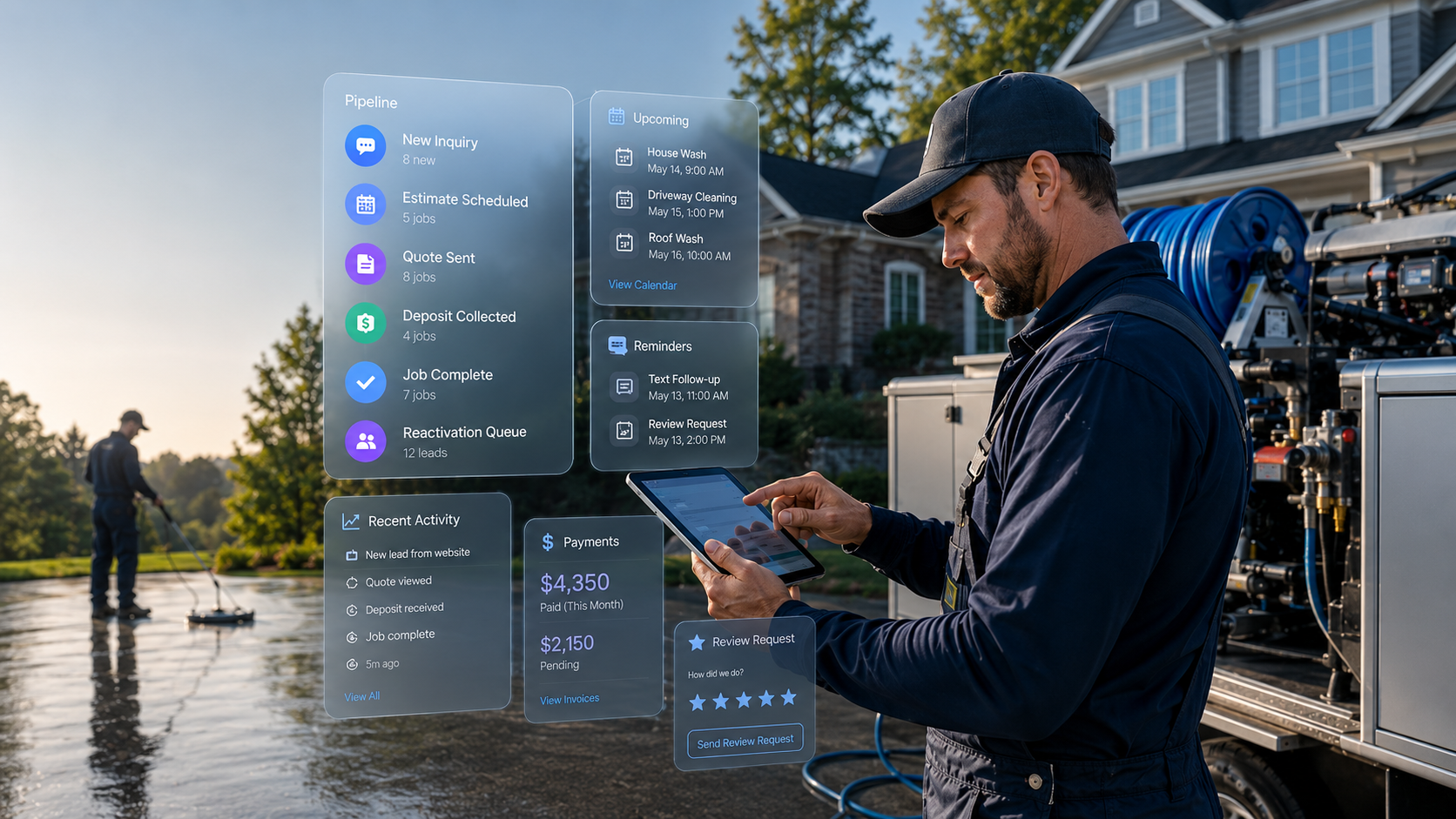
A functional pipeline for a pressure washing contractor has six stages, and each one needs an automation attached to it. Here's what that looks like in practice:
- New Inquiry: Lead comes in through your website form, Google listing, or a missed call. An automated text fires within 90 seconds acknowledging the request and asking for the job address.
- Estimate Scheduled: Appointment is confirmed. A reminder text goes out 24 hours before and again 1 hour before. No-shows drop dramatically when this is automated.
- Quote Sent: Your estimate lands in their inbox with a digital quote they can approve with one click. A follow-up reminder triggers automatically at 48 hours if they haven't responded.
- Deposit Collected: Once approved, payment tracking kicks in. Invoice is generated, deposit is requested, and the job moves to the scheduling board.
- Job Complete: Crew marks the job done in the system. Within 2 hours, an automated review request goes out via text. Response rates on text-based review requests run significantly higher than email-only approaches.
- Reactivation Queue: Customer is tagged by service type and added to a seasonal nurture sequence. Six months later, they get a personalized outreach reminding them it's time for another round.
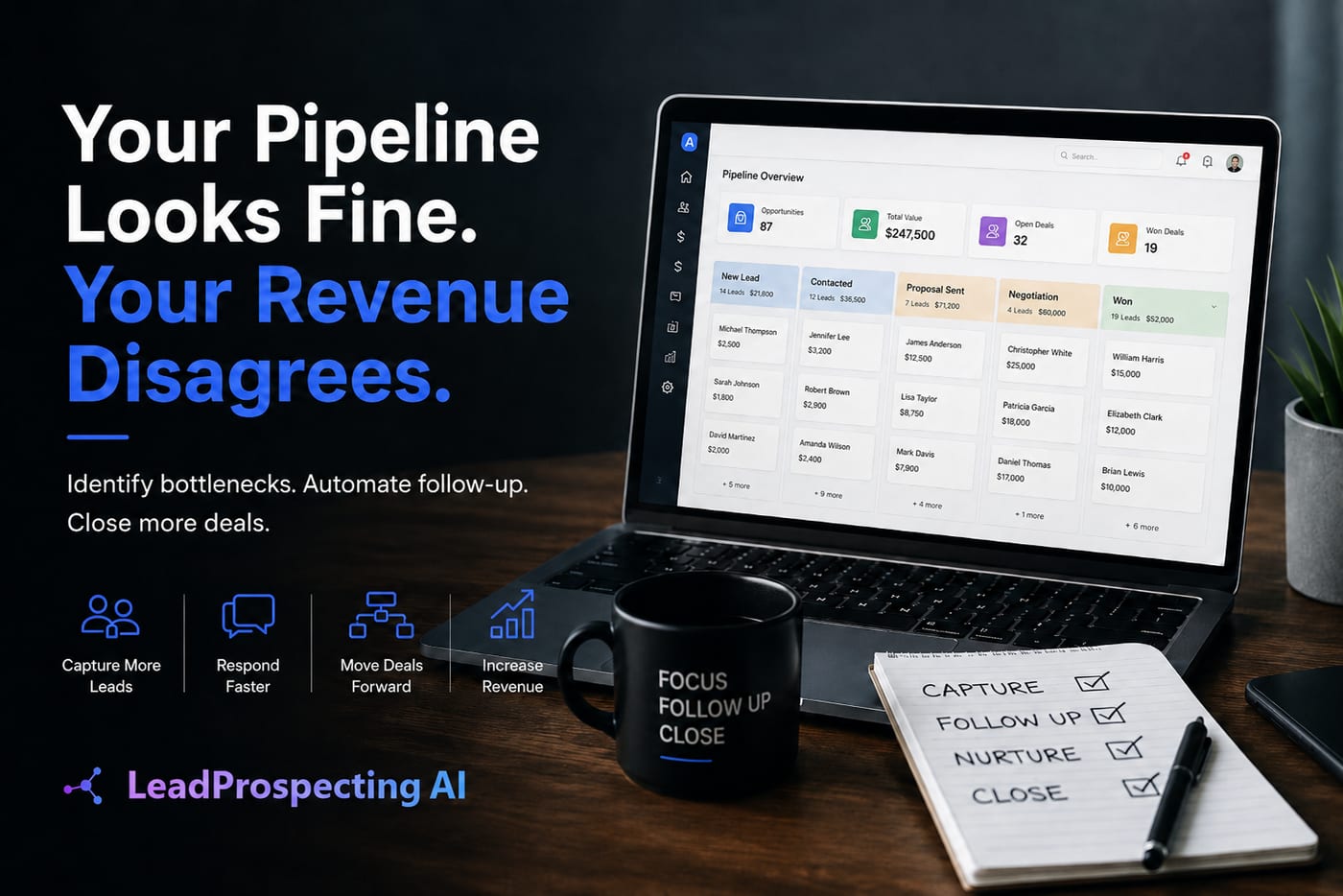
This isn't theoretical. This is exactly the kind of workflow the automation tools inside LeadProspecting AI are built to run. Drag-and-drop pipeline stages, trigger-based automations, smart reminders, and If/Else logic that routes leads differently depending on their responses.
If your current setup can't do all six of those things, you're leaving money on the table every single week. Check out this deeper breakdown on Why Your CRM Pipeline Isn't Moving: 7 Bottlenecks Killing Your Sales Velocity if you want to audit where specifically your deals are dying.
AI CRM Software: What It Actually Does Differently for Contractors
The phrase gets thrown around a lot, but here's what ai crm software actually does that a standard spreadsheet or basic booking app cannot.
First, it learns from your pipeline data. If leads who come in through Google Maps close at a 68% rate but leads from a referral partner close at 41%, an AI-assisted system flags that pattern so you know where to invest your time. That kind of insight used to require a dedicated sales ops person. Now it's built into the dashboard.
Second, it automates the follow-up work that humans consistently forget. According to Forbes, businesses that follow up with leads within the first hour are 7 times more likely to qualify that lead than those who wait even 60 minutes. Most contractors follow up when they remember to, which averages somewhere between never and too late.
Third, good ai crm software connects your marketing to your sales pipeline in real time. When someone fills out your form at 11 PM, they shouldn't wait until you check your email at 8 AM. The system texts them immediately, qualifies them with a smart reply, and adds them to your pipeline automatically. By morning, the lead is warm and waiting for you.
This is where LeadProspecting AI separates from the pack. It's not just a crm alternative to hubspot in terms of price (though the pricing is meaningfully more accessible for small contractors). It's a purpose-built revenue platform that includes lead capture, pipeline management, invoicing, automations, email marketing, and review generation under one roof. You don't need five different tools wired together with duct tape.
Email Warming and Outreach for the Off-Season Push
Here's the move most pressure washing contractors never make: a targeted off-season email campaign to every customer from the previous 18 months.
The challenge is that most contractors either don't have a clean email list or have a domain reputation so damaged that their emails land in spam before a single customer reads them. Sending bulk cold outreach from a cold domain is one of the fastest ways to kill your sender reputation permanently.
This is why email warming matters before you run any reactivation campaign. If you're planning a February push to book your spring calendar early, you should be warming your domain starting in January. The goal is consistent inbox placement before you hit send on anything.
LeadProspecting AI includes email warming as part of its platform, which means your domain reputation is being built in the background before you ever need it. Pair that with the built-in crm with email marketing functionality, and your seasonal outreach becomes a repeatable system instead of a one-time experiment.
If you want to do this right, this resource covers the mechanics clearly: The Cold Email Playbook: How to Reach the Inbox Without Torching Your Domain. Read it before you launch your next campaign.
The Operational Layer Most Contractors Ignore Until It Breaks
Pipeline management is the front end. Operations is the back end. Both need to work together or the whole thing falls apart the moment you hire your second crew.
According to research from the U.S. Small Business Administration, cash flow problems are among the top reasons small service businesses stall or close. For pressure washing contractors, this usually shows up as jobs completed but invoices not collected, or deposits taken with no systematic follow-through on final payments.
A real operations layer inside your ai crm software handles scheduling, time tracking, role-based permissions, and quote-to-payment tracking in one view. Your crew lead shouldn't need to call you to know which jobs are scheduled for Tuesday. Your office person shouldn't be chasing down invoice status manually.
The full-service platform at LeadProspecting AI is designed specifically for growing teams who need structure without bureaucracy. You get the operations dashboard, the pipeline management, the automations, and the marketing tools without needing to become a software engineer to set any of it up.
This is the difference between a business that scales and one that just stays busy. Busy doesn't pay you more. Systems do.
Frequently Asked Questions About CRM for Pressure Washing Contractors
Q: Do I really need a CRM if I'm a solo operator with fewer than 50 customers?
Yes, especially if you want to grow past that number without burning out. The habits you build at 30 customers determine whether you can handle 300. A CRM creates the system early so scaling doesn't require rebuilding everything from scratch later.
Q: What's the difference between field service CRM and a regular CRM?
A field service crm is designed around job-based workflows: estimates, scheduling, dispatch, job completion, and invoicing. A standard CRM is built around deal stages in a sales cycle. For contractors, field service functionality is far more relevant and actionable day to day.
Q: Is LeadProspecting AI a good CRM alternative to HubSpot for small contractors?
For most small contractors, yes. HubSpot is powerful but designed for marketing teams with dedicated staff. As a crm alternative to hubspot, LeadProspecting AI offers comparable automation capabilities at a fraction of the cost, with features specifically relevant to service businesses: missed-call text-back, review requests, local lead scraping, and invoicing all built in.
Q: How do I handle repeat customers in my CRM without manually reaching out every season?
Tag customers by service type and last service date. Build an automated nurture sequence that triggers at a set interval, such as five to six months post-service. The system handles outreach on schedule, and you only get involved when someone responds ready to book.
Q: Where should I start if my current setup is just spreadsheets and phone calls?
Start with pipeline structure and missed-call recovery. Get your stages defined, get your automatic text-back running for every missed call, and start logging every lead in one place. Those two changes alone will recover revenue you're currently losing. From there, layer in email nurture and review automation as your next priority. You can reach the LeadProspecting AI team here to get a walkthrough of how to set this up for your specific business.
Your competitors are still running their pipeline on a legal pad. That won't last much longer. The contractors who put a real system in place this season will be the ones booking out six weeks in advance by next spring. If you're ready to stop losing leads to voicemail and start recovering every dollar your business earns, explore everything LeadProspecting AI's small business CRM platform is built to do and make this the last season you operate without one.