TL;DR:
Small business owners told the Federal Reserve in its 2026 Small Business Credit Survey that their two biggest operational headaches are reaching customers and finding qualified staff. AI receptionists hit both at once. They answer every call you'd otherwise miss, qualify leads instantly, book appointments, and free your team to do the work that actually pays. Real research from MIT and Stanford shows generative AI boosts productivity 14% on average and 34% for less experienced workers. This post covers the five jobs to hand off today, what it actually costs, and what to look for if you're shopping.
Your phone rings. Nobody picks up. The caller doesn't leave a message. They Google the next result and give the job to your competitor.
If you're a small business owner who also answers the phones, runs the jobs, and chases the follow-ups, you already know how this story ends. What you might not know is how much it's costing you, and how cheap the fix has gotten.
According to the Federal Reserve's 2026 Small Business Credit Survey, the most common operational challenge small business owners report is reaching customers and growing sales. The second most common is hiring or retaining qualified staff. AI receptionists sit at the intersection of those two problems. They answer the calls you'd otherwise lose, and they don't quit, call out, or need health insurance.
This isn't about replacing your people. It's about freeing them from routine work so they can focus on the parts of the job that actually generate revenue.
A Friday night in Twin Falls
Picture this. It's 6:47 p.m. on a Friday in Twin Falls. A homeowner in Kimberly is staring at a water heater that just gave out, with a hot date for showering ruined and a weekend of cold ahead. She pulls up Google, types "plumber near me," and starts dialing. The first contractor's line rings six times and dumps her into voicemail. She hangs up. The second contractor's phone is busy. The third one picks up on the second ring, books her for 8 a.m. Saturday morning, and sends a confirmation text before she's off the call.
Guess which one gets the $1,400 job. Guess which one she calls next time something breaks. Guess which one she tells her neighbor about at church on Sunday.
The first two contractors will never know they lost it. They didn't see a missed call notification because their phones are sitting in their trucks. They didn't get a voicemail because she didn't leave one. As far as their CRM is concerned, that customer never existed. Multiply that scenario by every Saturday evening, every lunch break, and every job that runs long, and you start to see why so many small businesses feel stuck at the same revenue level no matter how hard they work.
What the research actually says
Two numbers are worth knowing before you decide if this is right for your business.
First, the missed call problem is bigger than most owners realize. Invoca, an enterprise call analytics company, found that 26% of calls to businesses go unanswered across all industries in its aggregate platform data. For home service businesses specifically, the number is 27%. And only 2% of those callers leave a voicemail. They just hang up and dial the next listing on Google.
Second, AI is genuinely good at this work. Researchers from MIT and Stanford (Erik Brynjolfsson, Danielle Li, and Lindsey Raymond) tracked over 5,000 customer support agents at a Fortune 500 company using a generative AI assistant. Their findings, published in the Quarterly Journal of Economics in 2025, showed a 14% average productivity gain. For less experienced and lower-skilled workers, the gain was 34%. The biggest beneficiaries were the people with the least training, which describes most small business front office staff.
That's the backdrop. Here's what to do about it.
5 tasks to take off your team's plate
1. Answering the phone
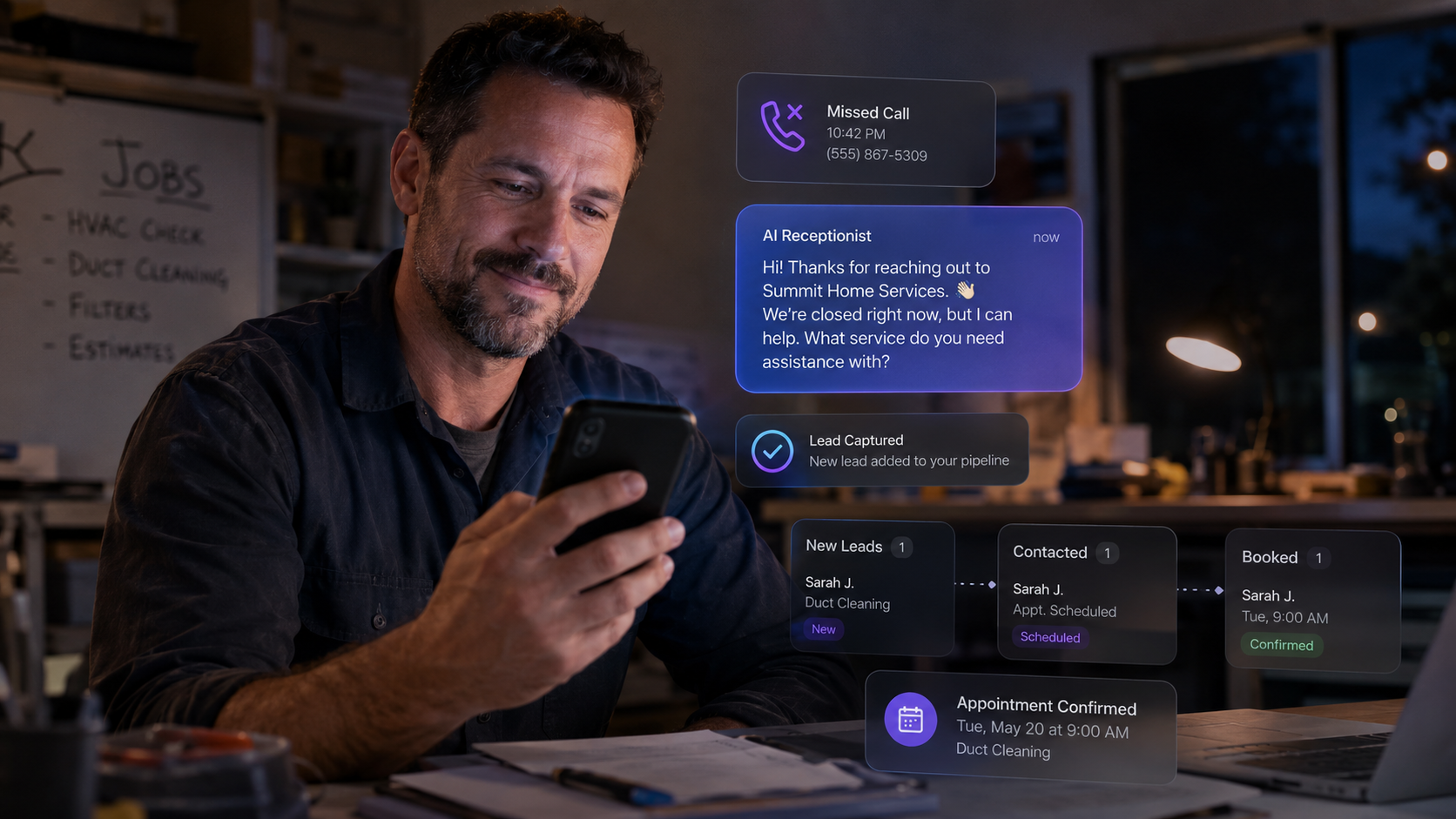
Your best closer can't close if they're juggling five lines. An AI receptionist picks up on the first ring, every time, including the ones that come in while your team is eating lunch or driving between jobs. It greets the caller, asks what they need, and either books them or routes the urgent ones to a human.
Remember the Invoca data: 26% of business calls are missed and 98% of those callers don't leave a voicemail. You're not catching them later. They're gone.
2. Qualifying leads in real time
Speed kills the deal, in both directions. A landmark study by Dr. James Oldroyd at MIT, published in the March 2011 Harvard Business Review, analyzed 2.24 million sales leads. Companies that contacted prospects within an hour were nearly seven times more likely to qualify them than companies that waited just one hour longer. Wait 24 hours and you're 60 times less likely.
A human team can't match that speed consistently. An AI receptionist can. It asks qualifying questions, captures the details, and drops hot leads onto your calendar before the prospect closes the browser tab.
3. Scheduling and rescheduling appointments
Back and forth texts to lock in a 9 a.m. window are a slow leak in your week. An AI receptionist checks your calendar, books the slot, sends the confirmation, fires the reminder, and handles the reschedule when the customer cancels. That's hours back per week for whoever was doing it before.
4. Logging call details into your CRM
How many caller details have slipped through the cracks because the person who took the call forgot to write them down? An AI receptionist captures every conversation, transcribes it, and drops the details into your customer record automatically. When you follow up, you already know what they wanted.
5. Handling after hours calls
Your business doesn't run 9 to 5, but your team does. Saturday morning calls and 7 p.m. Friday calls go to voicemail, and as the Invoca data shows, 98% of those callers won't leave one. An AI receptionist works the weekend without overtime.
The actual math
Here's the part most owners want to see.
According to the U.S. Bureau of Labor Statistics, the median hourly wage for a receptionist in May 2024 was $17.90, which works out to roughly $37,200 a year for full time work. That's before payroll taxes, benefits, training, and PTO. Loaded, you're closer to $48,000 or $50,000 per employee, per year.
Most AI receptionist tools cost a small fraction of that. But the bigger return isn't the salary you don't pay. It's the calls you stop losing.
Run the math on your own business. Two examples make the point.
A residential contractor with an average job value of $2,000 who misses just five calls a month that would've converted is leaving $120,000 on the table every year. That's not a marketing problem. That's a phone problem.
A salon or spa with an average ticket of $80 but higher call volume who misses ten bookings a month is losing $9,600 a year. Less dramatic, but still enough to fund the AI receptionist three times over with money to spare.
Both examples assume you'd have closed every call, which you wouldn't. Cut the conversion rate in half and the numbers are still bigger than what most owners pay for the tool. The point isn't the exact figure. It's that the calls you're not answering are usually worth more than the ones you are.
Where AI receptionists still fall short
Honest answer: they're not magic, and anyone selling them as a complete replacement for your front office is overstating things. A few places where you'll still want a human in the loop:
Emotional or sensitive conversations. If a customer is upset, frustrated, or grieving, an AI receptionist will handle the basics but won't read the room the way a good human can. For service businesses dealing with damage claims, insurance disputes, or family emergencies, those calls need a person.
Highly technical questions. An AI can answer "how much for a tune up" or "do you service this zip code." It can't diagnose why a customer's furnace is making a clicking sound. The smarter systems know when to hand off. The dumber ones try to fake it and frustrate everyone.
Long term relationship building. Your repeat customers who've been calling you for ten years want to talk to you, not a system. The right approach is to use AI to capture new leads and routine bookings, and to keep your human attention free for the people who already trust you.
The honest version: an AI receptionist is great at the high volume, low complexity work that's currently eating your team's day. It is not a substitute for human judgment when judgment is what the call actually requires.
What to look for if you're shopping
Not every AI receptionist is built for small service businesses. A few things matter more than the feature list:
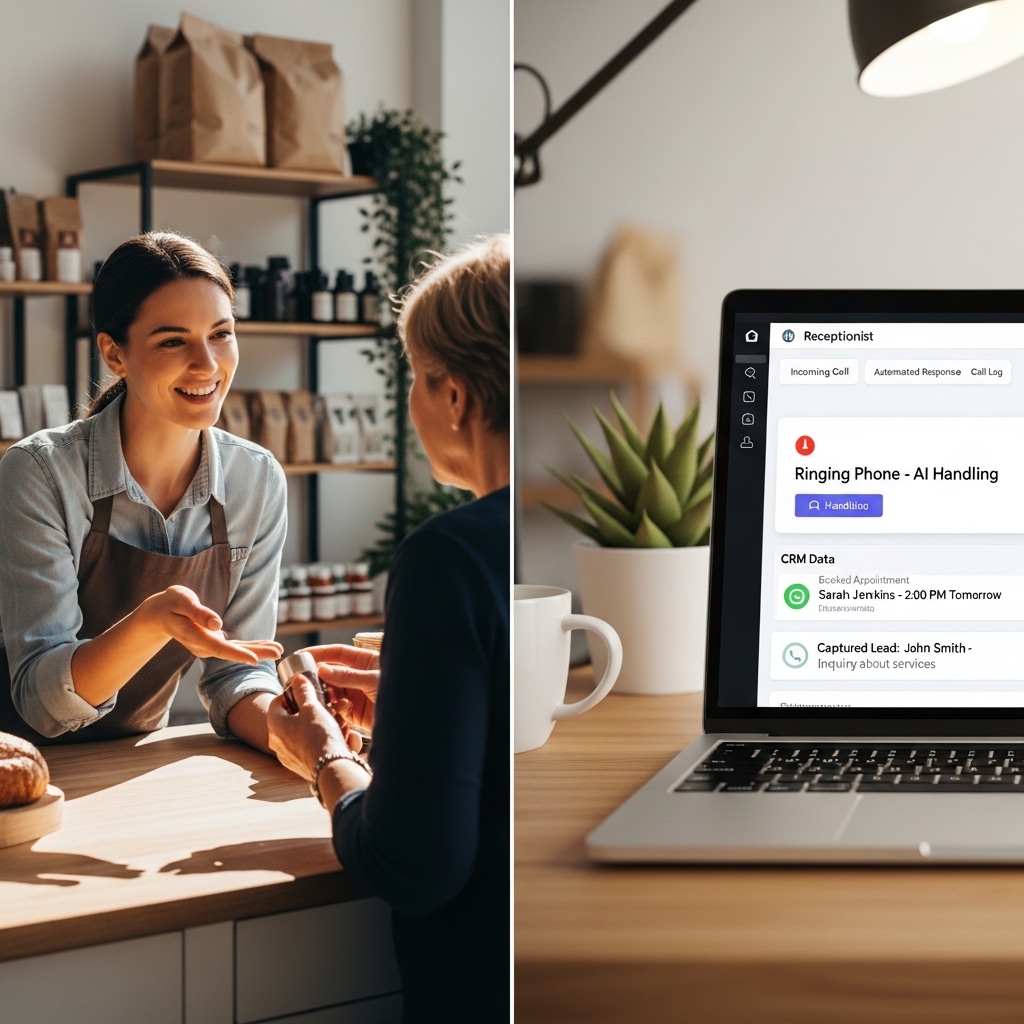
- Real CRM integration. Calls, contact details, and appointments should flow directly into your customer database. If you're copy and pasting after the call, you've solved nothing.
- Natural conversation, not a phone tree. Your customers should not feel like they're talking to a robot from 2008. Test it yourself before you buy.
- A workflow that fits your trade. A plumber needs emergency routing. A salon needs appointment slots. A contractor needs job qualification. The system should bend to your business, not the other way around.
- A clean handoff to a human. When something is too complex, the AI should pass the call with full context, not dump the customer back into a hold queue.
- Local support when something breaks. Software fails. You want to call someone who knows your name when it does.
LeadProspecting AI builds call handling into the same platform that runs your CRM, your follow ups, your reviews, and your invoicing. One login, one source of truth, and no piecing together five tools that don't talk to each other. If you want to see what your business is currently leaving on the table, the free trial is the fastest way to find out.
Frequently asked questions
Will an AI receptionist replace my staff? No. It handles the high volume, repetitive work like answering phones and booking appointments. Your team handles the parts that need a human, like closing deals and solving complex problems. The MIT and Stanford research actually found that AI helps less experienced workers most, so it tends to lift your team rather than replace them.
How much does an AI receptionist actually cost? Pricing varies by features and call volume, but most options run a small fraction of a full time hire. For comparison, the BLS reports the median full time receptionist costs about $37,200 a year in salary alone, and closer to $50,000 once you load benefits and payroll taxes.
Can it handle complicated customer questions? For routine questions like pricing, hours, and booking, yes. For anything complex, a good system hands the call to a human with full context already captured. The key is whether your AI knows when to escalate.
What happens to calls that come in after hours? That's the main reason most owners install one. An AI receptionist answers 24/7, qualifies the caller, books the appointment if it can, and flags urgent issues for your team to handle first thing in the morning.
How does this connect with the rest of my software? A good AI receptionist integrates directly with your CRM, calendar, and messaging tools so data flows automatically. If you're still copying caller details by hand, you've replaced one chore with another.