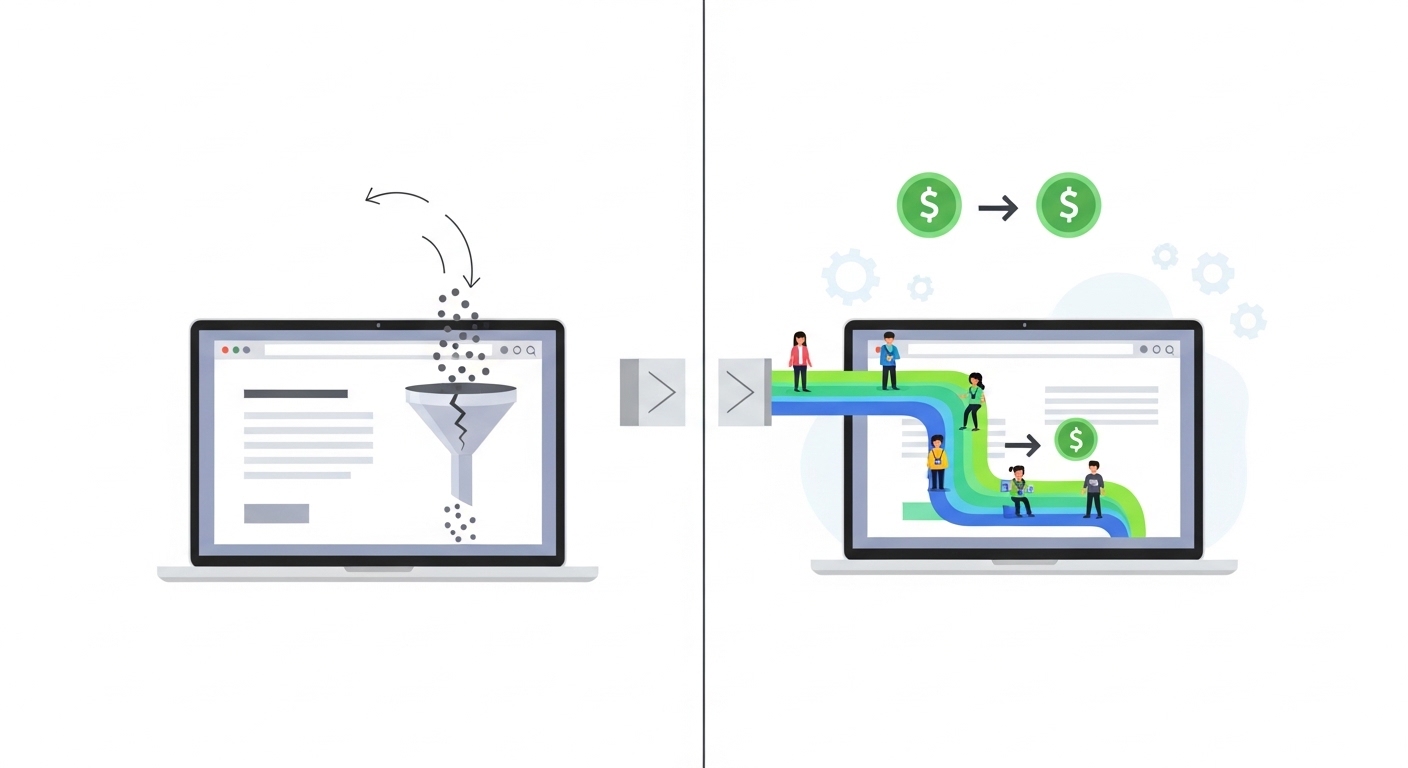
The Conversion Conundrum: Why Your Website Isn't Paying Off
You’ve invested in a website. You’ve even driven traffic to it. But despite the analytics showing visitors, your phone isn't ringing, and your inbox isn't overflowing with new leads. Sound familiar? You’re not alone. Many small business owners in places like Twin Falls, ID, find themselves staring at website traffic numbers, wondering why those visitors aren't translating into paying customers.
The truth is, getting visitors to your site is only half the battle. The real magic – and where revenue is generated – happens when those visitors take action. They need to fill out a form, call your business, book an appointment, or make a purchase. This is conversion, and it’s the heartbeat of online business growth. If your website isn't optimized for conversion, it's essentially a beautiful billboard in the desert: seen, but not truly impacting your bottom line.
This isn't about throwing more money at ads. It's about optimizing what you already have. We're going to break down 10 concrete website conversion fixes you can implement to start turning casual browsers into committed customers, often without a complete overhaul. Think of these as strategic tweaks that pay dividends, built on insights from years of helping businesses just like yours grow.

Foundation First: Technical & Design Essentials for Conversion
Before you even think about your message, your website needs a solid, fast, and intuitive foundation. If visitors hit technical roadblocks or find your site frustrating, they're gone. And they're not coming back.
- Supercharge Your Site Speed. Slow websites kill conversions. A study by Google found that as page load time goes from 1 second to 3 seconds, the probability of bounce increases by 32%. Every millisecond counts. Optimize images, leverage browser caching, and consider a Content Delivery Network (CDN). A fast website isn't a luxury; it's a necessity for user experience and SEO.
- Master Mobile Responsiveness. Over half of all web traffic comes from mobile devices. If your website looks clunky, unreadable, or difficult to navigate on a phone, you're alienating a massive segment of your potential customers. A truly responsive design adapts seamlessly to any screen size, making the user experience consistent and delightful. Our professional website design services specifically prioritize mobile-first approaches, ensuring your site looks great and performs flawlessly everywhere.
- Clarify Your Call-to-Action (CTA). What do you want visitors to do? "Click Here" is vague and uninspiring. Use strong, action-oriented verbs like "Get Your Free Quote," "Book an Appointment Now," or "Start Your Free Trial." Make your CTAs visually distinct and place them strategically above the fold and at key points in your content. Don't make people hunt for the next step.
- Streamline Your Navigation. A cluttered or confusing navigation menu is a conversion killer. Keep your main navigation simple, logical, and easy to understand. Use clear, concise labels that accurately reflect the content behind them. Less friction in finding information means more engagement and higher conversion rates.
Engage and Persuade: Content & Trust Signals That Convert
Once the technical foundation is strong, it's time to focus on what you're saying and how you're building trust. People buy from businesses they understand and believe in.
- Refine Your Value Proposition. Why should someone choose you over a competitor? This isn't just a tagline; it's the core promise you make. Is it clear, concise, and compelling? Does it immediately tell your visitor what problem you solve and why you're the best solution? Test different value propositions to see which resonates most with your target audience.
- Showcase Social Proof. People trust what other people say more than what you say about yourself. Integrate testimonials, case studies, client logos, star ratings, and review snippets prominently on your website. For businesses like home service contractors or health & wellness providers, real stories of satisfied customers are invaluable. If you're looking to generate more positive feedback, our platform includes automated review and referral requests, helping you build this crucial trust.
- Use High-Quality Visuals. Stock photos are fine, but professional, authentic images and videos that showcase your team, your work, or your products build connection. Show, don't just tell. High-quality visuals make your website more engaging, memorable, and trustworthy. Remember, people process images 60,000 times faster than text.

Streamline the Journey: User Experience & Automation
Even with great content, a complex or inefficient user journey will deter conversions. Make it easy for prospects to move from interested visitor to qualified lead.
- Optimize Your Lead Forms. Are your forms too long? Do they ask for unnecessary information upfront? Each additional field can decrease conversion rates. Aim for the minimum viable information needed to qualify a lead initially. Use multi-step forms for longer processes, breaking them into smaller, less intimidating chunks. Once a form is submitted, what happens next? Our platform's automated workflow builder ensures instant text replies and prompt follow-ups, so no lead falls through the cracks. For more on improving your outreach, check out our guide on How to Improve Lead Prospecting by Fixing What Prospects Actually See.
- Implement Marketing Automation & Follow-Up. A website visit is rarely a one-and-done conversion. What happens after a form submission or a cart abandonment? Automated email nurture campaigns, SMS follow-ups, and smart reminders keep your business top-of-mind. This allows you to scale your efforts without hiring an army of sales reps. According to a 2023 study by Statista, email marketing consistently delivers a high ROI. Automated email warming, a core service of LeadProspecting AI, ensures your messages actually land in the inbox, not the spam folder. Explore What Is Marketing Automation? A Complete Guide to Scaling Your Marketing Without the Manual Work for a deeper dive.
Refine & Scale: Advanced Tactics for Continuous Growth
Conversion rate optimization (CRO) isn't a one-time fix; it's an ongoing process. Smart businesses continuously test, learn, and adapt.
- Leverage A/B Testing & Analytics. Don't guess; test. A/B testing allows you to compare two versions of a webpage element (e.g., a headline, CTA button color, image) to see which performs better. Use analytics tools to track visitor behavior, identify drop-off points, and gain insights into what's working and what isn't. This data-driven approach removes guesswork and focuses your efforts on changes that genuinely move the needle. In our experience working with businesses nationwide, consistent testing yields the best results.
Implementing these 10 fixes can dramatically improve your website's ability to convert visitors into leads and paying customers. It's about creating a frictionless, trustworthy, and compelling online experience that guides your prospects naturally toward becoming clients. From the initial website design to ongoing CRM management and automated follow-ups, having an integrated platform simplifies this process immensely. For example, LeadProspecting AI's all-in-one system helps Twin Falls businesses (and those across the U.S.) manage everything from lead capture to final invoicing in one place, replacing disparate tools like HubSpot or GoHighLevel at a fraction of the cost.
You don't need to juggle a dozen different subscriptions and complex integrations. You need a unified strategy and a platform that supports it. A well-optimized website isn't just an expense; it's your hardest-working sales and marketing asset, open 24/7. Don't let it be a missed opportunity.
Ready to stop leaving money on the table? Discover how an expertly designed website, powered by integrated CRM and marketing automation, can transform your online presence into a revenue-generating machine. Book a Free Strategy Call with our team today and let's map out a plan to boost your conversions.
Frequently Asked Questions
Q: What's the most important conversion fix to start with for a small business?
A: Start with site speed and mobile responsiveness. If visitors can't quickly and easily access your site on any device, they won't stick around long enough to see your compelling offers. These foundational elements directly impact user experience and search engine rankings.
Q: How do I know if my website's conversion rate is good?
A: Conversion rates vary widely by industry and goal. For e-commerce, 1-3% is often cited as average, while lead generation sites might see 5-10% or higher for specific CTAs. The best benchmark is your own historical data; aim for continuous improvement. Regularly tracking your CRM performance KPIs will help you understand your unique benchmarks.
Q: Is professional website design really worth the investment for conversion?
A: Absolutely. A professionally designed website isn't just about aesthetics; it's about strategy. It incorporates user experience (UX) best practices, clear navigation, strong CTAs, and a mobile-first approach, all engineered to guide visitors toward conversion. A DIY site often misses these critical elements, leading to lost opportunities.
Q: How can I use automation to improve conversions after a visitor leaves my site?
A: Implement retargeting ads to remind them of your offer and set up email nurture sequences for those who partially completed a form or abandoned a cart. LeadProspecting AI's platform provides tools for automated email campaigns and text message follow-ups, ensuring you can re-engage interested prospects effectively.
Q: What role does SEO play in website conversion?
A: SEO (Search Engine Optimization) brings qualified traffic to your website. While SEO focuses on visibility, it indirectly boosts conversion by attracting visitors who are already searching for your products or services. High-quality, relevant traffic from SEO is more likely to convert than generic traffic. Our platform also includes SEO blog content creation to drive this targeted traffic.