Your Pipeline Is Leaking and Your Spreadsheet Is Lying to You
If you run a field service business and you're still tracking jobs, follow-ups, and invoices across three different apps and a Notes app on your phone, this is the article you've been looking for. The crm for real estate agents conversation gets all the attention online, but field service operators, from HVAC techs to roofing contractors to property managers, are quietly hemorrhaging revenue for the same root reason: no centralized system connecting their leads, jobs, and money.
According to Fieldwork's 2026 CRM research, CRM delivers an average ROI of $8.71 for every $1 spent, with most businesses seeing returns within 12 months. That's not a marketing claim. That's the math behind why Q3, with its heavy service volume for home contractors and seasonal surges for property managers, is the exact moment to get this right.
This post breaks down what a CRM actually needs to do for field service businesses, what most platforms miss, and how to use this quarter's momentum to build a system that grows with you.
Why the Field Service Market Demands a Smarter Home Service CRM Right Now
The timing matters more than most people realize. The Field Service Management Market Report from Research and Markets projects the global FSM market will grow from $5.12 billion in 2025 to $5.88 billion in 2026, at a CAGR of 15%. That kind of growth means more competition, more customer expectations, and more pressure on operators who are still running things manually.
Your competitors are investing in systems. If you're not, the gap between you and them widens every quarter. A home service CRM that handles dispatch, follow-up, and invoicing in one place is no longer a nice-to-have. It's table stakes for Q3 survival and beyond.
The businesses winning right now are not necessarily the ones with the best technicians. They're the ones with the best follow-up, the fastest quote turnaround, and the cleanest customer experience from first call to final invoice. That is a systems problem, not a talent problem.
The 6 Features That Actually Matter in a CRM for Field Service Operators
Not all CRM features are created equal. A feature that helps a crm for real estate agents close listings faster may do nothing for a plumber juggling 12 open jobs. Here's what field service businesses actually need, and what most platforms skip.
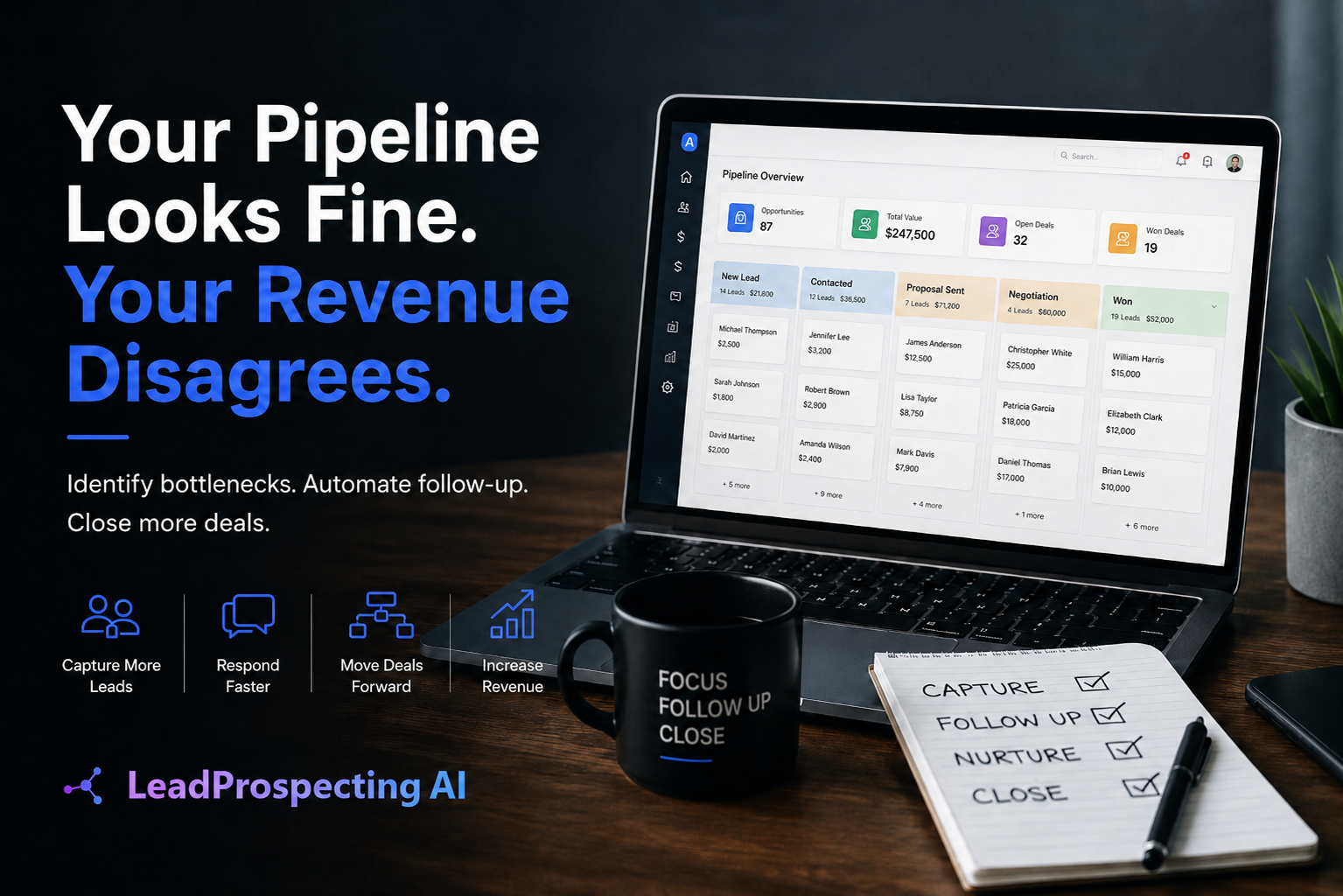
- Pipeline management with job-stage tracking: Drag-and-drop visual pipelines that let you see every job from inquiry to completed invoice, with smart reminders firing automatically when a stage hasn't moved in 48 hours.
- Missed-call text-back recovery: When a customer calls and no one answers, an automated text goes out within 60 seconds. Studies show that responding to a lead within 5 minutes makes you 9x more likely to close them. Most field teams can't answer every call. Automation covers the gap.
- Quote, appointment, and payment tracking in one view: No more switching between QuickBooks, Google Calendar, and a quote PDF buried in email. Everything tied to the contact record.
- Automated review and referral requests: After a job closes, your system should automatically send a review request. This is one of the most ignored growth levers in field service, and it compounds fast over 12 months.
- Smart forms with instant text replies: When a potential customer fills out your contact form at 10pm, an immediate text reply keeps you top of mind until your team is back in the morning.
- Role-based operations dashboard: Your office manager, your field tech, and your accountant do not need to see the same information. Role-based access keeps the business organized and your data clean.
If you want a deeper look at which of these features most businesses overlook and what it costs them monthly, 5 CRM Features Home Service Businesses Ignore (And What They Cost You Every Month) is required reading before you evaluate any platform.
What a CRM for Real Estate Agents Gets Right (That Field Service Should Steal)
Here's something worth borrowing from the real estate playbook. A good crm for real estate agents is built around one core idea: the relationship does not end at the transaction. Every closed deal is the beginning of a referral pipeline. Field service businesses understand this in theory but rarely build it into their system.
A homeowner who used your HVAC company in July is a candidate for a tune-up reminder in October, a referral ask in November, and a seasonal maintenance upsell the following spring. That sequence is worth hundreds of dollars per customer per year if it's automated. Without a CRM workflow, it simply never happens because nobody remembers to send it.
According to Salt Creative's 2026 CRM statistics research, businesses using CRM report a 29% increase in sales, a 34% improvement in sales productivity, and a 42% increase in sales forecast accuracy. Those numbers apply across industries. Real estate agents already know this. Field service operators are just catching up.
The LeadProspecting AI platform is built with exactly this kind of lifecycle thinking baked in. From the small business CRM that tracks every contact and pipeline stage, to the automated nurture campaigns that re-engage past customers without anyone lifting a finger, the system works for operators who do not have time to babysit their marketing stack.
How Automation Changes the Math for Growing Field Service Teams
Let's talk about what automation actually means in practice, not in theory. A telecommunications provider documented in a Solutions Review analysis of CRM redesign in 2026 achieved a 45% increase in productivity and a fourfold boost in customer satisfaction by connecting sales, service, and field operations into a single system. That is not a startup with unlimited budget. That is what happens when you stop managing operations in silos.
For a small field service business, the equivalent win looks like this: your tech finishes a job, marks it complete in the app, and within 10 minutes the customer receives an invoice, a review request, and a thank-you text, all without your office manager doing anything. That workflow alone recovers an average of 4-6 hours per week for most teams.
A true business automation platform does not just send emails. It connects triggers across your entire operation: form fills, appointment completions, payment receipts, missed calls, and pipeline stage changes. The full feature set at LeadProspecting AI is built around this kind of trigger-based logic, with If/Else workflow branches, smart reminders, and role-specific dashboards that actually reflect how field teams operate day to day.
For operators comparing platforms, understanding your true cost per acquisition before you automate is critical. Cost Per Lead for Home Service Businesses in the Magic Valley: 2026 Benchmarks and How to Lower Yours gives you the benchmark data to measure what your system is actually costing you right now.
Agencies, Consultants, and Multi-Client Operators Need a Different Setup
Not every reader running a field service operation is managing one brand. If you're running a crm for agencies that manages multiple clients in home services, property management, or professional services, the requirements shift significantly. You need white-label capability, multi-pipeline visibility, and reporting that separates performance by client or location.
You also need content infrastructure. An ai blog writer for business built into your platform means you can produce SEO content for each client without hiring a separate content team. LeadProspecting AI includes SEO blog content creation and publishing as a managed service, which means your clients rank while you stay focused on strategy and delivery.
The full services breakdown at LeadProspecting AI covers everything from lead scraping and email warming to Google My Business optimization and social media scheduling, all inside one platform. For agencies, this eliminates the 6-to-8 tool stack that most teams are currently paying for separately.
Frequently Asked Questions About CRM for Field Service Businesses
Q: What is the most important CRM feature for a field service business?
Pipeline management tied to job status is usually the highest-impact starting point. When every job moves through clear stages with automated reminders, nothing falls through the cracks and your team stops managing follow-up manually. Missed-call text-back is a close second for businesses that lose leads after hours.
Q: Can a crm for real estate agents work for a home service contractor?
Partially. Real estate CRMs are built around long sales cycles, listing management, and MLS integrations. Field service businesses need job dispatch, technician scheduling, quote-to-invoice workflows, and review automation. The underlying contact and pipeline logic is similar, but the specific workflows are very different. A purpose-built platform will outperform a repurposed real estate tool every time.
Q: How long does it take to see ROI from a CRM?
According to Fieldwork's 2026 research, most businesses see CRM returns within 12 months, with an average ROI of $8.71 per dollar spent. In practice, field service businesses often see faster returns because the immediate wins, like missed-call recovery and automated follow-up, start generating revenue in the first 30 to 60 days.
Q: Do I need separate tools for CRM, email marketing, and invoicing?
You do not, and you should not. Using separate tools creates data gaps, double entry, and reporting blind spots. An all-in-one business automation platform like LeadProspecting AI handles CRM, email campaigns, invoicing, quote tracking, and automated follow-up in a single system. This is how you get clean data and less overhead.
Q: What should I do first if I want to implement a CRM this quarter?
Start with a contacts and pipeline audit. Import your existing customer list, define your job stages, and set up one automation workflow, ideally missed-call text-back or post-job review requests. Get one workflow running before you build the rest. Complexity added before the basics are solid usually leads to abandonment. Check the LeadProspecting AI pricing page to find a plan that matches your current team size and scale up from there.
If you're ready to stop patching together tools and start running your field service business on a system that actually connects your leads, jobs, and revenue, reach out to the LeadProspecting AI team and see what a properly built CRM and automation stack looks like for your specific operation. Q3 is not the time to keep doing this the hard way.