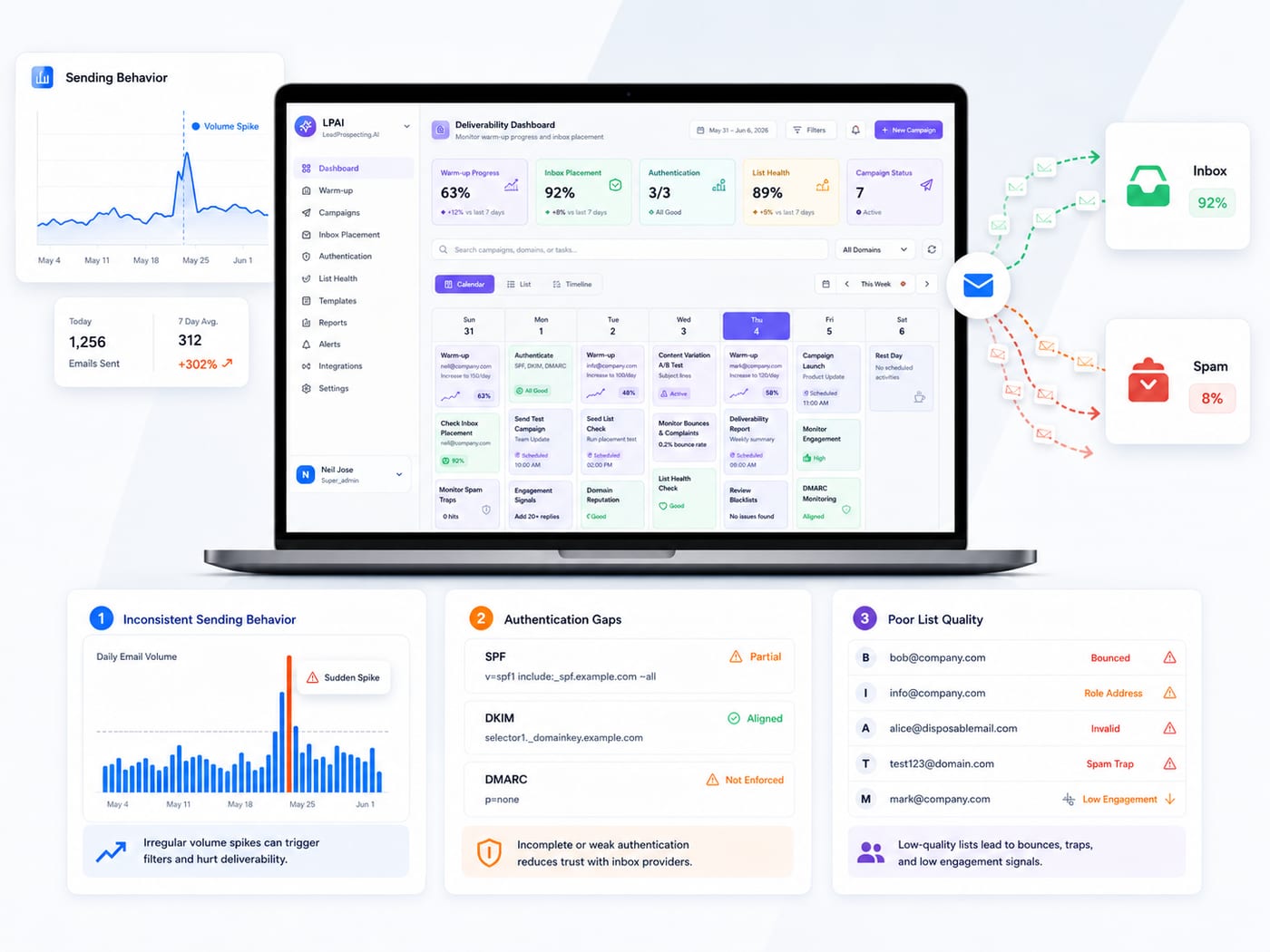
TL;DR:
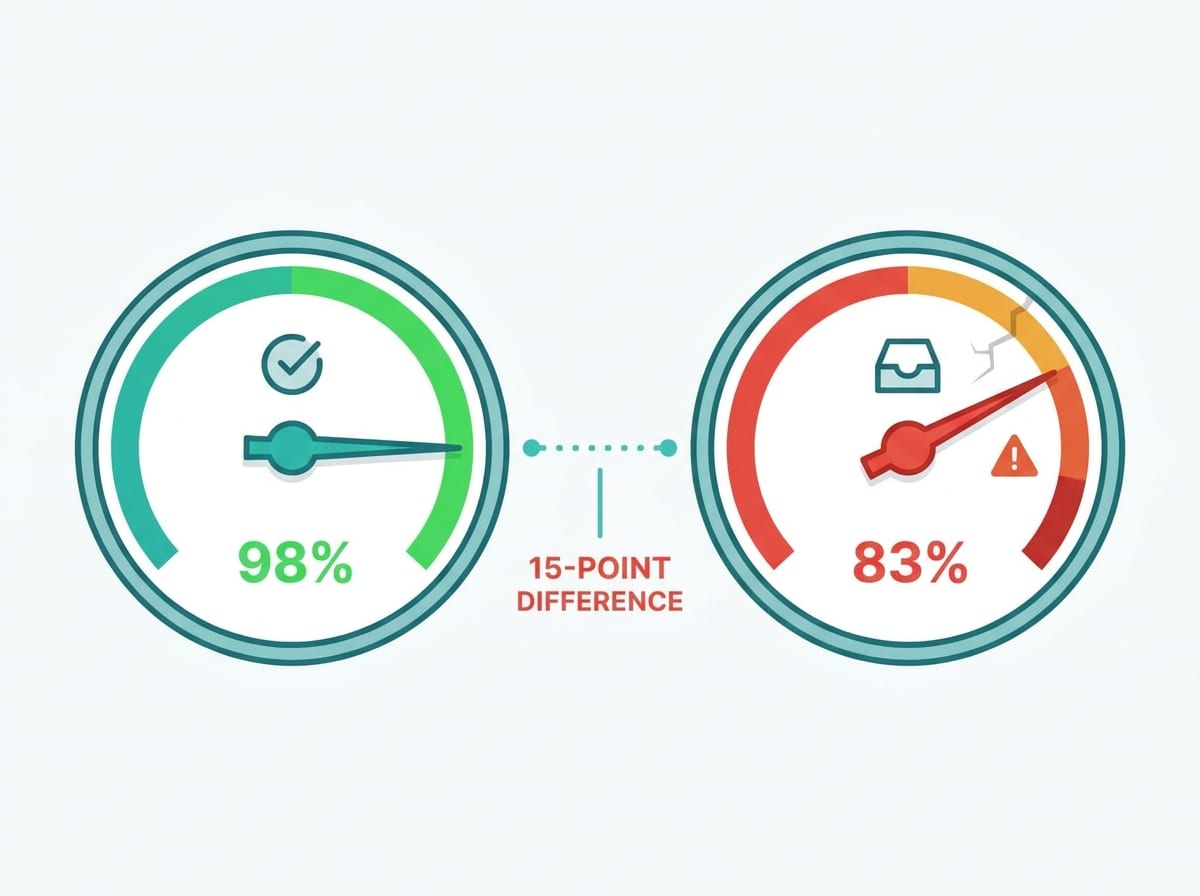
There's a 15-percentage-point gap between your email delivery rate and your actual inbox placement rate that most platforms never show you. Validity's 2025 benchmark puts the global delivery rate at 98.5%, but actual inbox placement at just 83.5%. That gap means roughly 1 in 6 "delivered" emails are sitting in spam folders where nobody will ever open them. This post explains the difference, why your dashboard is misleading you, and how to measure what actually matters.
A landscaping company owner in Buhl checked his email platform last week. It showed a 97% delivery rate on his spring cleanup campaign. "Great," he thought. "Almost everyone got it." His open rate was 9%. He blamed the subject line. He rewrote it. Sent again to the unopened segment. Open rate dropped to 6%. He concluded his list was dead.
His list wasn't dead. His emails were in spam. Every one of them counted as "delivered" because the receiving server accepted them. His platform had no way to tell him where they landed after that.
This is the most expensive blind spot in small business email marketing, and Sinch Mailjet's research found that 88% of email senders can't correctly define what "delivery rate" actually measures. More than half believe it means their email reached the inbox. It doesn't.
The two metrics and the gap between them
Delivery rate measures one thing: whether the receiving mail server accepted your email. When Gmail, Outlook, or Yahoo's servers receive your message and return an "OK" instead of an error code, that counts as delivered. It tells you nothing about where the email ended up. It could be in the primary inbox, the promotions tab, the spam folder, or a quarantine the recipient never sees.
Inbox placement rate measures whether the email reached the actual inbox where a human will see it. It excludes spam, promotions, and any other filtered folder.
The gap between these two numbers is where businesses silently lose revenue.
According to Omnisend's analysis of Validity's 2025 benchmark data, the global email delivery rate is 98.5%. The global inbox placement rate is 83.5%. That 15-point gap means roughly 15% of your "delivered" emails are invisible to your recipients. Your platform shows green checkmarks. Your leads see nothing.
The gap also varies dramatically by provider. Validity's benchmark data shows Gmail averages 87.2% inbox placement, while Microsoft (Outlook, Hotmail, Live) sits at just 75.6%. If a quarter of your list uses Outlook, one in four of those "delivered" emails is likely in spam.
Why this matters more than your subject line
When open rates drop, the instinct is to fix the copy. Better subject line. Shorter preview text. Different send time. Those things matter, but they're second-order problems. If 15% of your emails are in spam before any human can evaluate your subject line, you're optimizing the wrong variable.
The math scales quickly. A business sending 2,000 emails per month with an 83.5% inbox placement rate has roughly 330 emails per month landing in spam. If your average customer value is $500 and even 2% of those invisible emails would have converted, that's $3,300 per month in revenue you'll never see on any report. It doesn't show up as a lost deal. It doesn't show up as a missed call. It shows up as nothing, which is why most owners never realize it's happening.
How to measure what actually matters
Your email platform's delivery rate is not lying to you. It's just answering a different question than the one you're asking. Here's how to see the real picture.
Use seed list testing. Send a test email to a small set of addresses across Gmail, Outlook, Yahoo, and Apple Mail before every major campaign. Check where the email actually lands. Free tools like Mail-Tester will score your email and flag problems. Paid tools like GlockApps or InboxEagle provide per-provider placement breakdowns.
Check Google Postmaster Tools. Free for any domain owner. It shows your domain's spam complaint rate and compliance status for Gmail specifically. If your spam rate is above 0.1%, Gmail is filtering you. Above 0.3%, Gmail starts rejecting your mail outright.
Track inbox placement over time, not just per campaign. A single test tells you where one email landed. Consistent monitoring tells you whether your domain reputation is improving or deteriorating. Check quarterly at minimum. Monthly is better.
Stop using open rate as a proxy for deliverability. Apple Mail Privacy Protection inflates open rates by pre-loading tracking pixels. A "40% open rate" might include a significant percentage of automated opens that no human triggered. Inbox placement testing gives you a ground-truth measurement that open rates can't provide.
The one shift that changes everything
Once you understand this gap, the priority order for email optimization reverses. Most businesses work on copy first and infrastructure last. The data says infrastructure first, copy second.
Fix your authentication (SPF, DKIM, DMARC). Warm your domain if it's new or dormant. Clean your list. Monitor inbox placement, not just delivery rate. Then, once you know your emails are actually reaching humans, optimize the subject line.
LeadProspecting AI includes email warming, authentication monitoring, and CRM-based engagement tracking in one platform specifically so this gap doesn't silently drain your pipeline. If you want to see where your emails are actually landing right now, the free trial is the fastest way to find out.
Frequently asked questions
Can I have a high delivery rate and still be landing in spam? Yes, and this is extremely common. A 99% delivery rate with a 75% inbox placement rate means one in four of your "delivered" emails is in spam. Your platform shows success. Your leads see nothing. The only way to know the difference is to test inbox placement directly, which most email platforms don't include natively.
Which email providers are hardest to reach in 2026? Microsoft (Outlook, Hotmail, Live) is the toughest, with Validity reporting just 75.6% inbox placement. Microsoft's filters are heavily influenced by user engagement signals and complaint feedback. Gmail sits at 87.2%, which is better but still means roughly 1 in 8 emails miss the inbox. Yahoo falls in between.
How often should I test inbox placement? Before every major campaign at minimum. Monthly, if you're sending consistently. The test takes under five minutes with a seed list tool and tells you exactly where your emails are landing across every major provider. It's the single most useful diagnostic most businesses never run.