TL;DR:
Email warmup and deliverability tools solve different problems, and most small businesses confuse them or skip both entirely. Warmup builds your sending domain's reputation before you campaign. Deliverability tools monitor whether your emails are reaching inboxes after you send. Validity's 2026 benchmark report puts the global average inbox placement rate at just 83%, meaning roughly 1 in 6 emails disappear before anyone sees them. This guide explains how each tool works, when you need which one, what a proper setup looks like now that Google and Microsoft enforce authentication, and how to avoid the mistakes that get small business domains blacklisted.
An agency owner in Jerome spent two months building a list of 600 commercial property managers across southern Idaho. She wrote a solid cold email sequence, personalized the first line for each prospect, and hit send on a Monday morning. By Thursday, her reply rate was zero. Not low. Zero.
She rewrote the subject line. Sent again to the unopened segment. Still nothing. She hired a freelance copywriter to redo the entire sequence. Same result. Three months and $2,000 later, she discovered the problem had nothing to do with her copy. Her sending domain had no warmup history, no DMARC record, and Gmail was quietly routing every message she sent directly to spam. Six hundred prospects never saw a single email.
This happens more often than most business owners realize. The gap between "sending email" and "email actually arriving" is where campaigns go to die. Understanding which tools close that gap, and in what order, is the difference between a pipeline that works and one that silently bleeds opportunities.
The inbox placement problem in 2026
The scale of the problem is larger than most owners expect. According to Validity's 2026 benchmark report, the global average inbox placement rate across major email service providers is approximately 83%. That means roughly 1 in 6 legitimate, permission-based marketing emails never reach the primary inbox. Some land in spam. Some are silently discarded. The sender never knows.
For a small business sending 500 cold emails per week, that translates to roughly 85 messages per week disappearing. Over a month, that's more than 300 lost conversations. Real prospects, real revenue, real opportunities vanishing without a trace.
The authentication landscape makes this worse. EasyDMARC's 2026 DMARC Adoption Report, analyzing 1.8 million of the world's most-visited domains, found that even among top domains, only 52.1% have valid DMARC records. And more than half of those remain at the monitoring-only setting that provides zero actual protection against spoofing. Among smaller businesses and less-trafficked domains, the numbers are significantly worse. Most small business owners have never heard of DMARC, let alone configured it.
This matters for two reasons. First, Google's published sender guidelines now require SPF, DKIM, and DMARC authentication for anyone sending to Gmail in volume. As of late 2025, Gmail actively rejects non-compliant mail rather than just filtering it. Microsoft began enforcing similar requirements in May 2025. Second, a domain without proper authentication is vulnerable to being impersonated by spammers, which can permanently damage your sender reputation even if you've never sent a single spam email yourself.
What warmup does vs. what deliverability tools do
These two categories sound similar but solve different problems. Mixing them up is how businesses waste months without improving results.
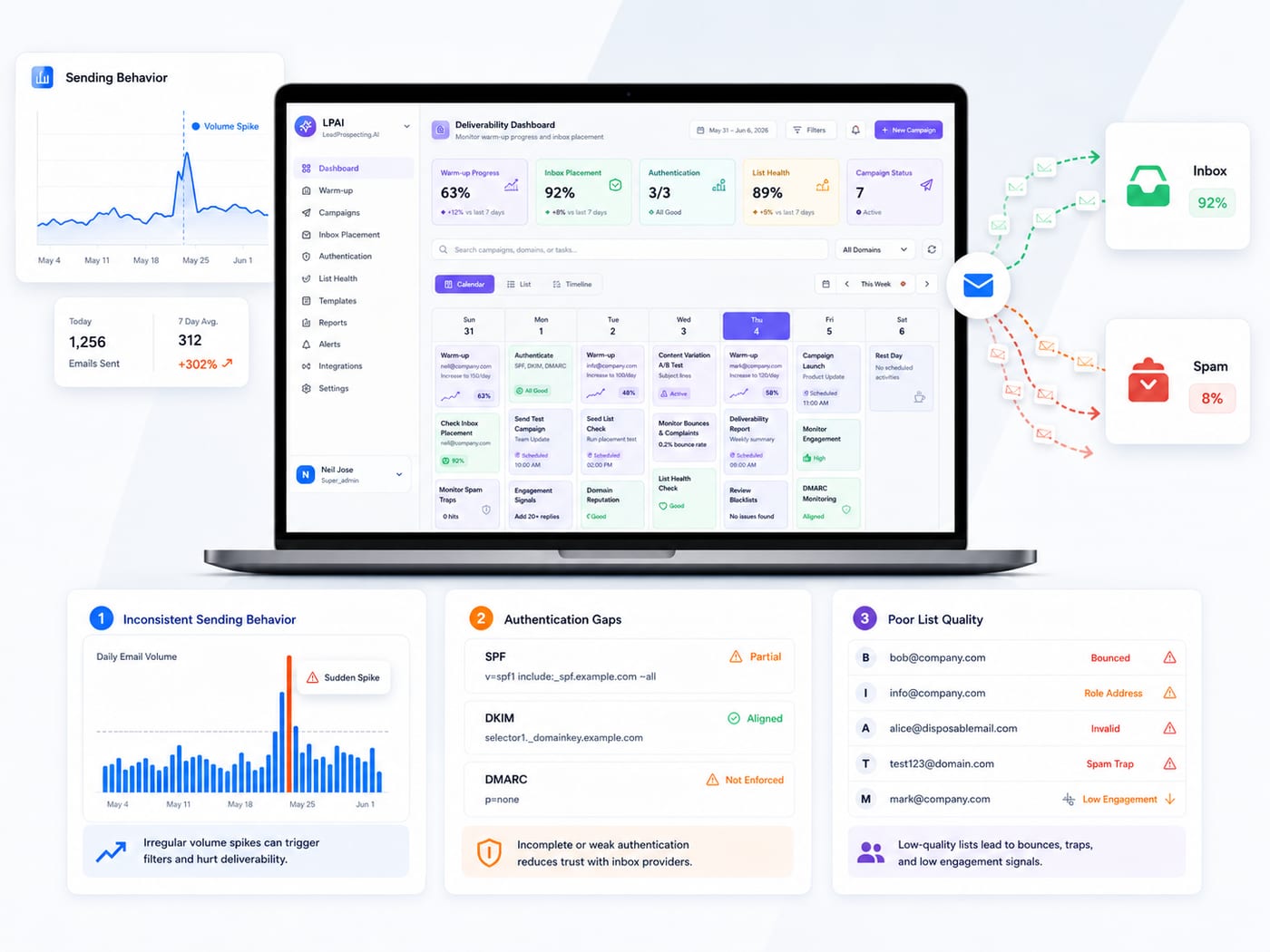
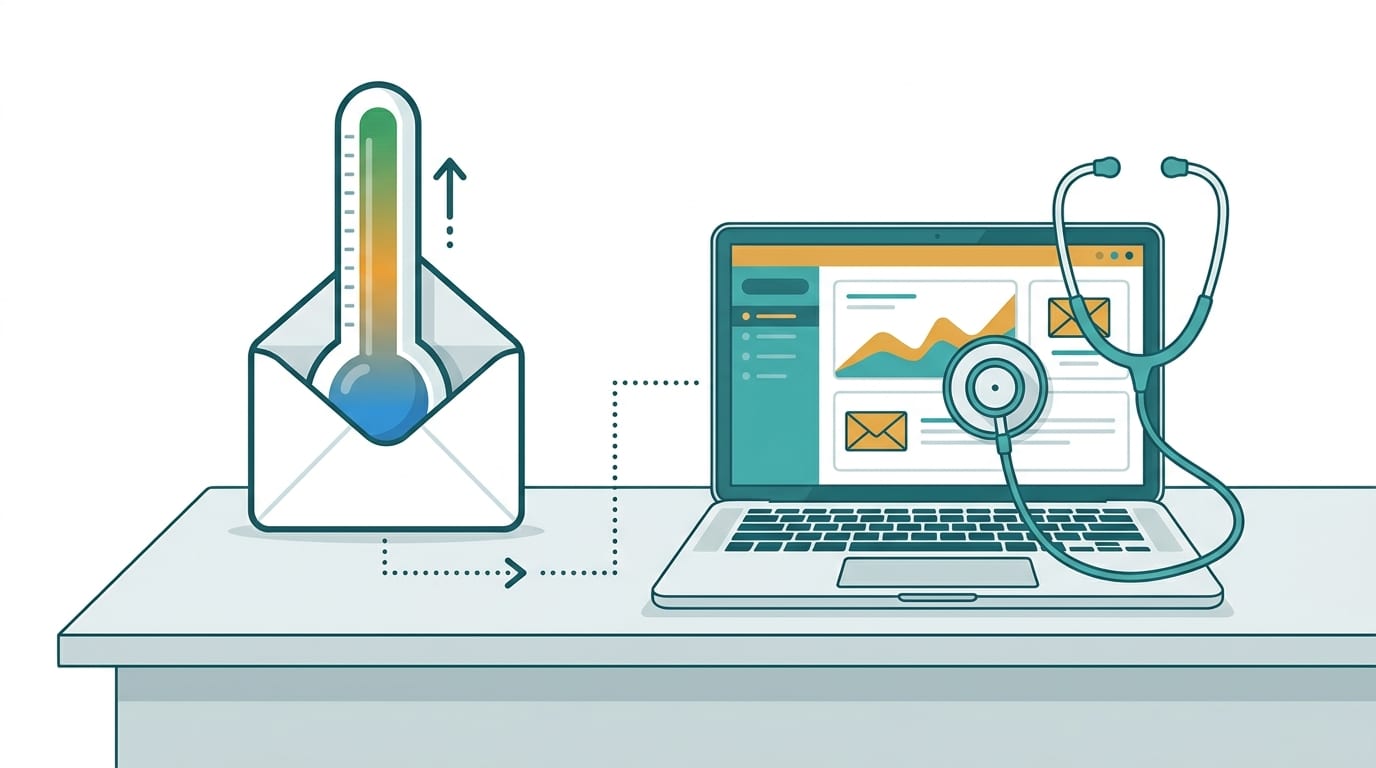
Email warmup is the process of gradually increasing sending volume from a new or cold domain so inbox providers learn to trust it. Warmup tools automate this by simulating real email activity between accounts over several weeks: sending messages, opening them, marking them as important, replying to them, and pulling them out of spam when they land there. Over two to four weeks, your domain builds a track record of legitimate, engaged communication.
Deliverability tools are diagnostic and ongoing. They monitor whether your emails are hitting inboxes or spam folders after you send, flag authentication issues, track your sender reputation score over time, and alert you when something breaks. They don't build your reputation. They tell you where it stands and warn you when it deteriorates.
Some overlap exists, but the use cases are distinct. Here's how to know which one you need:
New domain or brand-new outbound strategy. You need warmup first. Your domain has no sending history, and inbox providers will treat it the same as a spam operation until you prove otherwise. Start warmup before you write a single campaign email.
Existing domain with declining reply rates. You probably need a deliverability audit first. Something has changed: maybe your bounce rate spiked, maybe you hit a spam trap, maybe your authentication lapsed. Diagnose before you treat.
Active campaigns suddenly hitting spam. Authentication fixes and warmup simultaneously. Check your SPF, DKIM, and DMARC records first. If they're broken, no amount of warmup will save you. Fix the infrastructure, then re-warm.
High-volume sending across multiple domains. You need both running continuously. Warmup keeps each domain healthy. Deliverability monitoring catches problems before they cascade.
Most small businesses need some combination of both but rarely have either set up correctly.
What a proper setup looks like in 2026
The old shortcuts don't work anymore. Buying a domain and blasting 300 cold emails on day one is a reliable path to a permanent blacklist. Here's what a properly structured setup looks like for a small business doing cold outreach.
Separate your cold outreach domain from your main business domain. Use a variation (like getmybusiness.co vs. mybusiness.com) so that if your cold domain takes a reputation hit, your main domain stays clean. Your invoices, client emails, and password resets keep reaching inboxes while your outreach domain recovers.
Set up SPF, DKIM, and DMARC before sending a single email. This is non-negotiable. SPF tells receiving servers which IP addresses are authorized to send from your domain. DKIM adds a cryptographic signature verifying the message wasn't tampered with. DMARC ties them together and tells servers what to do when either check fails. Most hosting providers have documentation for this, and it takes less than an hour to configure.
Run a warmup period of at least four to six weeks before scaling volume. Start with 10 to 20 emails per day and increase gradually. Most dedicated warmup tools automate this entirely. Don't send real campaign emails until your domain has built a track record.
Monitor inbox placement, not just open rates. Open rates lie. A 40% open rate means nothing if half of those opens are Gmail's preview pane or Apple's mail privacy protection, not a real human reading your message. Use placement testing tools that show you exactly where your messages land: primary inbox, promotions tab, spam folder, or undelivered.
Connect your outreach to your CRM pipeline. When someone replies to a cold email, what happens next should be automatic. The reply should route to the right person, the contact should update in your CRM, and the next step in your sequence should trigger without anyone typing anything. If replies sit in an inbox until someone remembers to check, you're losing the speed advantage that cold email is supposed to provide.
Why deliverability is a revenue problem, not just a technical one
It's tempting to treat deliverability as a technical checkbox: set up the DNS records, run the warmup, move on. But the financial impact is real and measurable.
Omnisend's research on Shopify merchants found that strong inbox deliverability translated to a 17% higher conversion rate and a 40% lower bounce rate compared to merchants with deliverability problems. While that data comes from ecommerce (not service businesses), the principle applies universally: emails that reach the inbox convert. Emails that don't reach the inbox cost you money you'll never see on a report because the lost opportunity is invisible.
For a service business sending cold outreach, the math is similar. If your average job is worth $1,500 and you're losing 1 in 6 emails to spam, you're not just losing opens. You're losing the downstream appointments, quotes, and closed deals those emails would have generated. Over 12 months, even a modest cold email program with deliverability issues is leaving tens of thousands of dollars on the table.
Warmup is not a one-time event
Domain reputation is not something you build once and forget. Sending volume, list hygiene, engagement rates, bounce rates, and spam complaints all affect your reputation continuously. A domain that was healthy last month can deteriorate if you send to a bad list, spike your volume unexpectedly, or trigger a wave of spam complaints from an irrelevant campaign.
The practical implication: your warmup process needs to run continuously, not just during initial setup. The best platforms handle this in the background while your campaigns run, so your domain health stays stable without you monitoring it manually every day.
This is also why list quality matters so much. Sending to unverified addresses at volume is the fastest way to tank your sender reputation, even with warmup running. Every bounce damages your domain's trust score with inbox providers. Verify every address before it enters your outreach sequence.
Putting it together
The complete picture for a small business doing cold outreach in 2026 looks like this: a separate sending domain with SPF, DKIM, and DMARC configured correctly. A warmup period of four to six weeks before any real campaigns launch. Continuous warmup running in the background alongside active sends. Deliverability monitoring that catches problems before they cascade. And a CRM that captures replies and moves prospects through your pipeline automatically.
LeadProspecting AI handles warmup, authentication monitoring, and CRM integration as a connected system rather than three separate tools you stitch together manually. If you want to see how the pieces connect for your business, the free trial is the fastest way to find out, no credit card required.
Frequently asked questions
Do I need to warm up my domain even if I already send newsletters? Yes, if you're starting cold outreach on a domain previously used only for newsletters or transactional email. The sending patterns are different, and inbox providers treat bulk cold outreach differently than opt-in marketing email. Warmup establishes trust for a specific type of sending behavior, not just general email history.
How long does email warmup take before I can run a real campaign? For a brand-new domain, plan on four to six weeks before scaling to meaningful volume. If you're recovering a domain with a damaged reputation, the timeline can be longer, sometimes eight to twelve weeks depending on the severity. Rushing the process reliably makes results worse. Patience here is not optional.
What's the difference between SPF, DKIM, and DMARC? SPF tells receiving servers which IP addresses are authorized to send email from your domain. DKIM adds a cryptographic signature verifying the message wasn't tampered with in transit. DMARC ties them together and tells servers what to do when either check fails. All three are now required by Google and Microsoft for anyone sending at volume. Missing any one of them creates a gap that inbox providers will penalize.
What should I do if my cold emails suddenly start going to spam? Run a deliverability check immediately using a tool like Mail-Tester or GlockApps to identify whether the issue is authentication, content, or reputation. Check if your domain or IP has appeared on any blacklists using MXToolbox. If the issue is reputation-related, pause your outbound campaigns, fix the underlying problem, and run a brief re-warming period before resuming. Continuing to send while blacklisted accelerates the damage.
Can I use the same platform for both warmup and active campaigns? Some platforms support both, and that's the most efficient setup. The key is making sure the tool clearly separates warmup activity from your real sending volume in its reporting, so campaign performance metrics aren't skewed by warmup traffic. Running warmup and campaigns in the same system also ensures your domain health stays stable as you scale, because the warmup adjusts to your actual sending patterns rather than operating independently.