
The Numbers Don't Lie: What Manual Follow-Up Is Actually Costing Your Magic Valley Business
You just spent $2,000 on a Google Ads campaign. A lead comes in. Your phone is ringing, you're juggling three jobs, and that new inquiry sits in your inbox for two hours.
By then, it's too late. Your competitor who responded in five minutes just won that deal.
Manual lead follow-up isn't just inefficient, it's bleeding your revenue. If your company spends $100,000 on lead generation and 70% of those leads are never contacted due to slow follow-up, you've torched $70,000 of your marketing budget.
In the Magic Valley, where contractors, service businesses, and agencies compete for the same pool of customers, speed isn't a nice-to-have; it's a survival skill. Let's break down exactly what manual follow-up costs, and why smarter competitors are leaving you behind.
The Time Cost: Your Team Isn't Selling, It's Administrating
Research shows sellers spend less than 30% of their time actually selling, with the remainder consumed by administrative work. In a typical day, your sales team is fighting through emails, manually logging follow-ups, checking spreadsheets, and forgetting to reach back out to prospects.
That's hours of lost selling time. Multiply that across your team, and you're looking at a massive productivity drain.
Here's the math that hurts: If you have a three-person sales team and each rep should spend 6 hours selling but only gets 1.5 hours because of manual follow-up chaos, you've lost 13.5 hours per week of actual revenue-generating work. In a year, that's over 700 hours of lost selling time.
- One rep loses 2 hours daily to manual follow-up tasks
- Three reps lose 6 hours daily across the team
- Monthly loss: 120+ hours of potential client conversations
- Annual cost: $15,000 to $40,000+ in lost productivity (at average sales labor rates)
And that's before you count the deals you missed.
The Response Time Trap: Your Competitors Are 9x More Likely to Close
Here's where the real damage happens. Web leads are 9x more likely to engage if contacted within five minutes of showing interest. Not interested enough to wait for your 2-hour response. Not willing to sit tight while you finish your current call.
In our experience working with Magic Valley service businesses, the average manual follow-up response time is between 4 to 24 hours. By that point, the lead has already called three other contractors.
Conversion rates drop by 8 times when follow-up is delayed by a mere five minutes. Even waiting 10 minutes instead of five can slash your chances of qualifying a prospect by four times.
Think about what this means: If you generate 100 leads per month and your response time averages 12 hours instead of 5 minutes, you're not just losing a few deals. You're leaving 70+ qualified prospects for competitors.
That's not a follow-up problem. That's a business problem.
The Persistence Penalty: 92% of Your Team Is Quitting Too Early
Manual follow-up doesn't just slow things down; it stops things altogether. 44% of salespeople give up after one follow-up attempt, and 92% of salespeople give up after no sales on the 4th call. Yet 95% of all converted leads are reached by the sixth call attempt.
So while your competitor is making the 5th and 6th call, your team member has already moved on to the next lead or given up on the follow-up process entirely.
It's not laziness. It's reality: manually tracking and following up with dozens of leads across multiple channels is mentally exhausting. Without automation, consistency is impossible.
Here's what winning looks like in the Magic Valley: You need a system that remembers to follow up automatically, removes the emotional barrier (the fear of rejection that stops reps from making the 5th call), and ensures every lead gets the attention they deserve.
The Missed Opportunity Cost: The Real Revenue Leakage
Let's get concrete. Say you're a plumbing contractor in Twin Falls generating 50 leads per month from Google Local Services and your website. Your average job is worth $3,500.
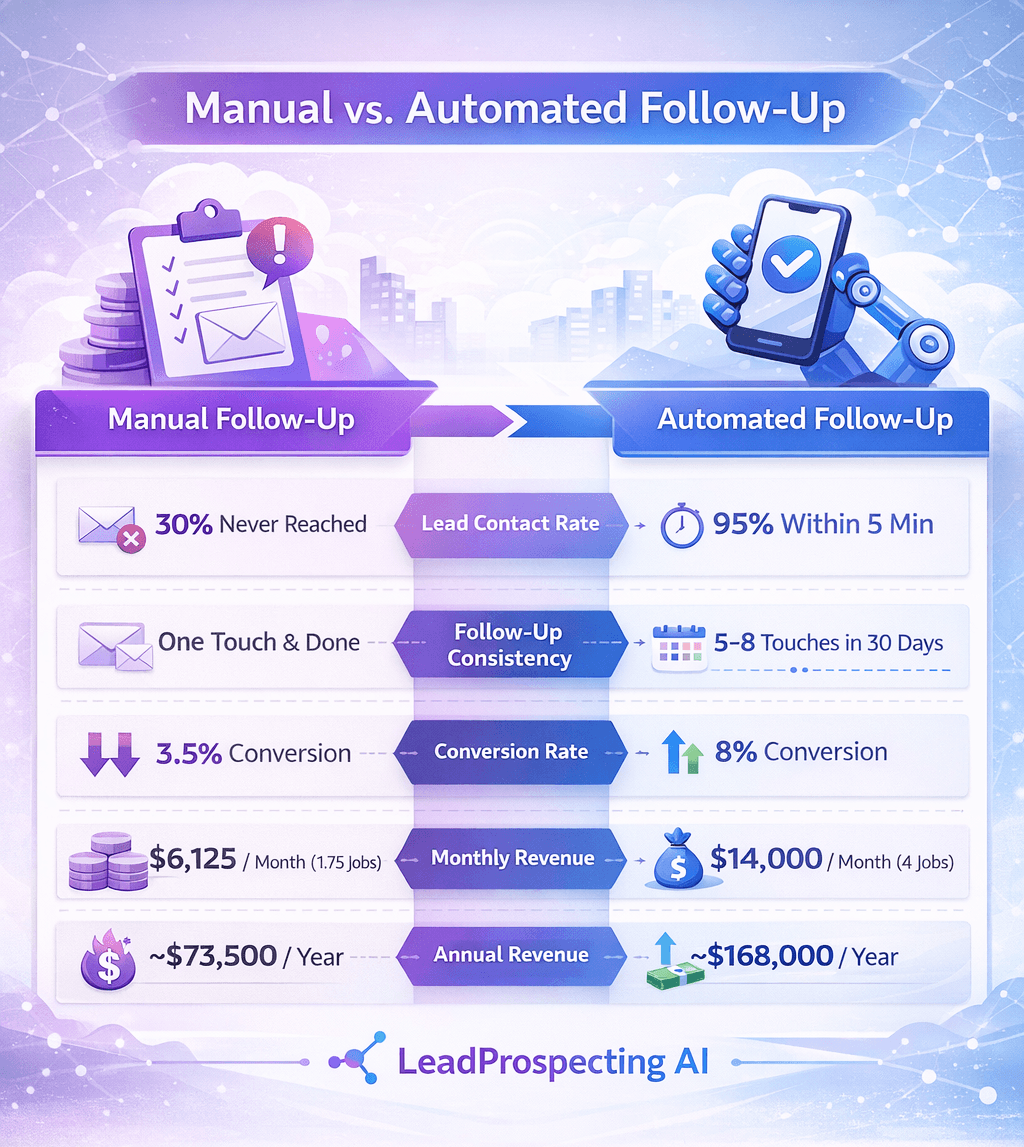
The difference? $94,500 per year. That's not from getting more leads. That's from doing more with what you already have.
Across 100 leads per month, that gap becomes nearly $200,000 annually. And if you're scaling lead generation at all, the compounding effect is massive.
Why Manual Systems Fail: The Hidden Breakdown Points
You probably know your follow-up process is broken. Here are the exact places where it collapses:
- No real-time notification. A lead fills out your form, but nobody knows for 30 minutes. By then, they've already texted two competitors.
- Lost in multiple tools. Leads are scattered across Google Forms, Facebook Messages, email, text, and that one CRM nobody uses consistently. Your team can't see the full picture of each lead, so they re-pitch the same thing or forget they already called.
- No follow-up reminders. Your sales rep intends to call back Tuesday, but Tuesday is chaos. The reminder never happens. The lead is cold by Wednesday.
- No data on follow-up history. Your new employee calls a prospect and doesn't know this is the 4th touch, so they pitch like it's the first call, and the prospect gets annoyed.
- Emotional barriers. Your rep doesn't want to make the 5th call because it feels pushy. So they don't. The lead dies. Your competitor wins.
- No scoring or prioritization. All leads look equal, so your team chases cold leads instead of the hot ones ready to buy today.
The solution isn't working harder or hiring more reps. It's automating the follow-up process so every lead gets consistent, timely, personalized attention without burning out your team.
With an all-in-one CRM system that includes automation workflows and integrated contact management, you can:
- Instantly assign leads to the right rep based on capacity, specialty, or geography
- Trigger automatic SMS, email, or call reminders for follow-ups
- Build multi-touch sequences that run on a schedule (so every lead gets 5-8 touches automatically)
- See the full follow-up history in one place so your team never repeats a pitch
- Score leads automatically so your reps prioritize hot prospects
- Get alerts when a lead re-engages (clicked your email, viewed your pricing page) so you can strike while interest is high
This isn't about replacing your sales team. It's about freeing them to do what they actually do best: building relationships and closing deals. Not chasing spreadsheets and praying they remember to follow up.
What Your Magic Valley Competitors Are Already Doing
Right now, the contractors and service businesses pulling ahead in your area are using automation. They might call it a "CRM," an "email drip campaign," or a "sales system," but the effect is the same: Their leads are getting consistent follow-ups, fast responses, and multiple touchpoints, without any extra work from the sales team.
They're converting 7-8% of leads instead of 3-4%. They're closing deals in 21 days instead of 45. They're generating $150,000+ more annual revenue from the exact same number of leads you're getting.
And because they're faster and more consistent, they're also winning more referrals. Nothing builds your reputation like responding to an inquiry at 8:45 AM on a Saturday and getting the job booked by noon. Your competitor did that. You're responding Monday afternoon.
The best part? When you close more deals through proper follow-up, you also have more happy customers to generate referrals and five-star reviews, which feeds the entire funnel.
How to Fix It: Start This Week
You don't need to overhaul your entire business. Start with one thing: automate your first response.
When a lead comes in, they should get an immediate acknowledgment (automated SMS or email: "Thanks for reaching out! Our team will call you within 1 hour"). Then, your system should instantly notify the right rep and trigger a follow-up reminder for tomorrow, then the day after, then one week out.
That one change will increase your conversions by 15-20% in the first month.
Then, build out a 30-day follow-up sequence that works even when your team isn't actively thinking about it. A simple email drip campaign with 3-5 touchpoints can increase conversion rates by 5-10%.
Finally, use a single CRM to track everything. One system for contacts, follow-ups, conversations, and deal stage. No more lost leads in Outlook. No more duplicate pitches because you didn't know the lead had already talked to your team.
A CRM with built-in automation, pipeline management, and integrated follow-up workflows handles this all at once. Leads come in. They get instant acknowledgment. Your team gets notified. Reminders happen automatically. Follow-ups are logged. History is saved. Nothing falls through the cracks.
Frequently Asked Questions
Q: How quickly should I respond to a lead?
Within 5 minutes is ideal. If that's not possible, aim for within the hour; response rates drop dramatically after that window. An automated SMS or email acknowledgment (sent instantly) counts as a first response and buys you time for a human follow-up within the hour.
Q: How many times should I follow up before giving up?
At least 5-6 times. 80% of successful sales require 5+ follow-ups, but 92% of sales reps quit after 4. By persisting to the 5th and 6th touch, you're in the top 8% of persistent salespeople, and you'll close more deals than competitors who stop early.
Q: Should I follow up via email, phone, text, or all three?
All three. Multi-channel follow-up (email, SMS, phone, LinkedIn) increases response rates by 300% compared to single-channel efforts. Each prospect has a channel they prefer, and you'll never know unless you try multiple approaches. A CRM with automation can handle all channels from one system.
Q: What's the cost of NOT automating follow-up?
For most Magic Valley businesses, it's $50,000-$200,000+ per year in lost revenue. This comes from slower response times, leads falling through the cracks, and your team not persisting long enough. An automated CRM typically costs $99-$299/month and pays for itself in recovered deals within the first month or two.
Q: Will automation make me seem impersonal or spammy?
No. Automation handles the repetitive, time-sensitive touches (first response, reminders, initial outreach sequences). Your sales team then takes over for actual conversations, consultations, and negotiations. The result is faster, more consistent contact, not robotic or impersonal. Leads actually prefer this because they get immediate acknowledgment instead of silence.
Don't Let Manual Follow-Up Cost You Another Year of Revenue
The gap between your conversion rate and your competitors' isn't about better salespeople or better products. It's about systems. The businesses winning in the Magic Valley today have automated follow-up. They respond fast. They persist longer. They track everything in one place.
You can too. The first step is to stop letting leads sit in your inbox. Set up a system where instant follow-up is automatic, reminders happen without human effort, and every lead gets the attention they need to convert.
See how an all-in-one platform replaces five separate tools and reclaims the $50,000-$200,000 your business is losing to manual follow-up chaos. Start a 21-day free trial with LeadProspecting AI, no credit card required. Experience how automated follow-up, integrated CRM, and lead routing transform your conversion rates in real time.
Your Magic Valley competitors aren't smarter than you. They're just faster. It's time to catch up.