TL;DR:
A 97% delivery rate does not mean 97% of your emails reached the inbox. Roughly 1 in 6 marketing emails globally never reaches the primary inbox, landing in spam or disappearing entirely. The gap between "delivered" and "actually seen" is where most small businesses lose revenue without ever diagnosing the real cause. Here are the seven mistakes driving that gap, and how to fix each one.
You send 1,000 marketing emails. Your email service provider reports a 97% delivery rate. You feel good. Then you check your open rate: 3%. The problem is not your subject line.
According to Validity's 2024 Email Deliverability Benchmark, roughly 1 in 6 marketing emails globally never reaches the inbox, keeping the global inbox placement average around 84%. The Digital Bloom's 2025 B2B analysis puts it more specifically: 10.5% of emails end up in spam and 6.4% go missing altogether. An email sitting in spam is a delivered email. Your ESP reports it as a success. Your prospect never sees it.
The gap between delivery rate and inbox placement rate is where small businesses lose revenue they never trace back to the real cause. They blame their offer. They blame their list. The actual problem sits in their DNS records and sender reputation score.
Mistake #1: Skipping Email Authentication (SPF, DKIM, DMARC)
Authentication is the foundation. Without it, nothing else matters.
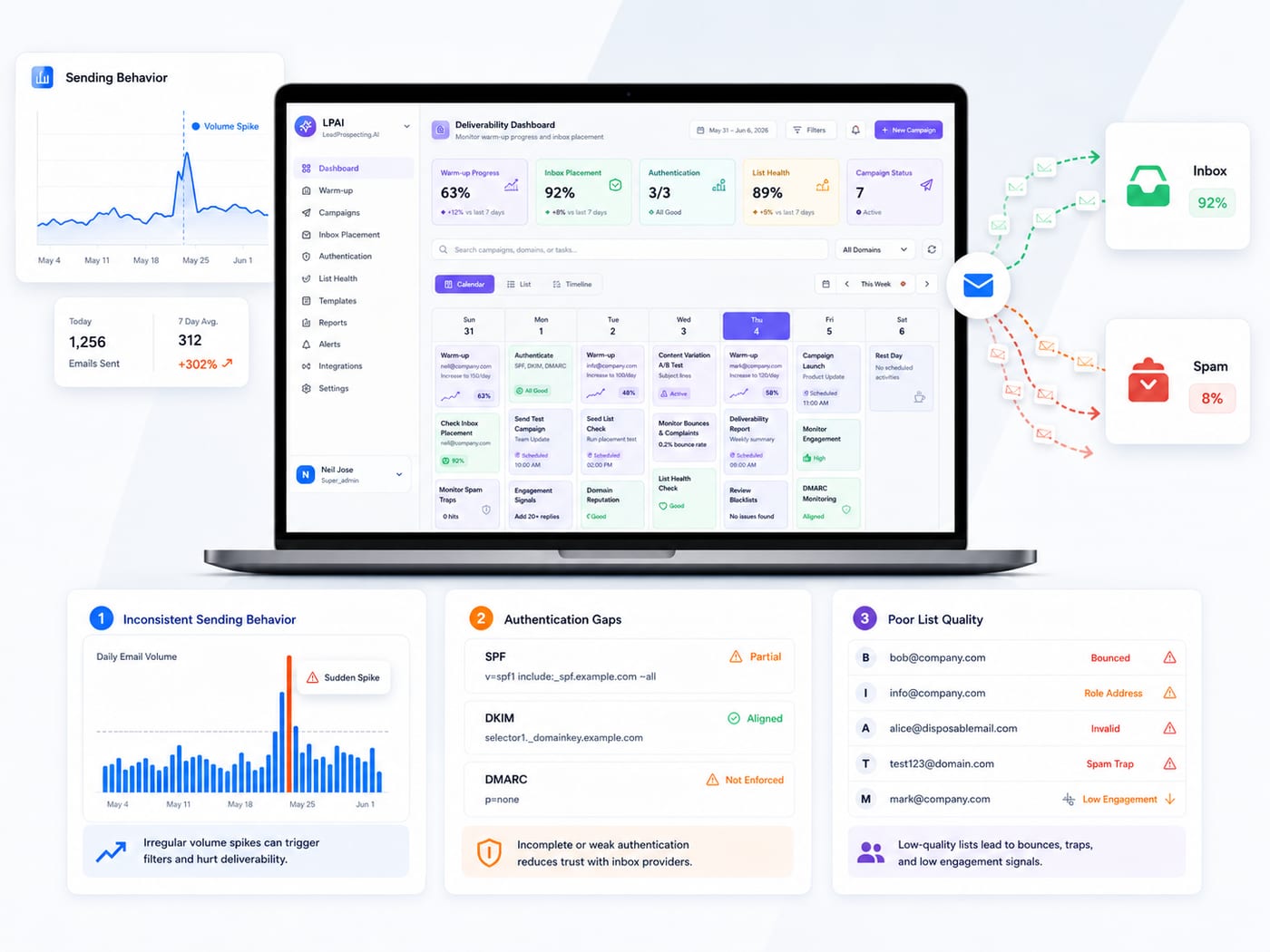
Fully authenticated domains using SPF, DKIM, and DMARC are 2.7 times more likely to achieve inbox placement than unauthenticated senders, according to The Digital Bloom's 2025 B2B Email Deliverability Report. Despite that, only 7.6% of domains enforce DMARC policies, meaning the vast majority of senders are either completely unprotected or running monitoring-only configurations that provide zero spam protection.
Here is what each protocol does and why it matters:
SPF specifies which mail servers are authorized to send on behalf of your domain. Without it, any server can spoof your address.
DKIM attaches a cryptographic signature to your emails confirming they were not altered in transit. It is one of the primary signals inbox providers use to determine legitimacy.
DMARC tells receiving servers what to do when an email fails SPF or DKIM checks, and sends you reports on authentication failures. Without enforcement, you have no visibility and no protection.
Google and Yahoo mandated SPF, DKIM, and DMARC for bulk senders in February 2024. Microsoft followed with the same requirement in May 2025. These are no longer optional for anyone sending at scale. If you have not set up all three, this is the first fix.
Mistake #2: Not Warming Up Your Domain Before Sending at Volume
New domains start with zero reputation. ISPs treat unknown senders with suspicion, which is a reasonable default since spammers constantly create new domains to evade filters.
According to Postmark's domain warmup research, most senders can expect their domain to develop an established reputation and dependable full-volume deliverability in 3 to 6 weeks. The commonly cited guidance of 30 days minimum aligns with this. A new domain faces approximately a 30 percentage point inbox placement penalty compared to a mature domain, according to The Digital Bloom's 2025 analysis. A new domain achieves roughly 55% inbox placement. A mature, properly warmed domain reaches 85%.
The modern warmup is not just a volume ramp. It is engagement-based reputation building. Inbox providers now evaluate whether recipients open, reply to, and engage with your emails, not just whether you are sending at a controlled pace. Starting with your most engaged contacts and gradually introducing cold outreach over several weeks is what separates a successful warmup from one that stalls.
The practical minimum: start with 10 to 20 emails per day in week one, double gradually as engagement metrics stay healthy, and do not scale cold outreach until inbox placement tests show at least 80% primary inbox delivery.
Mistake #3: Ignoring List Hygiene
Every hard bounce tells ISPs that you are not maintaining your list. Enough hard bounces and your entire domain gets treated as a low-quality sender.
A bounce rate above 2% begins triggering penalties with major inbox providers. Above 5%, blacklisting risk becomes significant. The mechanism is straightforward: hard bounces signal either poor list management or the use of scraped and purchased lists, which is exactly how spammers operate. ISPs use that signal to filter your future sends, including emails going to valid addresses.
B2B contact data decays at approximately 22.5% per year, according to research compiled by MarketingSherpa. A list that was clean when you built it is not clean today. The fix is verification before every import and re-verification of active segments on a quarterly basis. Remove hard bounces within 24 hours of detection. Suppress contacts who have not engaged in 90 days before including them in cold outreach campaigns.
Mistake #4: Not Monitoring Your Sender Reputation Score
Your sender reputation changes with every email you send and every recipient interaction. It is not static, and it is not something you can check once and forget.
According to Litmus research, marketers who describe their email programs as successful are 22% more likely than those at less successful programs to monitor their deliverability or inbox placement. The correlation is not coincidental: monitoring is what allows you to catch problems before they escalate from a low sender score to a blacklisted domain.
Free tools for ongoing monitoring include Google Postmaster Tools, which shows domain and IP reputation scores specifically within Gmail, and Sender Score from Validity, which rates IP reputation on a 0 to 100 scale. Scores above 80 support strong inbox placement. Scores below 70 typically indicate something needs immediate attention. Check these monthly at minimum. If your score is declining week over week, that is the signal to pause high-volume sends and investigate before the damage compounds.
Mistake #5: Spiking Volume Too Fast After Warmup
This is one of the most common mistakes teams make after completing a warmup. They spend four weeks carefully building domain reputation, then immediately launch a 50,000-email cold campaign. That sudden spike in volume is one of the clearest signals ISPs associate with spam behavior. Reputation damage from a volume spike can happen within hours. Recovery typically takes four to eight weeks.
The correct approach is gradual scaling at every stage, not just during initial warmup. If your baseline is 500 emails per day, do not jump to 5,000. Double volume over a week or two while monitoring bounce rates, spam complaint rates, and inbox placement test results. If any metric deteriorates, ease back before continuing to scale. The goal is to look like a legitimate business sender at every volume level, not just during the warmup window.
Mistake #6: Sending to Disengaged Contacts or Purchased Lists
Engagement is now one of the primary signals inbox providers use to evaluate sender quality. Gmail, Microsoft, and Yahoo track whether recipients open, click, reply to, or move your emails out of spam. Low engagement across your sends tells ISPs that recipients do not want your emails, which is functionally the same signal as spam complaints.
Purchased lists are the fastest path to low engagement. Recipients on those lists never opted in, do not recognize your sender name, and have no reason to engage. Each one who ignores or marks your email as spam damages the reputation you have spent weeks building.
According to Stripo's analysis of email deliverability behavior, 39% of email marketers rarely or never clean their contact lists, despite list hygiene being one of the most cited factors in maintaining sender reputation. Segment your list by engagement. Stop sending to contacts who have not opened in six months before running a re-engagement sequence. If they do not respond to a re-engagement campaign, remove them. A smaller list of engaged contacts will outperform a large list of disengaged ones every time.
Mistake #7: Treating List Cleaning as a One-Time Task
List hygiene is not a project. It is an ongoing process. Email data decays at approximately 22 to 23% per year due to job changes, domain updates, and account closures. A quarterly cleaning schedule is the minimum for most B2B outbound programs. Teams running active daily outreach should clean monthly.
The practical maintenance schedule: remove hard bounces within 24 hours of detection, suppress soft bounce repeats after two failures, remove contacts with no engagement in 90 days from cold sequences, and re-verify any list segment that has been inactive for more than three months before sending to it again. This is not losing contacts. It is protecting the deliverability that lets you reach the contacts who actually matter.
How the Mistakes Connect
These seven mistakes are not independent problems. They compound on each other. A sender who skips authentication and buys a list starts with two strikes against their reputation. They then skip warmup, spike volume, and ignore bounce rates. By the time they notice a deliverability problem, their domain is blacklisted and their repair timeline is measured in months, not weeks.
The sequence that works in reverse looks like this:
Authentication first. Warmup second. Clean list third. Gradual volume scaling fourth. Consistent monitoring throughout. Engagement-based send discipline ongoing. Quarterly list hygiene as maintenance.
Teams that follow this sequence reliably achieve 85 to 95% inbox placement, which is where the revenue lives.
Ready to Fix Your Email Infrastructure?
LeadProspecting AI's Email Warming tool handles domain warmup automatically, monitors your sender reputation continuously, and flags deliverability issues before they escalate. It connects directly to our Lead Scraper for verified contact data and our AI Email Campaigns for sequencing, so your outreach runs on clean infrastructure from the first send.
Start a 30-day free trial with no credit card required.
Frequently Asked Questions
Q: What is the difference between delivery rate and inbox placement rate?
An email sitting in the spam folder is counted as "delivered" by your email service provider. Inbox placement rate is the percentage of delivered emails that actually reach the primary inbox, not spam, not promotions, not any other filtered folder. A 99% delivery rate can coexist with a 60% inbox placement rate. Always measure where emails land, not just whether the receiving server accepted them.
Q: How long does domain warmup actually take?
Most senders can expect a stable reputation and reliable deliverability in 3 to 6 weeks, according to Postmark's domain warmup research. Plan for 30 days minimum before scaling cold outreach. Do not rush it. An extra week of warmup costs almost nothing. Reputation damage from rushing costs weeks of repair time and lost pipeline.
Q: Can a damaged sender reputation be repaired?
Yes, but it requires patience and consistent action. Stop the damage first: clean your list, remove hard bounces, pause large volume sends. Then rebuild slowly with engaged contacts while monitoring your sender score weekly. Most repairs take 4 to 8 weeks depending on how severe the damage is. Monitoring tools like Google Postmaster Tools and Sender Score show you the trend so you know whether your actions are working.
Q: Is automated email warming against Gmail's rules?
Using reputable warmup tools that generate real engagement signals is not against Gmail's policies. Gmail's concern is synthetic engagement at scale from bot networks. Legitimate warming services that create real opens and replies do not trigger this. Validate that any tool you use generates authentic engagement, not fake bot activity, and confirm current provider compatibility before using it.
Q: Should I use a dedicated IP or shared IP?
For most small businesses, a shared IP managed by a reputable email platform is appropriate. A dedicated IP gives you full control over reputation but requires active warmup and consistent high-volume sending to maintain. If you are sending fewer than 100,000 emails per month, a shared IP with a quality provider is usually the better choice. Focus on domain reputation, which affects all senders equally regardless of IP configuration.