You Don't Have an Algorithm Problem. You Have a Consistency Problem.
If you've spent your evenings rage-refreshing analytics, wondering why your reach tanked, a social media scheduler for small business is probably the fix you're avoiding. The truth most "growth gurus" won't tell you: the algorithm isn't punishing you. You just stopped showing up.
I've watched dozens of small business owners burn out chasing trends, hooks, and "the best time to post" charts. They post five times one week, then go dark for three. Then they blame the platform.
Here's the reframe that changes everything in Q3 2026: posting consistently on a sustainable cadence beats sporadic algorithm chasing every single time. And the data backs it up hard.
The Data: Consistency Outperforms Intensity (By a Lot)
Let's deal in real numbers instead of vibes. Buffer analyzed creator behavior across a 26-week window and found something staggering: creators who posted in 20 or more weeks saw around 450% more engagement per post compared to those who posted in 4 weeks or fewer (Buffer, How to Grow on Social Media in 2026).
Read that again. It's not about the perfect post. It's about being there week after week. The creators who win aren't more clever. They're more present.
That same theme shows up everywhere. A separate Buffer study of 52M+ posts found that accounts which didn't post in a given week underperformed their own baseline growth rates, and accounts that consistently reply to comments outperform those that don't by as much as 42% on Threads and 30% on LinkedIn (Buffer, State of Social Media Engagement 2026).
The lesson isn't "post more." It's "stop disappearing." A consistent presence plus actual conversation in the comments compounds. Sporadic genius does not.
How Often Should You Actually Post? Less Than You Think.
Here's where small business owners overcorrect. They hear "consistency" and assume that means a firehose of daily content. Wrong direction.
Sprout Social found that 74% of consumers prefer one to two posts per day from brands, and that consistency beats intensity every time, so you should choose a sustainable cadence over unsustainable bursts (Sprout Social, Social Media Best Practices).
It gets even more interesting. Zoomsphere analyzed 25,000+ profiles and found engagement rate actually peaks at one or two posts per week, suggesting audiences respond best to focused, high-quality content rather than volume (Zoomsphere, The Frequency Formula).
So what's the takeaway you can implement today? Pick a cadence you can actually sustain for 26 weeks straight. For most solo operators and small teams, that's:
- 3 to 5 posts per week if you have content to share and a system to batch it.
- 2 to 3 posts per week if you're a one-person show juggling client work.
- Daily replies in your comments and DMs, regardless of post volume, because engagement is where the algorithm rewards you.
The brands winning in 2026 aren't louder. They're more intentional. Social Insider reported that Facebook showed a 48% decrease in post frequency, pointing to brands moving away from volume and toward curated, high-value updates (Social Insider, Social Media Benchmarks for 2026).
Why a Social Media Scheduler for Small Business Is the Real Unlock
Knowing you should post consistently and actually doing it are two different planets. Life gets busy. A pipe bursts. A client emergency eats your Tuesday. And just like that, your posting streak dies.
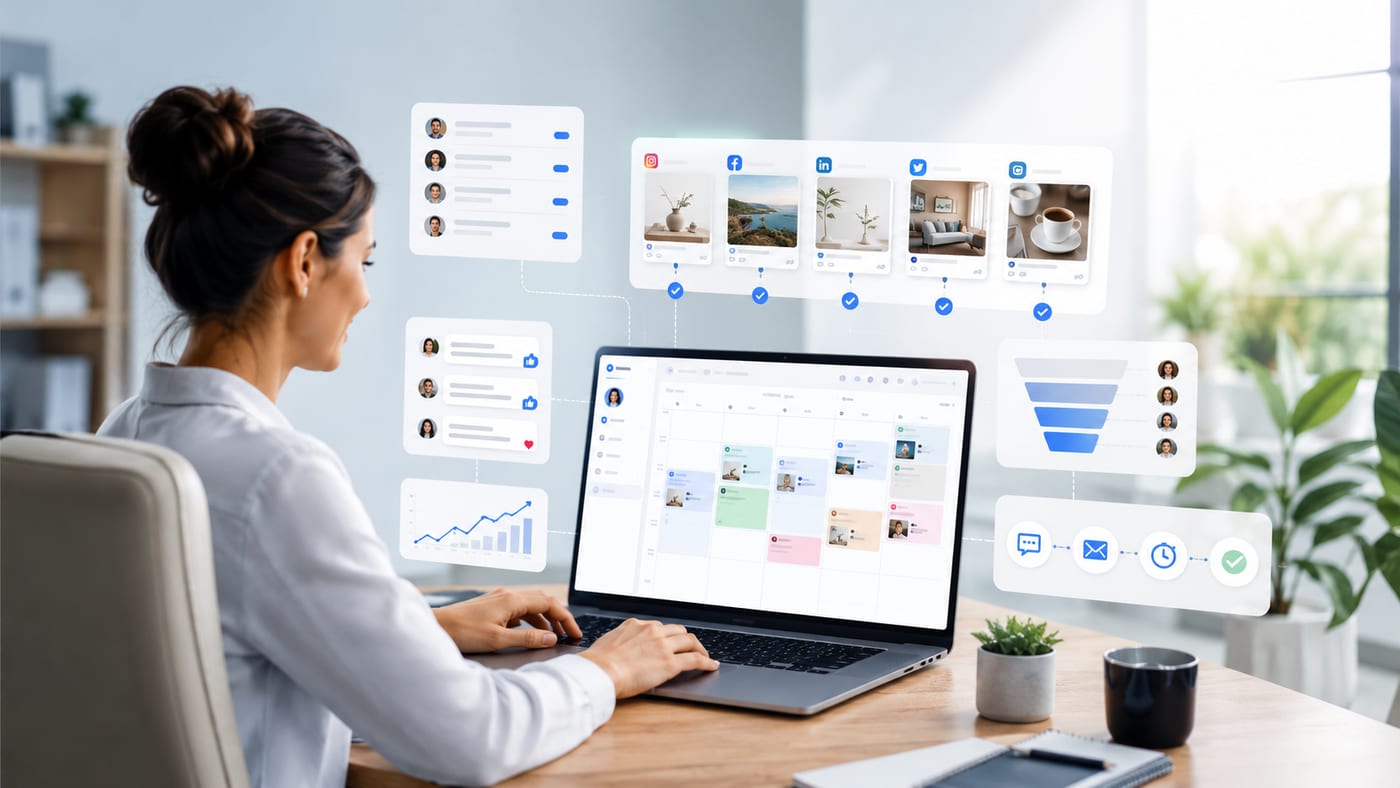
This is exactly why a social media scheduler for small business exists. It removes willpower from the equation. You batch your content once (say, an hour every other Sunday), schedule two weeks out, and your presence runs on autopilot while you run your business.
The math is simple. One focused batching session can cover 10 to 14 days of posts. Compare that to the daily scramble of "what do I post today," which usually ends with you posting nothing. A scheduler turns 30 stressful daily decisions into two calm planning sessions a month.
And here's the part most tools miss: scheduling is only half the job. The other half is the conversation that follows. The same way automated follow-up email beats manual every time on revenue math, automated and scheduled social posting frees you to spend your limited human energy on replies, DMs, and turning followers into customers.
The AI Trap: Where Automation Helps and Where It Hurts
AI is everywhere in social media right now, and a good social media AI tool can genuinely cut your content creation time in half. But there's a line you cannot cross, and the data is blunt about it.
The University of Houston SBDC reported that 52% of consumers become less engaged if they suspect content is AI-generated, with 25% saying it makes a brand feel impersonal (University of Houston SBDC, 2026 Social Media Trends).
So here's the honest take from someone who uses these tools daily: use AI social media posts as a starting draft, not a finished product. Let it handle the blank-page problem, the first 70% of structure and ideas. Then you add the human 30%: the real story, the customer name, the photo from the actual job site, the opinion only you would say.
That blend is the sweet spot. Pure AI feels hollow and consumers smell it. Pure manual feels impossible to sustain. AI-assisted plus human-finished, scheduled in advance, is how small teams stay consistent without sounding like robots.
If you want a deeper dive on getting useful output from AI tools without losing your voice, our breakdown of the AI content writer ROI for business walks through exactly where automation pays off and where it backfires.
Stop Stitching Tools Together: The Hidden Cost of Fragmentation
Most owners I talk to run a Frankenstein stack. One tool for scheduling, another for email, a spreadsheet for leads, a separate app for invoicing, and a notebook for follow-ups. Each one costs money, and the bigger cost is the context-switching that quietly drains your week.
The smarter play is consolidation. When your social media scheduler lives in the same system as your small business CRM, your posts can actually feed your pipeline. A new follower fills out a smart form, lands in your CRM, gets an automated text-back, and enters a nurture sequence. That's a closed loop, not a scattered mess.
We built LeadProspecting AI as an all-in-one platform precisely because tool overload is a real tax on small businesses. If you've ever felt the pain of a dozen logins, our piece on the hidden cost of tool overload will hit close to home.
This is also why business owners researching a Salesforce alternative small business option often land on platforms that bundle social, CRM, and automation together. You don't need enterprise complexity. You need scheduling, pipeline management software, and email working as one connected system. See how the pieces fit on our features page, and when you're ready, our pricing plans are built for small teams, not bloated sales orgs.
One more practical note: your social presence and your email outreach should reinforce each other. If you're driving traffic but your emails land in spam, you're leaking results. Our email warmup vs. deliverability guide shows how to protect the other half of your funnel.
Frequently Asked Questions
Q: How many times a week should a small business post on social media?
Aim for a cadence you can sustain for at least 26 weeks. For most small businesses that's 2 to 5 posts per week. Zoomsphere data shows engagement often peaks at just 1 to 2 high-quality posts weekly, so prioritize consistency and quality over volume.
Q: Does using a social media scheduler hurt my reach?
No. Scheduling tools post natively and there's no evidence platforms penalize scheduled content. What hurts reach is inconsistency and ignoring comments. A scheduler actually helps reach by keeping you present every week.
Q: Is it bad to use AI to write my social media posts?
Only if you publish raw AI output. 52% of consumers disengage when they suspect content is AI-generated. Use a social media AI tool for first drafts, then add your real voice, photos, and stories before scheduling.
Q: Should my scheduler connect to my CRM?
Ideally, yes. When your social media scheduler for small business connects to your small business CRM, new followers and form fills flow straight into your pipeline with automated follow-up. That turns engagement into actual revenue instead of vanity metrics.
Q: What's the single most important thing for social growth in 2026?
Showing up consistently and replying to comments. Buffer found accounts that reply consistently outperform those that don't by up to 42%, and accounts that skip weeks underperform their own baseline. Presence plus conversation beats clever every time.
If you're tired of juggling a scheduler, a spreadsheet, and a separate CRM, it's time to consolidate. LeadProspecting AI brings social scheduling, AI-assisted content, pipeline management, and automated follow-up into one system so consistency becomes the default, not the struggle. Reach out today and let's build a posting and follow-up system that runs whether or not you remember to log in.